dailynewsnblog
The war in Ukraine has made it painfully obvious that large, static military bases are highly vulnerable and have, in many cases, become a liability. While such bases can serve as centers of regional influence, deterrence, and the engine of heavy combat operations, they can also be easily targeted. This may come in the form of conventional gravity bombs, stand-off weapons such as advanced cruise missiles, and, increasingly, comparatively cheap, mass-producible drones such as the Shahed.
The United States military has relied on a global network of such bases since the Cold War. Since that historical epoch, US military planners have relied on this extensive global framework for the purposes of deterrence, reassurance, and rapid power projection to any hotspot requiring attention. Those times have changed, and this reality is particularly evident in the Indo-Pacific, where China possesses a substantial arsenal of cruise missiles and a diverse range of conventional ballistic missiles.
In a regional contingency, particularly one involving Taiwan, these missiles would likely be used to target American bases across the region. In response, US military strategy has shifted toward distributed operations, dispersing forces and capabilities across smaller, more mobile operational nodes. This complicates Chinese intelligence, surveillance, and targeting efforts, and small, remote islands such as Wake Island are increasingly taking center stage.
The Vulnerability Of US Bases In The Asia-Pacific Region

The US military infrastructure in the Asia-Pacific region alone is vast and deeply embedded, with around 80,000 service members stationed across this region, primarily concentrated in Japan and Korea, a legacy of World War II and the Cold War. Throughout mainland Japan and Okinawa, there are approximately 90 US military facilities, including major military bases. In terms of personnel across all services, there are roughly 60,000 stationed on mainland Japan and Okinawa, with the US Marine Corps and US Navy making the largest force concentration at around 20,000 personnel respectively.
Korea, on the other hand, has approximately 24,000–25,000 permanently stationed service members, with the majority being US Army soldiers, with the predominant forward-deployed unit being the 2nd Infantry Division. Within this force are motorized and mechanized infantry, artillery, combat aviation, and logistical elements. This combat power is spread across 60–70 installations. While the Army is prominent, all US military services have deployed forward units within Korea.
Finally, Guam has a comparatively small force of around 9,700 personnel, distributed across 46 permanently based military units. Nevertheless, the island retains significant strategic importance as a key link between the continental United States and Asia. As such, the island provides robust, responsive naval, air, and logistical capabilities for US infrastructure in Asia.
Missile Type | Representative Systems | Estimated Missiles | Primary Role | Range |
|---|---|---|---|---|
SRBM (Short-Range Ballistic Missile) | DF-15, DF-16 | ~600 | Taiwan contingency, regional strike | |
MRBM (Medium-Range Ballistic Missile) | DF-17, DF-21 variants | ~1,300 | Precision strike, anti-ship, regional deterrence | 1,000–3,000 km |
IRBM (Intermediate-Range Ballistic Missile) | DF-26 | ~500 | Guam strike, anti-ship, regional strike | 3,000–5,500 km |
Ground-Launched Cruise Missiles (GLCM) | CJ-10 family, CJ-100 | ~300+ | Precision land attack | 1,500–2,500+ km |
Hypersonic Glide Vehicle Systems | DF-17 | Included within MRBM inventory | Rapid penetration of missile defenses | ~1,800–2,500 km |
This vast Asia-Pacific-based military infrastructure falls under the wide-ranging umbrella of China’s robust arsenal of short to long-range ballistic and cruise missiles. While a direct military confrontation would be wide-ranging and destructive, and detrimental to the global economy, Beijing has clearly stated that the reunification of Taiwan with the mainland will either be political or by military force.
It is widely believed that, if the latter option is taken, the US would become directly involved. Knowing this, Beijing could have incentives to order its military to conduct preemptive strikes on US military bases in Japan, possibly in Korea, and Guam is often discussed as a potential target in higher-end escalation scenarios. Given this reality, the US military has embraced distributed basing operations in order to reduce the risk profile of forward-deployed units and complicate targeting for the Chinese military.
How Strategic Air Force Bases Anchor American Air Power In The Pacific
This article will take a look at the utility of US main operating bases and the USAF strategy in the Indo-Pacific.
Breaking Up Isn’t Hard To Do

All US military branches have developed strategies that will allow them to operate in contested environments, whether in a potential conflict with Russia in Europe or within areas surrounding the South China Sea. The Army has created Multi-Domain Task Forces (MDTFs) with roughly 1,500–3,000 soldiers, which can further break down into smaller elements of 20–150, depending upon their mission.
The Marine Corps has stood up two Marine Littoral Regiments of roughly 1,800–2,500 Marines, which can break down into Expeditionary Advanced Base Operations (EABO) consisting of 50–100 Marines. The Air Force has created Agile Combat Employment (ACE), and the Navy has begun Distributed Maritime Operations.
MDTFs and EABO elements, while not the same, are composed of sensor and communications operators, command and control, air defense, offensive fires, and reconnaissance units. An ACE detachment will be built around four aircraft with a small command and control group, fuel and weapons personnel, maintainers, security, and a communications element. In sum, an ACE detachment will consist of 50–100 airmen.
Once these elements have been dispersed, they create an interconnected web of mutual support, with the ability to harass and deny an adversary the ability to maneuver, while being difficult to target given their size, flexibility, and mobility. This translates into enhanced survivability and enhanced intra-theater mobility for US military units.
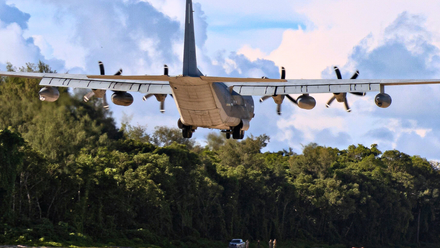
KC-130 Hercules Lands On USMC Rebuilt Runway In Peleliu On Site Of WWII Battle
In a move to restrain the expanding and evermore assertive actions of the Chinese military, the US has begun refurbishing Pacific bases from WWII.
Calling Wake Island, You’re Needed For Grand Strategy

Wake Island is positioned about halfway between Hawaii and Guam, and lies outside the range of the majority of China’s missile arsenal. In a contingency involving China, Wake would serve as a support node that would complement and enhance mobility and strategic flexibility. To this point, the island—while lacking the scale of a major air base—would likely be used as a refueling point and forward logistics staging area, supporting military operations closer to the South China Sea.
To further support military activities on Wake Island, numerous upgrades have been completed. These include the repair and extension of Taxiway Bravo, the construction of new aircraft parking aprons and hardstands, and the repair of drainage infrastructure beneath the taxiway. The Hot Cargo Pad, used for handling hazardous cargo, was also rehabilitated. Additionally, new airfield lighting and ground systems have been installed, all under a contract valued at $87 million (£65 million).
Presently, the US Air Force maintains and operates the island’s 9,800-foot-long runway. The airfield can accommodate aircraft ranging from the Lockheed Martin F-35s strike aircraft,  Boeing B-52s strategic bombers, the Boeing C-17 strategic transport, and the Boeing P-8A Poseidon patrol and reconnaissance aircraft.
Regarding the latter, the US Navy is planning to use the airfield on Wake for two 60-day periods between June 12 and November 30 for “Navy Summer Exercise 2026”. The P-8s will be operated by Task Force 72, which leads reconnaissance and surveillance operations for the Japan-based United States Seventh Fleet.
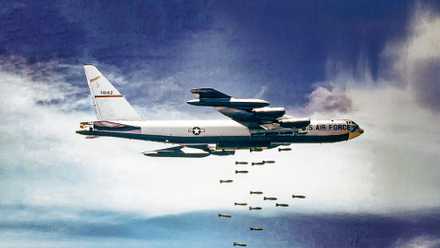
The Real Reason The US Air Force Is Still Flying B-52s Built Before Most Of Its Pilots Were Born
The B-52 is an iconic Cold War aircraft. It was supposed to retire, now lets dive into why it has and will remain in service for decades to come.
Recent Activity on Wake Island

As recently as November 2025, US Army soldiers assigned to the 25th Infantry Artillery Brigade of the 25th Infantry Division executed a dry fire of a HIMARS mobile rocket system. This operation was conducted through the Joint Pacific Multinational Readiness Center rotation at Wake Island. The training exercise demonstrated the ability of rocket artillery personnel to rapidly deploy to remote operating sites, quickly set up, fire, and redeploy. This operation utilized the C-17, which is optimized for landing on remote airstrips and unprepared landing sites.
Slightly farther back, in mid-December 2024, the US Marines’ 12th Littoral Anti-Air Battalion conducted training on Wake focused on a long-distance tactical air surveillance raid. During this operation, the Marines deployed a sophisticated AN/TPS-80 radar complex (Ground/Air Task-Oriented Radar), which can detect, identify, and track multiple types of missiles, aircraft, and weapons projectiles. The objective of the training was rapid deployment and honing skills that would be used while operating in a contested environment against a peer adversary.
Both of these training scenarios are part of the distributed operational web. While the Army deployed the HIMARS, they would be connected to a sensing and tracking node within their Multi-Domain Task Force, with capabilities similar to what the Marines set up. This highlights the necessity of spreading out capabilities and rapidly moving them to new sites in order to complicate adversarial targeting missions.
The US Military’s Seaplane Programs
New amphibious aircraft prototypes are shaping up to change the future of maritime defense strategies, ushering in a fresh era the US military.
The Complicated New World Of Operating In A Contested Environment

Since the fall of the Soviet Union in 1991, the US military has been largely capable of operating without the worry or constraints of a capable peer competitor. This is clearly not the case now, with China rapidly building up its naval and air forces and restructuring its army. While China has not been in any significant military confrontations since its border war with Vietnam, its military is now much more capable than it was then, and it is increasingly able to operate with an extended reach.
At the same time, the US military and its partner states within the Asia-Pacific area are operating under the umbrella of China’s rocket force that can reach targets as far as the distant island of Guam. This new reality has given rise to the distribution of forces and capabilities in order to increase resilience, survivability, and complicate the operational environment for Chinese military units, particularly its navy and air force.
It is clear that the US military and partner states must continue to carry out joint training with a focus on expeditionary and distributed operations. This also must be accompanied by the opening of newer and more distributed operational sites, such as Wake and Peleliu Islands.