dailynewsnblog
Here’s a riddle: Why did a Goshen Police Department officer search 6,474 automated license plate reader (ALPR) networks, representing data from 82,413 cameras, on May 7, 2025?
If your answer is “I don’t know,” it turns out you’re 100% correct. The officer left the letters “idk” in the search field where cops are supposed to document the reason for the search.
When law enforcement and tech salespeople pitch ALPRs to city councils, they stick to a familiar script. They trumpet the technology, which is often provided by private companies like Flock Safety, Motorola Solutions, or Axon, as an essential tool for solving high-stakes crimes, such as car jacking, kidnapping, or murder.
But when you strip away the carefully curated talking points, the data continues to reveal a different (and frankly, ridiculous) story. An EFF analysis of ALPR search logs from Flock Safety systems shows that officers across the country are spying on drivers for completely nonsensical “reasons.” Police are routinely searching the Flock database without providing any legitimate justification, making a mockery of our civil liberties by logging reasons like “LOL” (short for “laugh out loud”), “LMAO” (short for “laughing my ass off”), “sexy,” and “idk” (short for “I don’t know”) to access sensitive ALPR location data.
And in some cases, officers are just mashing keyboard buttons rather than articulating the nature of their searches.
Flock Safety claims it has improved its system by requiring officers to select from a dropdown list of crimes before running a search–but that only makes it easier for officers to hide improper searches behind the veneer of uniformity. The system does not require proof that the dropdown reason actually matches the true purpose of the search.
With no warrant requirements, limited guardrails, and deficient audit processes, ALPR databases have fostered a culture of unrestricted access to everyone’s location information. This culture of abuse has allowed police to treat a mass surveillance network like their own personal search engine, permitting the tracking of the movements of everyday citizens for low-level complaints, personal whims, and sometimes, seemingly, for the lols.
A Documented Culture of Abuse
ALPR misuse isn’t a new phenomenon; it has dominated headlines for more than a year. We already know that officers regularly abuse these systems to stalk past and potential romantic partners. We’ve seen ALPRs used to surveil protests, which can chill First Amendment-protected dissent, and seen officers try to use an ALPR system to track down a woman seeking an abortion.
Typically, we learn about these uses from documents called “network audits,” which are long spreadsheets that document all the searches that run through an agency’s system. It is not unusual for even a small agency to have a record of millions of searches from thousands of external agencies across the United States.
We’ve also uncovered horrific systemic profiling, with more than 80 law enforcement agencies using terms like “roma” and “g*psy” to target ethnic Romani people—often without any mention of a suspected crime. And when police aren’t using ALPRs for stalking or profiling, they routinely use them for extreme low-level investigations: verifying whether a student lives in a specific school zone, running employment background checks, following up on loud music complaints, or targeting a motorcyclist simply for holding a cell phone.
But somehow, it gets worse.
The Absurdity of Documented Search Reasons
EFF’s analysis of Flock Safety’s ALPR search data obtained through public records requests has uncovered a disturbing trend. In the absence of judicial oversight, officers are inputting ridiculously unserious terms to justify their searches. Here is just a snapshot of what police consider a “reason” to track someone’s vehicle:
Surveillance as a Joke
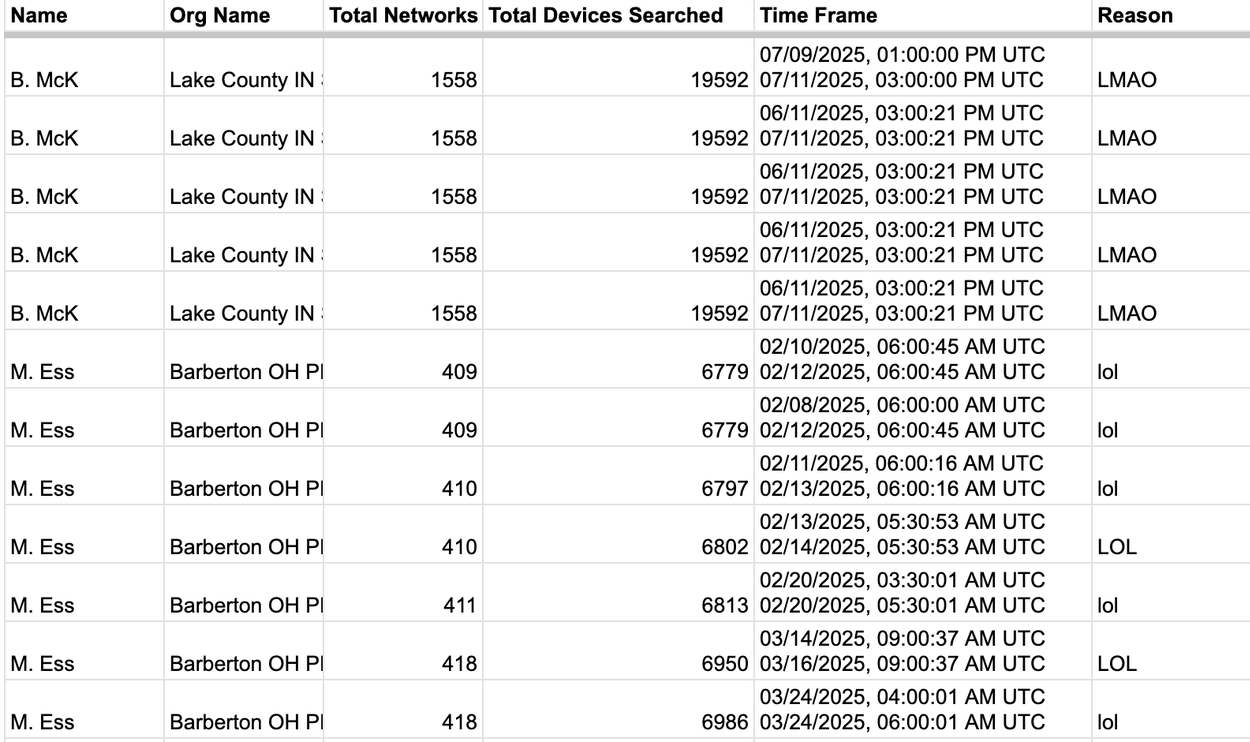
Audit logs sample
- Barberton Police Department (Ohio) employees ran numerous searches between March 2024 and May 2026, listing “LOL” or “lol” as the reason.
- Harris County Sheriff’s Office (Texas) employees ran several searches between April and May 2026 listing “LOL” or “lol” as the case number.
- Lake County Sheriff’s Department (Ind.) employees ran searches in July 2025 for “LMAO.”
- Richmond Police Department (Calif.) employees ran over multiple searches in November 2024 for “Hehe.”
- Riverside County Sheriff’s Department (Calif.) employees ran searches in 2024 for “Haha.”
“Don’t Know, Don’t Care” Approach
- Kankakee County, Sheriff’s Office (Ill.) employees ran searches (2023–2025) for “idk” or “idk lol.”
- Goshen Police Department (Ind.) ran searches (May–June 2025) for “idk.”
- Fishers Police Department (Ind.) ran searches in May 2025 for “blah.”
- A Pasco Police Department (Wash.) employee searched for at least four different license plates, leaving “robbery i don’t remember the case number leave me alone” in the reason field.
- The San Diego Sheriff’s Department (Calif.) ran searches in May 2025 with “idk” in the reason field.
- More than 30 agencies ran more than 6,300 searches with “TBD” (short for “To Be Determined”) as the “reason.” These included the Arizona Department of Public Safety, the Manteca Police Department (Calif.), and the Baton Rouge Police Department (La.). The Priceville Police Department (Ala.) alone ran 1,954 searches with reasons “TBD.”
Insults and Inappropriate Searches
- Belton Police Department (Mo.) ran searches (Aug–Sept 2024) for “d*ckhead.” (asterisk/redaction our own)
- A Manteca Police Department (Ill.) employee ran searches in June 2024 for “sh*thead” (asterisk/redaction our own)
- A Norton Police Department (Mass.) employee ran searches in December 2024 for “Sexy.”
- Corona Police Department (Calif.) employees ran searches (2023–2025) for “weird” or “WEIRD KID.”
- Thornton Police Department (Colo.) employees ran several searches in October 2025 for “driving around being weird.”
- A Columbus Police Department (Ohio) officer ran searches in 2023 for “idiot.”
- A Michigan City Police Department Officer (Ind.) ran searches in June 2025 listing “f*ck this new search engine.” (asterisk/redaction our own)
Button Mashing
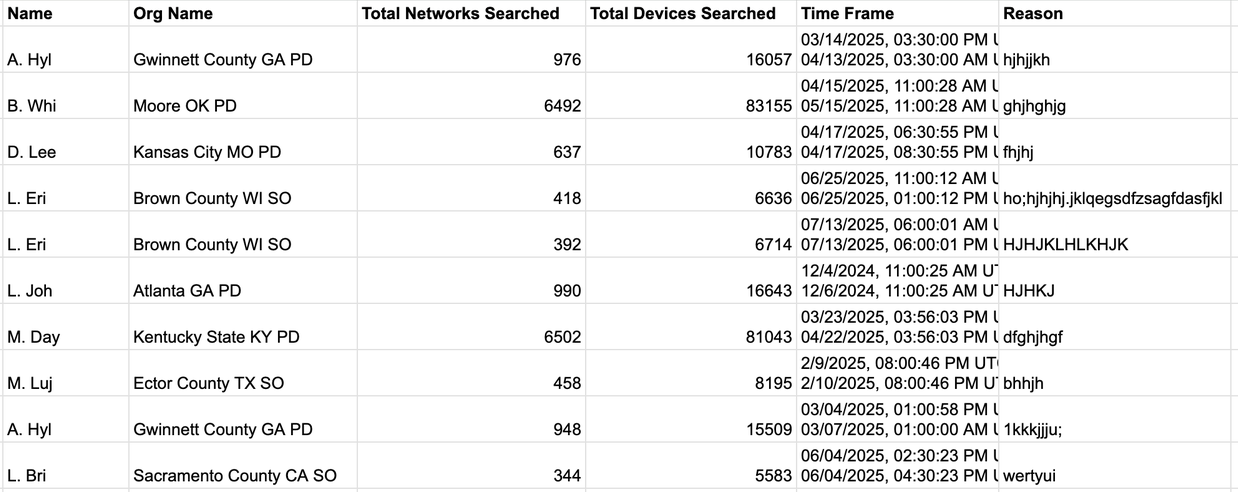
Button mashing audit logs sample
One of the more alarming discoveries we found in the network audit data is a large number of “reasons” that appear to be nothing more than an officer mashing buttons. These typically involve a nonsensical long string of characters from the same line or area of the keyboard.
For example:
- An Eatonton Police Department (Ga.) employee ran searches with reasons such as HJKNUILH, uiokjk.kuj, GJLHBNMN, hjhbnmg, and iuohjk.
- An Atlanta Police Department (Ga.) employee ran searches with asdfga as the reason.
- Bay County Sheriff’s Office (Fla.) employees ran searches with reasons such as ;’lkjh, /lkjh and lkjhg.
- A Brown County Sheriff’s Office (Wis.) employee ran searches with reasons such as gyghkkghghjkghjk, ggyjgyujdsrdghdfhjkghjghk, HJHJKLHLKHJK, hjjkjkhjkljk and JHLJKHHJKL.
- A Lake County Sheriff’s Office (Ohio) employee ran searches with reasons such as asdfg and ghjkl, and a second officer ran a series of searches that started off with “investigation” but then devolved into button mashing, including:
- Investigatafy, Investigatafyd, Investigatafydl, Investigatafydlh, investigatafydlhj, investigatafydlhji, investigatafyfdlhji, investigatafyfdlhjigkfgty, investigatafyfdlhjigkfgtyy, investigatafyfdlhjij, investigatafyfdlhjik, investigatafyfdlhjikf, investigatafyfdlhjikfg, investigatafyfdlhjikfgty, investigatafyfdlhjikfgy and investigatafyfdlhjiy.
- A Moore Police Department (Okla.) ran searches with reasons such as jhjhjkhj, jhjkhjh, jhjkhjkh, jkhhkjhjk, Jkhjkhj, Jkhjkhjk, Jkhjkhjkh, jkhjkhkjh, jkjkhjkh, kjjkhjk, loiuiou, ukjhjkh and ulkuiou.
- A Westlake Police Department (Ohio) employee ran searches with reasons such as fghjkl, ghjkl, and lkjhg.
- A Kentucky State Police employee ran searches with reasons such as mhghjk, mhgnhjkj, nbvcxcvbn, nmbvcbnm, and sdfghj.
It’s hard to imagine a situation where these characters add up to a legitimate police code. However, it’s easy to imagine an officer cutting corners with a text field they know no one is checking, especially if they are accessing the Flock Safety app from their phones while driving.
How Police Departments Are Responding
When confronted with these flagrantly unserious searches, police departments offered a mix of bureaucratic deflections and excuses.
In response to EFF’s request for comment, Thornton Police Department (Colo.) claimed the system didn’t require officers to select from a defined list at the time, but it does today. They also audited the “driving around being weird” searches, claiming they were all actually for “legitimate public safety purposes.”
Other police departments we reached out to for comment shared the following:
- Richmond Police Department (Calif.) stated that the officers involved with the “Hehe” and “idk” searches were “counseled.”
- Corona Police Department (Calif.) noted that the employees searching for “WEIRD KID” are no longer employed by the city for unrelated reasons.
- Columbus Police Department (Ohio) pointed to their union contract, stating their Inspector General only has jurisdiction to investigate incidents within the last 90 days, giving the officer who searched for “idiot” in 2023 a free pass.
- Belton Police Department (Mo.) promised a “thorough investigation” of the “d*ckhead” searches through existing union and personnel policies.
- Manteno Police Department (Ill.) said it will “review the searches and the circumstances surrounding them thoroughly” and “take whatever action is determined to be appropriate based on the facts and circumstances.”
- Manteca Police Department (Calif.) said: “Since the beginning of 2026, our personnel have been directed that the reason field for ALPR searches must identify the law enforcement purpose for the search and that ‘TBD’ is not an acceptable entry.” The spokesperson added: “The presence of ‘TBD’ in the reason field in prior searches should not, by itself, be interpreted to mean that the associated search was conducted without a legitimate law enforcement purpose or that reasonable suspicion was required.” EFF has asked the agency to clarify whether it verified the hundreds of “TBD” searches were legitimate, and we will update this post with a response if we receive one.
- Fishers Police Department (Ind.) said that the detective that searched for “blah” has done so “when he has issues with the technology” and that the term “is used when he is actively using the technology to solve a criminal case, and the technology is not moving fast enough for him.” The department shared that “he has been told to use “test” in the future.”
- The Cobb County Police Department (Ga.) acknowledged that “TBD” stood for “To Be Determined” and is no longer an acceptable search reason: “We have instituted a new policy that took place after the dates listed in your audit that now require, in addition to a criminal offense and a reason, a case number for any search conducted on FLOCK.”
- The San Diego County Sheriff’s Department says that it checked the cases where “idk” was used and determined “there was an active investigation associated with the searches.” The department said that this was due to the reason field being optional at the time (which was true on a software level) but California law has required officers to document a purpose for accessing ALPR data since 2015. The sheriff’s spokesperson says the reason field is now mandatory, and involves a dropdown menu.
Other agencies did not respond to EFF’s requests for comment. We will update with responses as they are received.
The Cop Out of the Drop-Down Menu “Feature Update”
Under the guise of streamlining audit logs, in late 2025, Flock safety announced that they will be replacing the required, free-text search “reasons” with a pre-populated dropdown menu of generic offense categories. Since this update, officers are no longer required to type out why they are digging through a driver’s movement history, and instead can select a pre-packaged option like “Traffic infraction” or “Other” in half a second.
Replacing the requirement to articulate the reason for the search with one-click searches is a loss for transparency, but also may explain why audit logs including the searches we highlight in this piece significantly decreased since early 2026.
The Punchline is Our Privacy
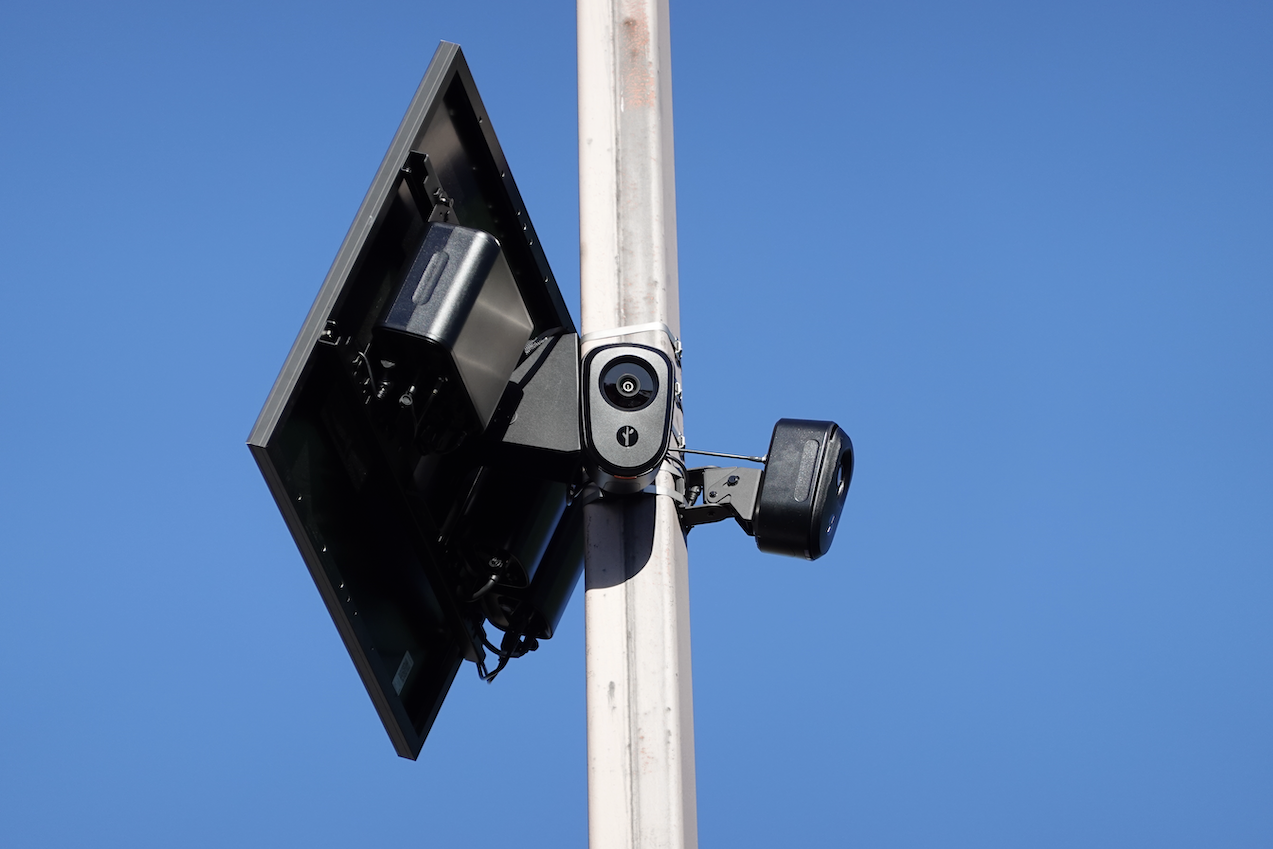
Entries like these defeat transparency, undermine accountability, and entirely fail to satisfy what many jurisdictions require by law or policy: an actual reason for the search. And this keeps happening because police use ALPRs as a convenient shortcut around constitutional privacy safeguards.
In other contexts, such as searches of cell phone location information, police have to go to a judge, demonstrate probable cause, and get a search warrant. But because laws and courts have not caught up with the pace of ALPR technology, police do not do the same before searching ALPR databases. Instead, they are given free rein to track a person’s movements without a sliver of judicial oversight.
As we mention in our piece about the use of ALPR surveillance for low-level investigations, if a police chief stood in front of a city council and asked for permission to install hundreds of cameras just so his officers could investigate the high crime of “haha,” they would be laughed out of the room. The same could be said if an officer asked a judge to sign a warrant to track someone down for “LOL.”
The fact that these searches were not only missed by the agency supervising the officer, but by the often thousands of other agencies whose systems were searched, demonstrates how agencies cannot be trusted to oversee themselves.
Mass surveillance is incompatible with a free society, and especially so when the people with access to this data are treating it like a joke. This ALPR mass surveillance—the indiscriminate, continuous collection and retention of location data on every driver, regardless of suspicion—should not exist. But because it does, EFF continues to urge courts and state legislatures to immediately step in and impose strict, enforceable restrictions to rein in this abuse. At an absolute minimum, this means mandating rigid data deletion deadlines and an ironclad warrant requirement.
If police want the power to track a person’s movements, they must be required to convince a judge with evidence and probable cause. They should not be able to bypass the Constitution with a search for “haha.”