dailynewsnblog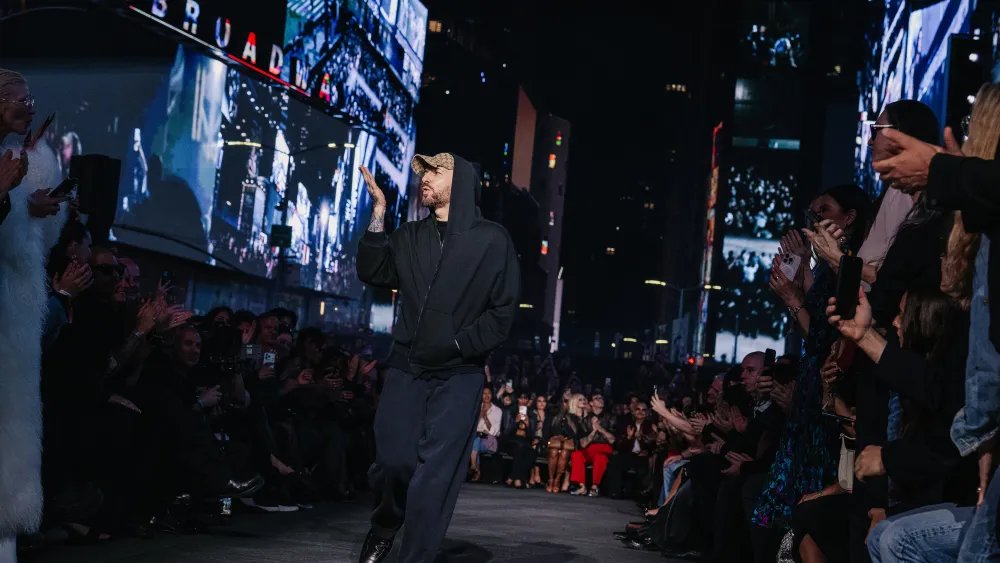
NEW YORK — Gucci‘s artistic director Demna loves a challenge, and on Saturday night, his ambition came to life in New York’s most bustling location: Times Square.
“Times Square, that was a bit of a crazy idea,” Demna told WWD during a preview ahead of his first cruise show for the Italian luxury house. Recalling that he “almost chickened out” after arriving in New York nearly two weeks ago and sauntering through the famous billboard-clad, tourist-crazed area, he noted that he and his teams were up for the seemingly impossible production.
“I always wanted to do a show in New York, like in the stock exchange; it’s something I did with my previous showing [for Balenciaga resort 2023]. I thought, I’ve done a show in New York, the one I wanted to do, but then when we’re talking about the show now, I thought, ‘Where do I do it now?,’” he recalled. “Out of the blue, I said, ‘What about Times Square?’
“It’s the first show in my career that I will not have a rehearsal for,” he explained of the complex process, including working with the city to secure permits, having mere hours before showtime for installations, forgoing a formal run-through in the venue and keeping the 9 p.m. cruise show location under wraps for security measures, to name a few. Times Square is as busy at 1 a.m. as it is at 11 a.m., certainly on the weekend, after all.
“The idea was to actually come to Times Square because it’s symbolic. It’s iconic, it’s New York, but it’s also a set design already. My idea was to actually use the screens of Times Square as the backdrop of the runway,” he said, hinting at Saturday night’s pre-show installation displayed on the large scale digital billboards.
But his decision to debut his first traveling cruise show in New York following his debut fashion show in February in Milan, and his Times Square location, spoke to his broader, ongoing study of the “Gucciness of Gucci.”

Gucci Cruise 2027
Giovanni Giannoni/WWD
“I felt outside of Italy, because the cruise shows are always going somewhere, and it’s kind of obvious to go to New York, but for Gucci it’s kind of necessary. To me it became a global brand from the moment they opened the store in New York,” he said of the house’s boutique opening on Fifth Avenue and 58th Street in 1953 — it’s first major brick-and-mortar expansion outside of Italy. He continued that this was where the international perception of the Gucci brand really started — not in Los Angeles or London, but New York.
He added that learning about the store’s Apartamento Gucci top floor for VICs, who were given golden keys to the elevator — which his cruise show invitations were a nod to — played into tying the history of Gucci with his vision today.
“Once you were a VIC client, they would give you this access, and you could buy everything. They had furniture, art, painting, sculptures. It was really very tasteful. I felt that was so Gucci in itself, so it was kind of obvious to do it here. And also, because America is so important outside of the history,” he explained.
Certainly, America has become an important market for luxury houses, as seen through this season’s Dior outing in Los Angeles on May 13, followed by Gucci’s and Louis Vuitton’s runway shows in New York this week, and soon, Hermès and Zegna’s debuts, back in Los Angeles, in early June.
With the American customer in mind for cruise, Demna explained that his, “research into the Gucciness of Gucci is probably climaxing in this show.” The collection serves as a culmination of the separate studies he undertook in his first three outings, first in his debut “La Famiglia” series of archetypal characters for spring 2026; his pre-fall dive into the Tom Ford Gucci era, and fall’s continuation with a sexy study of the body and lightness.
“‘La Familia’ was really a study of Gucci pre-fashion — the [Dawn] Mello era, the ’70s, the Jackie and the classicism, because for me it was necessary. I didn’t know about it myself, so I needed to. That was one segment,” he said. “The other one was Generation Gucci collection within pre-fall, which was a lot about the era of Gucci that had an impact on me, which is Tom [Ford’s] era, right through my lens, because a lot of the things were not really archival pieces, we had to create those things.
“Then ‘Primavera,’ which was very much going into the area that I’m not really acquainted with, which is the body conscious, sexuality, sex appeal through clothes,” he said. “Here it’s basically the combination of all of those, because to me, Gucci is not one of either of those things.”
Last September, the artistic director told WWD he was taking “baby steps” to reset the perception and understanding of what Gucci is through his reinterpretation. This next step for cruise was combining his deep study of Gucci’s history while fully introducing a major new pragmatic category: Gucci Core.
Heading into the season, Demna said he forwent mood boards and inspirations, and instead focused on key items that everyone should have in their wardrobes — and preferably from Gucci. In that vein, he explained that cruise is made up of 90 percent Gucci wardrobe staples — key classics the brand was seemingly missing, and 10 percent more seasonal, fashion-forward styles to complete the wardrobe.
“Sometimes people say, ‘What is Gucci about that, or what is Demna about that?’ Here, it is the combination of these ingredients, and on top of that, there is the collection that I call Gucci Core, which is an important part of the Gucci aesthetic — wardrobe, which currently we don’t really have, in a way,” he said of filling this gap with the perfect peacoat, pussybow blouse, cropped leather jacket, etc.
“It was really defining those elements, and I approached this collection as a merchandiser more than a designer. I didn’t have a mood board. I really wrote down the words trenchcoat: do we want it or do we not?” he said of making a list of products that construct the idea of the ultimate core Gucci wardrobe, which the brand has a consumer for, but up until now, not as much of an offering, he explained.
Demna added he saw resort as an opportunity to add these crucial elements into his study of who the Gucci crowd is today — not only who wears the Florentine house’s clothes, but how they wear them.
“I kind of needed to do that also as a study of Gucci myself to not only remind people of what Gucci is, because there was a very confused idea of Gucci I feel like in the couple of last years. But also to create a platform or a base on which now I can also build my silhouette, my Demna Gucci architecture of that silhouette,” he said.
More broadly, the strategy directly aligns with Kering chief executive officer Luca de Meo’s strategy for the Gucci renaissance.
During a three-and-a-half-hour speech at Kering’s Capital Markets Day in Florence in April, de Meo spoke at length about reigniting the desirability of Gucci, which contributes up to 40 percent of the French group’s sales.
“In one second, you know it’s Gucci, and that does not mean covering the world in GG. Being unmissable can also be quiet, discreet and refined, expressed through craft and identity codes that are immediately Gucci, even when they are not there and they are just subtle. We are activating this renewed identity to a Gucci Vita [Life]. This is our cultural expression that turns codes into culture,” he said last month.
Furthermore, the ongoing evolution means reinventing the heritage, rather than preserving it under glass, de Meo explained, with clarity, coherence and modernity and “injecting newness into our most iconic shapes and signature styles.”

Gucci Cruise 2027
Giovanni Giannoni/WWD
In addition to the ambition to double the contribution of women’s handbags to represent around 20 percent of leather goods sales and grow ready-to-wear and shoes, with refined, luxury essentials, by more than 600 million euros, both by 2030, and jumpstarting jewelry and watches, de Meo said addressing quality and rebalancing pricing are both key.
As reported, Gucci is anchoring the core of its business in a strong midprice proposition between 2,000 euros and 3,000 euros, elevating its top tier with distinctive details and richer materials, and redesigning entry level styles without compromising quality.
While criticism of Demna’s first three collections have been divisive — which the artistic director said he is used to — his approach reflects the overall house strategy.
In a nutshell, Demna’s aim is to break down the rigidity of fashion by defining what the modern luxury product at Gucci means, with desirable products he describes as FOMO; imbuing lightness into garments — not for the sake of it, but for practicality and comfort, and overall, cleansing and clarifying what Gucci is through his lens. Building toward his ultimate design-forward, smart Demna-Gucci vision.
“I feel like now we’re in the moment in the luxury industry where all the big brands have redefined their identity and who they speak to. At one point, I think post-COVID, everything overlapped. You would not know anymore which brand is which brand, and I feel now we’re starting to see that. And for me, this is exactly what I want to do at Gucci,” he explained of his work to define the brand’s audience, which he believes is broader than many other European luxury houses due to its history.
“Culturally, Gucci has touched on the bourgeois segment of social hierarchy, but also it spoke to streetwear people, and at the same time it’s the super high-end and couture consumer. So there is a lot of that,” he said, adding he sees it as an advantage to work as a creative who can create dialogue with Gucci’s wide-spanning customers. “It’s much easier for a brand that has much more of a monotonous customer, which you know a lot of big brands are. Gucci is really a very wide spectrum of consumer or potential consumer.”

Iman
Lexie Moreland/WWD
He noted that holding a show in New York also legitimized his approach to cruise “in a way, because it’s very pragmatic, it’s [the city] about really studied clothes. For me, Gucci, as well as the idea of American fashion, is very pragmatic. It’s very consumer-oriented; there is no fantasy land behind it. In Europe, we have a lot of that. In Italy, different ways than in France, but it kind of gave me an alibi to do the show here.”
During his two-week trip to New York — one of his longest visits in recent years after a quick two or three day jaunt for the 2024 Met Gala — the artistic director said his vision for cruise paralleled the pragmatism of real New Yorkers, who certainly need clothes to carry them from mornings into late nights.
“We were projecting on what our idea of New Yorkers are while we were doing this lineup, and I have to say, since I’m here, I see a lot of these people on the streets, so I’m very happy that our projection made sense, because of this consistency of dress codes. In Europe, we don’t see business guys in their suits with a backpack; here, all these commuting businessmen, they have it. We had it [in the lineup], and now I see these people,” he said.
During his visit, he saw his customer shopping at Bergdorf Goodman, but also carved out personal time for book and vintage shopping at Manhattan’s Dashwood Books and Brooklyn’s appointment-only High Valley Books.
“It’s by appointment, and the guy who owns it — it’s in his house, and there are books everywhere,” he said of the latter. “You have to walk sideways, but he has the most unbelievable selection of books and magazines. He has art, architecture, a lot of fashion, Japanese streetwear and a lot of weird items, like a file folder I got of Diana Vreeland’s. I left with two boxes of books — I love books and buy so many. I have a huge library, so it’s the only thing I really shop for.”
Demna explained that two times a year — his research weeks — he spends time scouring through these photography and art books, sometimes 300 at a time. “It’s like watching 300 movies, I love it,” he said.
His keen interest in the arts — including the Italian Renaissance, art history and certainly media and film, as seen through his short film “The Tiger,” which premiered during Milan Fashion Week last year, and his Gucci Generation pre-fall 2026 look book images, which Demna photographed himself –– plays a significant part in extending his vision of Gucci.
“The idea was to really build the lineup as almost like a movie of New York characters walking down Times Square wearing a Gucci wardrobe without being a classic wardrobe,” he said.
Certainly there were luxe, strong visions of the wardrobe on the runway, but with hints of edge melded with signifying codes like the web, the interlock, the GG, the Flora, the bamboo, the bit and the Jackie. Furthermore, it was about putting the styles together in a way that becomes fashion for every type of customer, rather than addressing wardrobing as boring classics.
“I want in every show that I do to speak to a different variety of people in different ways. Also this show, I feel like it’s kind of a completion of that reset in some way of Gucci as a brand and it allows me and gives me a platform to build my version of Gucci, which is more personal,” Demna said. “It doesn’t mean that it doesn’t consider all of these elements. It is because it’s a platform on which I want to build it, but this is more where I start to bringing Demna into this conversation. A little bit already in the show, but I wanted it to be a bit more gradual.”

Gucci Cruise 2027
Giovanni Giannoni/WWD