dailynewsnblog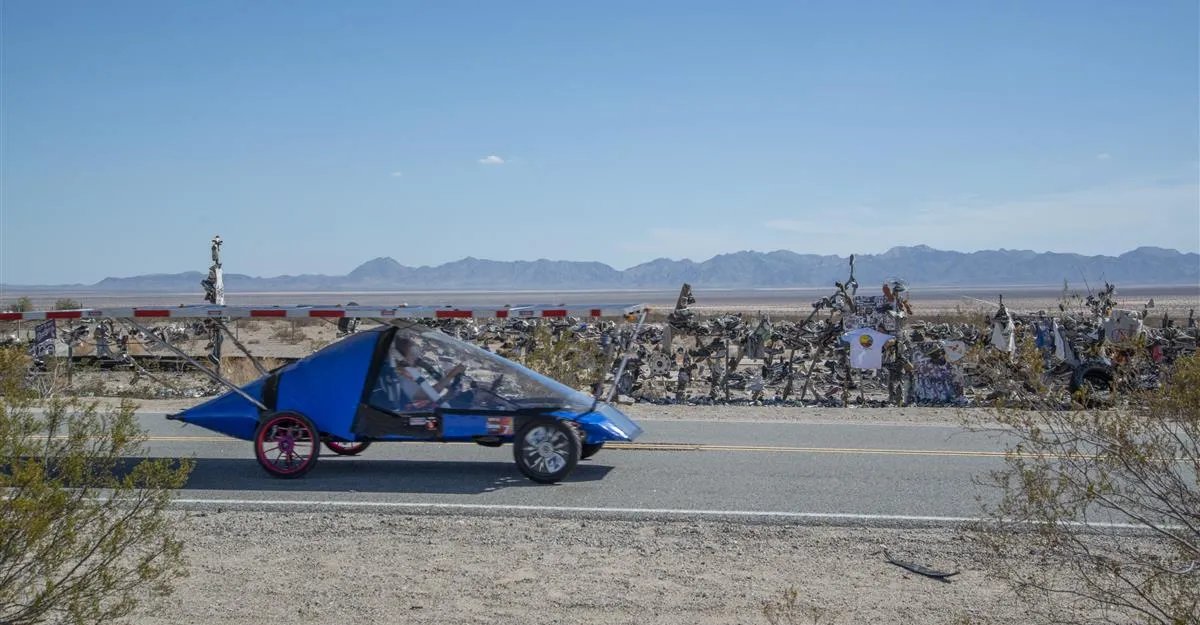
On July 19th, dozens of teams of high school students will begin a five-day, 630-mile road race from Fort Worth to Fort Stockton in Texas. But this is not your typical contest. The students design and build the cars themselves, using off-the-shelf parts and 3D printed materials. The winner is the team that accumulates the most driven miles. And the only fuel they can use to power their Frankenstein-looking vehicles comes from that mass of incandescent gas that hangs in our sky: the Sun.
This year is the 30th anniversary of the annual Solar Car Challenge, a contest that brings together high school students from around the country with the one goal to build the fastest, most efficient solar-powered car. The race was founded in 1993 by Dr. Lehman Marks, a Texas educator with a long-held interest in STEM. Students learn a variety of skills through the challenge, including project management, budgeting, fundraising, and engineering. But mostly, they have to build a race-worthy solar vehicle that can hopefully go the distance.
This year is the 30th anniversary of the annual Solar Car Challenge, a contest that brings together high school students from around the country with the one goal to build the solar-powered car that can go the distance
Lehman said that the Solar Car Challenge was born out of his frustration with the state of STEM education in the late ’80s and early ’90s. At the time, he had a group of students who were disengaged and uninspired by learning solely from textbooks, and seeking a way to spark their interest, he accepted an invitation from a friend at the University of North Texas, who was building a collegiate solar car for what was then a brand-new competition.
“We went up there and the kids were just mesmerized by the intricacy of the solar project,” he told me. “And all the way back from Desmond to Dallas, they kept yelling, ‘Doc, won’t you please let us build a solar car?’”
He relented, but quickly realized that high school students would never be able to compete fairly against college teams because they lacked the technical expertise and financial resources available to universities. Thus, the Solar Car Challenge for high school students was born, with the educational program officially kicking off in 1993 and the first national competition in 1995.
1/6
Since its inception, the program has engaged over 85,000 students across 39 states and multiple countries, including Canada, Mexico, Costa Rica, Spain, and Singapore. There are currently over 260 active high school solar projects. The event alternates formats between on-track and cross-country, with this year’s event being a grueling, 630-mile race across Texas. The five-day trek starts July 19th in Fort Worth and travels through the towns of Palestine, Round Rock, Fredericksburg, and San Angelo, before finishing in Fort Stockton. Lehman said that town residents come out and celebrate the teams each time they pass through.
”It’s not just building a car,” Lehman stressed. “It’s learning how to officially drive that car. In this coming event, one of the things I’ve been preaching to the kids is, before you ever get here, you need to put 500 miles in your car. You need to know, will it break? You need to know, even if it breaks, let it break in your own parking lot so you can fix it.”
The race typically features three categories of competition: classic, advanced, and electric-solar power, in which the teams race electric vehicles that receive energy from stationary solar power stations. This year’s challenge introduces a new division: cruiser. In this category, teams build four-seater vehicles with solar arrays integrated directly into the car’s body.
The decision to create a new division was born out of years of people questioning whether solar cars would ever resemble actual automobiles instead of flat, highly aerodynamic vehicles with a driver often crammed beneath a wide solar panel. Indeed, many of the cars barely resemble anything you would recognize as road-worthy, appearing more like a mix between futuristic spacecraft and high-tech go-karts.
“It’s not just building a car.”
— Lehman Marks, Founder of the Solar Car Challenge
Lehman said the organizers wanted students to build solar-powered vehicles that looked like real passenger cars, with solar cells integrated into the bodywork itself, room for four passengers, four doors, and a trunk. He believes this helps demonstrate that solar-powered transportation can have practical applications, allowing people to imagine what future solar-assisted passenger vehicles might actually look like.
“People would say, ‘Oh, this is really neat, but it’s not reality,’” he said. “Now we can show them what it could be. And I think that’s a step up.”
Blake Wood is a 17-year-old rising senior from Benbrook Middle-High School in a suburb of Fort Worth. He’s also one of the captains of the Old Rip Racing solar car team, one of the few independent teams in the race. Their 14-member team includes students from three different schools, something Wood sees as their biggest strength, because it allows students who otherwise would never have met to collaborate on a shared engineering challenge.
Wood says the team began planning approximately a year before the competition. Their earliest work consisted of paper sketches while they studied successful cars from previous years in the Classic Division, which is intended primarily for first- and second-year teams. They analyzed what made those other cars work well and incorporated those ideas into their own initial concepts. As the project progressed, the team improved its computer-aided design (CAD) skills, gradually translating their hand-drawn concepts into digital engineering models. Learning the design software became part of the educational process.
“People would say, ‘Oh, this is really neat, but it’s not reality.’”
— Lehman Marks
“I think our vehicle, it looks really nice to me,” Wood tells me. “It’s unfortunate. So we don’t really get to see it that often all put together, and it feels like we’re always fixing something or making something and then putting something back on, and then we’re like, ‘Oh no, we need to weld in that area. Let’s take that electrical component back off.’”
But while battery-electric vehicles have become mainstream, solar cars have remained largely experimental. A number of startups pursuing solar cars have either pivoted to more proven technology or gone bankrupt. Wood says he’s optimistic that solar vehicles have real long-term potential, as long as educational competitions like the Solar Car Challenge continue to expose students to renewable energy technologies at an early age. As participants eventually enter professional careers, they can continue developing the innovations needed to make solar transportation commercially viable.
1/4
“We’re making progress,” Wood said. “I mean, we have a whole lot of high school students making them, and I think with the right equipment and a little more expertise than maybe all of us have, I think it could definitely be possible.”
Lehman agrees, pointing to startups like Aptera that are still pursuing the goal of a mass-market solar car. But he said that commercialization has never been the real goal of the Solar Car Challenge.
“People say, ‘Well, are you trying to build a better solar car?’ Between you and me, I’m not,” he said. “I’m trying to build a student who is capable, who learns about commitment, dedication to a project, to learn about teamwork, to learn about engineering and battery technology. I’m trying to build a workforce and trying to build engineers.”