dailynewsnblog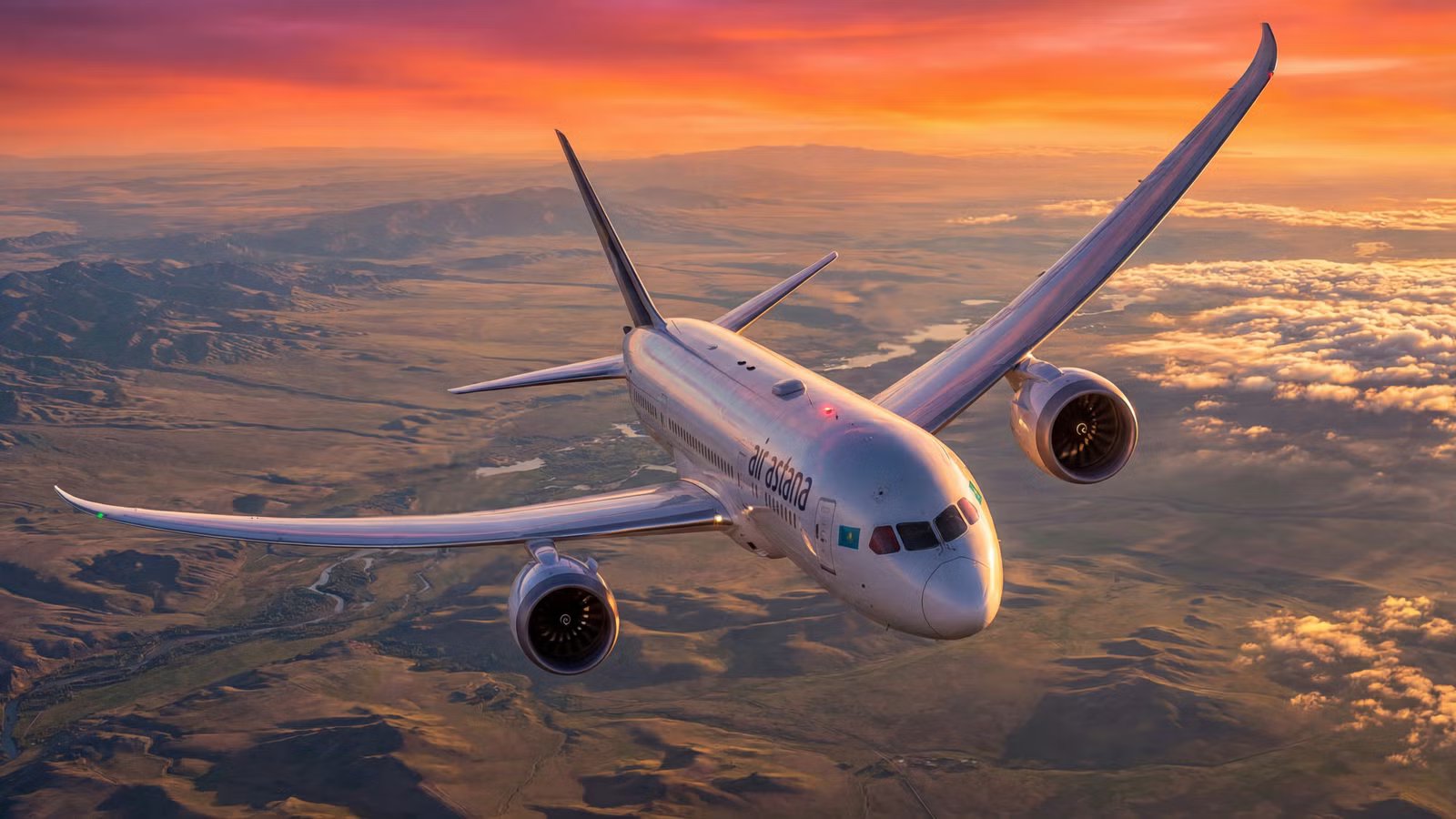
Last year, Kazakh flag carrier Air Astana made headlines by placing an order for up to 15  Boeing 787-9 Dreamliner aircraft. These modern US-built widebody twinjets will help the airline to expand its long-haul fleet and operations as Kazakhstan continues its quest to establish itself as an emerging aviation market.
Among the many merits of the Boeing 787 Dreamliner family is that its size and range have allowed its existing operators to unlock hundreds of new city pairs. For Air Astana, the US would be an obvious target for such network growth, but, as it happens, geopolitical hurdles will make this trickier than expected.
Stopped By Sanctions

At today’s Q1 results presentation, Simple Flying asked about Air Astana’s order for the Boeing 787-9 in more detail with Ibrahim Canliel, the Chief Executive Officer of the Kazakh flag carrier. He explained that, as far as deliveries are concerned, “the first 787s will come in September of this year.” In order to get pilots and cabin crew up to speed, he explains that Air Astana “will do quite a lot of short sector operations in the first [few] months.”
This is a common practice for airlines receiving new widebodies, and one, he explains, that will continue “perhaps a bit beyond the delivery of the second aircraft in the later part of this year.” The 787’s range should help foster network growth, but, while the carrier wants to fly to the US, doing so in the most direct way would require the use of Russian airspace. This, of course, remains off limits due to sanctions, as Canliel told Simple Flying:
“The 787 will need to be able to fly via a routing that we currently are not able to operate because of sanctions. (…) That will need to be resolved before we can start considering a direct operation to the US.
The Story Of Air Astana’s Boeing 787 Order

Air Astana made headlines throughout the world of commercial aviation last November when it placed a 15-aircraft order for the Boeing 787-9. This, Boeing explained at the time, represented “Air Astana’s largest single airplane purchase” in its history, with the deal signed at the C5+1 Summit. As is often the case with major aircraft orders, after being announced in November 2025, the order was officially finalized three months later, this February.
In addition to the up to 15 units of the Boeing 787-9 Dreamliner that Air Astana has committed to purchasing outright as part of this landmark deal, the carrier is also set to receive another three examples of the modern widebody twinjet from aircraft leasing companies. This would see its total 787 fleet rise to up to 18 aircraft, representing a considerable expansion when compared to its current relatively modest widebody footprint of three 767s.
These older Boeing 767-300ER jets, as detailed in our coverage linked below, are typically used by Air Astana to fly internationally from Almaty to Dubai, Male, Phuket, and Seoul Incheon. However, with the size of its widebody fleet set to grow significantly, new routes, such as to the US, are on the cards. It is worth noting that, of the 15 orders that make up Air Astana’s historic deal, five are firm, five are options, and five are purchase rights.

Huge Ambitions: Where Could Air Astana Fly The Boeing 787?
It has ordered up to 15 787s, which will prove a very risky and expensive proposition, but…
A Step Up In Passenger Experience

In any case, regardless of the routes that Air Astana’s Boeing 787-9 Dreamliner twinjets end up serving, they stand to mark a strong step forward as far as the onboard passenger experience is concerned. On this front, Canliel says that “customers are going to love the new product,” adding that “in both cabins, it’s bringing a significant upgrade to the product offering that we provide to our customers” compared to the airline’s existing offering.
To this end, Canliel explains that the 787 “will place [Air Astana’s] competitiveness at an even stronger place,” and that “[offering] that product across our network [will enable] further growth both on medium and longer haul [routes].” For context, aeroLOPA shows that Air Astana’s existing Boeing 767-300ER widebodies have 30 business class flatbeds in a staggered forward-facing 1-2-1 configuration and 192 seven-abreast (2-3-2) economy seats.