dailynewsnblog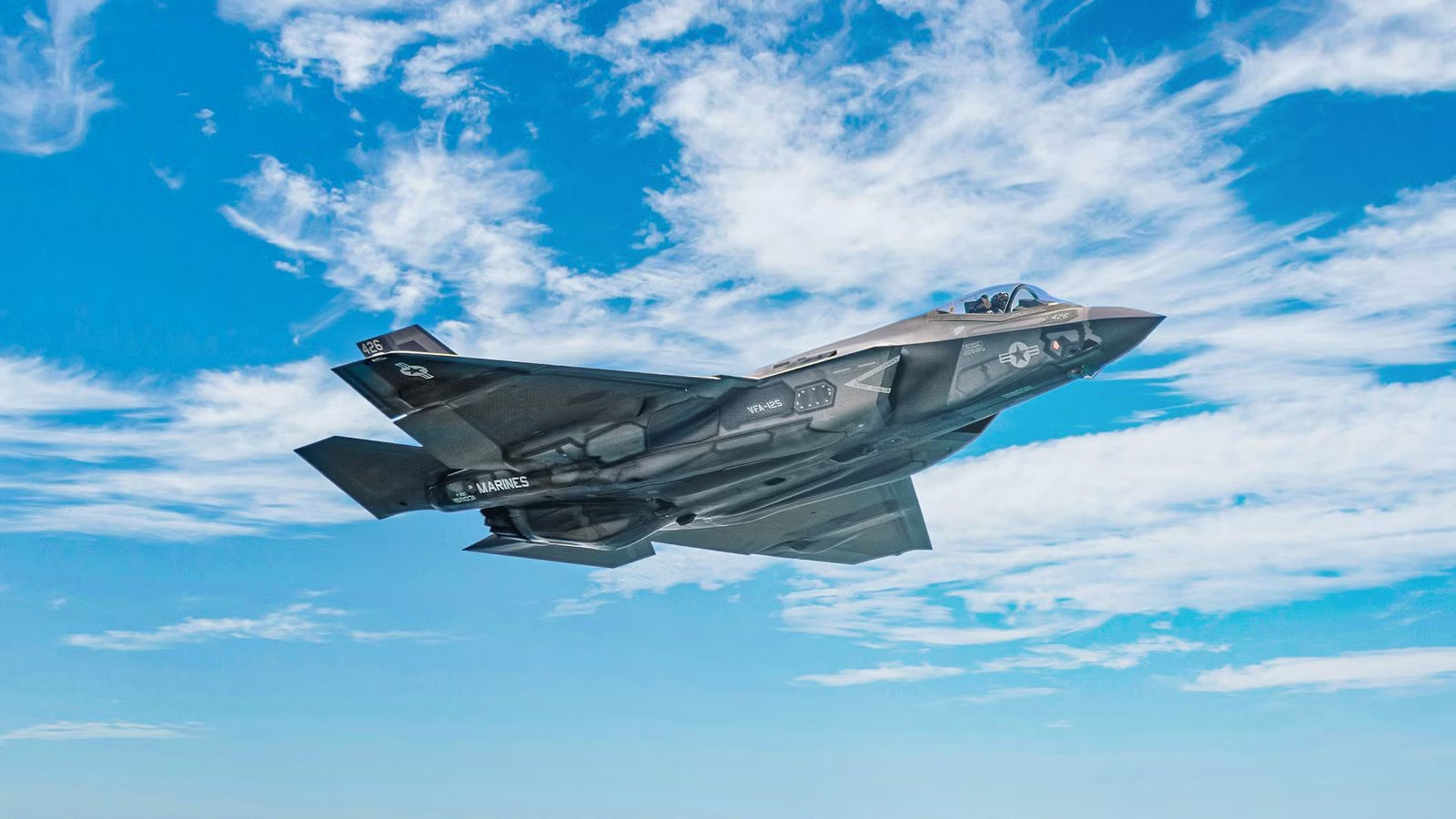
When the Lockheed Martin F-35 Lightning II fifth-generation fighter was introduced to the US Navy and Marines, it was not only the first stealth fighter but also ushered in a generational leap in combat data link technology. The F-35B of the US Marines is the first stealth ‘jump jet’ and a far more computerized aircraft than the McDonnell Douglas AV-8B Harrier that it replaced. While the ‘flying supercomputer’ quality of the F-35 is a huge tactical feature, legacy systems are still adapting to catch up.
The US Marines also operate the F-35C carrier-capable variant, but much of the air support for frontline troops in the Marine Air Ground Task Force is delivered by rotary wing assets, aka helicopters. Many of the helo airframes in service with the Marines are derivative of 1960s designs, specifically the Bell AH-1Z Viper and UH-1 Venom. These are also much smaller than similarly vintage Sikorsky CH-53 Super Stallions, meaning that they cannot generate as much electrical power.
This power supply is the performance gap that will be resolved through the structural and power improvements for the NextGen Effects upgrade program that was awarded to Bell Textron in July. The contract is a $300 million firm-fixed-price contract to retrofit 28 AH-1Z and 21 UH-1Y. After the helos are processed, they will be able to accommodate high-powered Link 16 ‘combat cloud’ data networking equipment so they can keep up with fifth-generation assets like the F-35 Joint Strike Fighter.
21st Century Hardware For Cold War Helos

The AH-1Z and UH-1Y are aging airframes being asked to do a new generation’s job. The aircraft that became the AH-1 Cobra was built by reusing proven UH-1 Huey components, which the Venom is derivative of, to compress development into roughly eight months. Bell launched a company-funded design effort for the Model 209 in January 1965 and entered combat in Vietnam in 1971.
The current-generation AH-1Z is a much later derivative of that basic airframe concept, having emerged from the 1990s-2000s H-1 upgrade program as a modernization of the Marine Corps’ AH-1W SuperCobras, sharing over 84% parts commonality with the UH-1Y Venom. Bell delivered the 189th and final AH-1Z to the Marine Corps on November 2, 2022, and combined with 160 UH-1Y Venoms completed in 2018, the H-1 upgrade program produced 349 aircraft.
The upcoming SPINE Phase 3.0, announced on July 24, includes a commitment for $33.64 million and builds upon momentum started by a series of smaller-scale upgrades executed in the past. The Department of the Navy has ordered nine A-Kits, two D-Kits, and numerous smaller components to be equipped over the three-year estimated schedule. Bell will install improved generators, wiring and control units, and a modern data bus for net-enabled weapons and communications.
The Marine Corps expects to keep flying the Viper through the 2040s. Rather than introducing a new aircraft, the program focuses on upgrading the existing fleet so it can accept new technologies as they become available. The underlying constraint SPINE removes is the simple lack of electrical power from alternators on the turbine engines that power the helo. At the same time as the upgrade to power supply and digital avionics, the external equipment like hoist and litter kits as well as sheer payload capacity is also being enhanced.
Reinventing Raider Doctrine: Pivot To The Pacific

The immediate operational payoff of SPINE is not a new sensor or weapon by itself, but the electrical and data ‘plumbing’ that lets other new systems function simultaneously rather than competing for scarce power. That plumbing is being built specifically to support a reorientation of the AH-1Z’s mission set toward distributed, long-range maritime strike in the Indo-Pacific. Rather than treating the AH-1Z mainly as a close air support platform, the SPINE program supplies the reinforcement and digital architecture needed to convert it into a mobile node within a larger networked kill web.
In the context of Marine Corps force design emphasizing distributed maritime and expeditionary advanced base operations, the modernized Viper shifts primary employment toward receiving external cues and launching from relative sanctuary rather than always flying exposed at low altitude. That shift is already showing up in weapons programs riding on SPINE’s power and data backbone. The Navy awarded an $86.2 million contract to L3Harris Technologies in early 2026 to produce Red Wolf missile systems for the Marine Corps’ Precision Attack Strike Munition program, with missiles and support materials due by the end of 2027.
Red Wolf has completed dozens of flight tests, including low-altitude releases from the AH-1Z supported by beyond-line-of-sight communications. The ‘Wolf Pack’ system pairs explosive Red Wolf missiles with electronic-warfare-focused Green Wolf missiles, both reaching targets more than 200 nautical miles (370 km) away. That is a dramatic increase over the roughly 5-mile (8 km) range of existing Hellfire munitions carried by AH-1Z Vipers.
This is also important as there is no firm successor to H-1 defined yet. Thus, with the SPINE 3.0 and Wolf Pack, the Vipers and Venoms can keep flying for another fifteen-plus years rather than allow a capability gap to develop for the MAGTF.
One Team One Fight: Joint Ops In The Pacific Command

Bell’s SPINE Phase 3.0 upgrade and the Wolf Pack are not standalone programs. They are the rotary-wing half of a much larger Marine Corps bet on distributed warfare in the Indo-Pacific. The 2026 Aviation Plan describes how the F-35B and F-35C will be the primary node of a concept that the service describes as a return to the Raider-style expeditionary posture. This is composed of small, dispersed detachments on austere island air strips or ‘lightning carrier forces’ centered on amphibious assault vessels.
SPINE gives the AH-1Z Viper and UH-1Y Venom the electrical and data capacity to plug into the same kill web designed for the F-35. And since the JSF’s core features are the same for all 19 partner nations that operate it, the same architecture that links Marine helicopters to Marine F-35Bs also, in principle, extends to connect all Joint Forces in the region. That not only includes the US Navy and US Air Force but also the Royal Australian Air Force, the Republic of Korea Air Force, the Japan Air Self-Defense Force, and the Republic of Singapore Air Force.
US Marine F-35s can even operate from the decks of the United Kingdom’s Royal Navy carrier groups as its Fleet Air Arm and Royal Air Force squadrons also fly the F-35B, adding another layer of interoperability to extend the kill web to as many forces as possible within the combat cloud in the Indo-Pacific. Having every one of these aircraft, surface vessels, or ground units in the multinational alliance seamlessly interconnected through the same data link makes every piece of hardware more valuable.
Translating On The Fly To Stay On Target

That phrase kill web, rather than kill chain, is a key distinguisher because it describes a system in which any sensor can cue any shooter, as opposed to the fixed sequence in legacy doctrine under which one platform finds the target and another designated unit fires. Lockheed Martin has been building and testing that concept specifically in the Indo-Pacific since at least 2019. The AH-1Z’s own record in that exercise series shows both the promise and the current limits of the concept.
During Talisman Sabre 2023, AH-1Z Vipers flew live-fire aerial-assault missions alongside F-35B Lightning IIs, AC-130 gunships, and allied ground forces. The Viper’s current nose-mounted Target Sight System with FLIR and laser designation has a much shorter effective range than the 200-nautical-mile reach of the Wolf Pack missiles. As a stopgap bridge method to employ kill web tactics with the legacy systems, according to The War Zone, the Marines installed a tablet-like adapter on Venoms to pass targeting data to the Vipers, dubbed the MAGTAB.
Linking the helos together in a scaled-down version of the kill web allowed the AH-1Z gunships to provide fire support to the UH-1Y transports during exercise missions. Still, it would overstate the current state of the program to describe SPINE-upgraded H-1s as a mature multinational F-35 sensor network. The technical bridge between the F-35’s stealthy MADL network and Link 16-equipped legacy platforms like the H-1 still runs through gateway translation technology that, while demonstrated, is not universally fielded.
Denial Defense Along The First Island Chain

The regional fleet of JSF squadrons that are at the center of the coalition kill web is growing quickly among the allied air powers of the First Island Chain. Japan is on pace to become the largest F-35 operator outside the United States, with a program of record for 105 F-35A and 42 F-35Bs. The F-35Bs are intended to fly from the converted Izumo-class ships, giving Japan shipborne fixed-wing aviation for the first time since WWII, which will work in parallel with the US Navy carrier strike groups, USMC Lightning carriers, and Royal Navy aircraft carriers.
Meanwhile, Australia already has 72 F-35As, and although it may not grow to 100 as originally planned, the RAAF continues to invest in armaments and installations to support its JSF force and the regional alliance. The ROKAF has 40 F-35A stealth jets and is considering adding more to its order, while Singapore has become the latest member of the coalition with its order for 16 F-35Bs and eight F-35As.
Lockheed Martin projects the combined Indo-Pacific F-35 fleet will exceed 300 total by 2035. The AH-1Z and UH-1Y fit into this picture as the rotary-wing complement disperses among amphibious ready groups and aviation combat units and forward posts. Despite the fact that the Huey and the Cobra were originally intended for a different type of warfare, these vintage airframes continue to adapt and evolve, providing close, organic fire support to troops on the ground. Now, with the latest edition of standoff maritime strike, they will once again be a critical element of the combined forces strategy for the US and its allies.
Catch what other trackers miss
Emergency squawks, holds, NOTAMs — live signals, no signup.
Open tracker
Catch what other trackers miss
Emergency squawks, holds, NOTAMs — live signals, no signup.
Open tracker