dailynewsnblog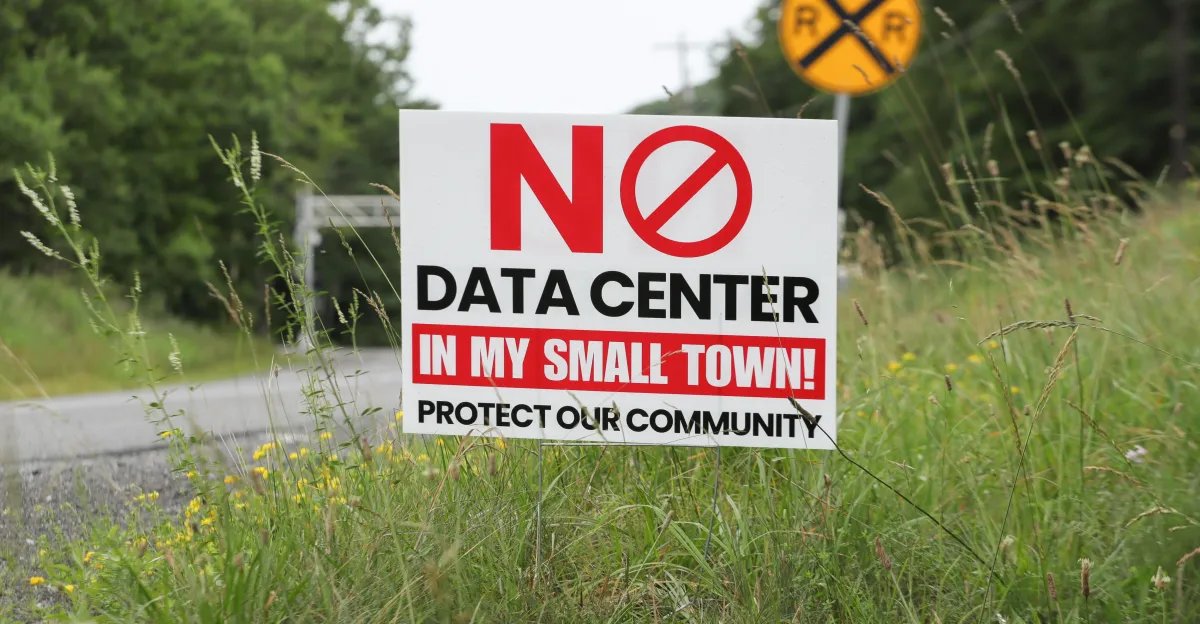
This is The Stepback, a weekly newsletter breaking down one essential story from the tech world. For more on the data center buildout, follow Emma Roth. The Stepback arrives in our subscribers’ inboxes on Sunday at 8AM ET. Opt in for The Stepback here.
Years before the AI boom threatened local power grids, a small group of protesters set the stage for the battles cropping up across communities today. In 2015, Apple announced plans to build a roughly $1 billion data center in the sleepy town of Athenry, Ireland. The data center’s 500-acre site would power Apple’s services in Europe, including iTunes, iMessage, and Siri. At the time, Apple said the data center would offer outdoor education spaces, walking trails, and an initiative to replant native trees. It would also use 100 percent renewable energy. With the approval from the local government and plans to give back to the community, Apple likely didn’t anticipate the lengthy battle it was about to face.
Apple’s building plans were quickly derailed after Irish residents lodged complaints to the country’s independent planning board about the expected noise, light pollution, flooding, traffic, and impact on local wildlife. While the board ultimately approved Apple’s facility in 2016, the fight didn’t end there, as residents applied for judicial review of the board’s decision in the Irish High Court. In 2017, the Irish High Court ruled in favor of Apple, but the pair of activists behind the appeal wanted to bring the decision before Ireland’s Supreme Court — and that was finally enough for Apple to call it quits. Even with the support of some of Athenry’s residents, Apple gave up just months later, in May 2018, after its building plans remained in limbo for years.
Over the past decades, data centers for cloud storage and other non-AI-related purposes have become ubiquitous. But data centers are coming under increasing scrutiny in 2026, with sprawling AI data centers consuming as much energy as entire states and some as large as cities.
More people are recognizing the risks AI data centers pose to their communities as residents living near these facilities report rising energy costs, issues affecting local water quality, and noise and light pollution, along with concerns about greenhouse gas emissions. The US Energy Information Administration said commercial energy demand would surpass residential demand for the first time this year due to the AI data center buildout. That demand is expected to double by 2027.
Now, many people are rushing to block the buildout of AI data centers in their communities, with residents flooding town halls across the nation to voice their concerns about the buildout. From January to March alone, protesters have blocked or delayed at least 75 projects in the US valued at $130 billion, according to a study from Data Center Watch, a research project backed by the AI security company 10a Labs. “The number of active opposition groups more than doubled from 396 at the end of 2025 to 833 by the end of Q1 2026, now spanning 49 states,” the study says. “Over 235,000 petition signatures were collected in this quarter alone.”
In January, the Blackstone-owned data center company QTS dropped plans to build a $12 billion campus in DeForest, Wisconsin, following protests from community members. Meanwhile, a planned data center on a 580-acre campus in Delaware City is facing roadblocks, as local regulators determined in March that the planned facility is prohibited under the state’s Coastal Zone Act, which blocks heavy industry on its shorelines. And so far in July, opponents successfully blocked a QTS data center in Prince William County, Virginia. The “Digital Gateway” would’ve spanned 2,000 acres in a state that’s already dealing with rising energy costs from data center buildout. Residents also pressured Shark Tank star Kevin O’Leary to downsize his proposed 40,000-acre Project Stratos campus in Box Elder County, Utah.
With new data center proposals emerging what seems like each week, the fight is far from over.
As protests in communities across the US and beyond play out, a political battle is breaking out in Congress. Data centers are a key part of President Donald Trump’s plan to win the AI race against China, which is why he signed an executive order last year to fast-track the construction of the sprawling facilities. But not everyone on Capitol Hill is on board with Trump’s stance on AI data centers.
With midterm elections around the corner, some Republican candidates are distancing themselves from Trump’s data center-friendly views to curry favor with residents. Sen. Bernie Sanders (D-VT) and Rep. Alexandria Ocasio-Cortez (D-NY) introduced a bill that would pause the construction of new AI data centers until Congress passes laws that would prevent the facilities from raising utility prices or harming the environment. At the same time, lawmakers from both sides of the political aisle are backing the Ratepayer Protection Act, a set of laws that codifies an agreement signed by Google, Meta, Microsoft, and other tech giants to pay for their own data center energy costs. Other lawmakers stand behind the Guaranteeing Rate Insulation from Data Centers (GRID) Act, which would force data centers to use energy sources separate from the US electric grid in an effort to protect residents from utility bill increases.
Local governments are taking steps to regulate AI data centers, too. Tech Policy Press reports that both Democrat- and Republican-led states have enacted 28 laws related to AI data centers, including Florida, which introduced rules to prevent data centers from passing on costs to residents. Idaho put restrictions on AI data center water usage, while Washington state removed a tax break for the companies operating the facilities.
The current patchwork of local laws isn’t enough to rein in the buildout, and the federal-level bills still have to make their way through Congress, leaving many communities to fend for themselves. Just two people were enough to tie up Apple’s plans in Ireland, and now it’s taking entire towns and cities to fight against the massive data centers coming to their neighborhoods, like Meta’s $27 billion “Hyperion” build in Louisiana, Google’s $10 billion Project Mica in Missouri, SpaceXAI’s $20 billion campus in Mississippi, and the $500 billion Stargate data centers planned across the US.
- Wyoming officials recently found that a contractor linked to Meta’s data center flushed bacteria-contaminated water into public sewers.
- Factories across the Midwest are facing rising electricity costs due to nearby data centers.
- Plans to build 74 gas-fired plants to power data centers across the US could release as much greenhouse gas pollution as all of Australia, according to the Environmental Integrity Project.
- The Verge’s Lauren Feiner has a great write-up about how Google plans to replenish more water than it uses at its data centers.
- You might’ve heard about plans to put AI data centers in space, but you might want to read UPI’s report about how Samsung and Hyundai want to put data centers on boats.
- Check out Erin Brockovich’s map of the planned data centers across the US.