dailynewsnblog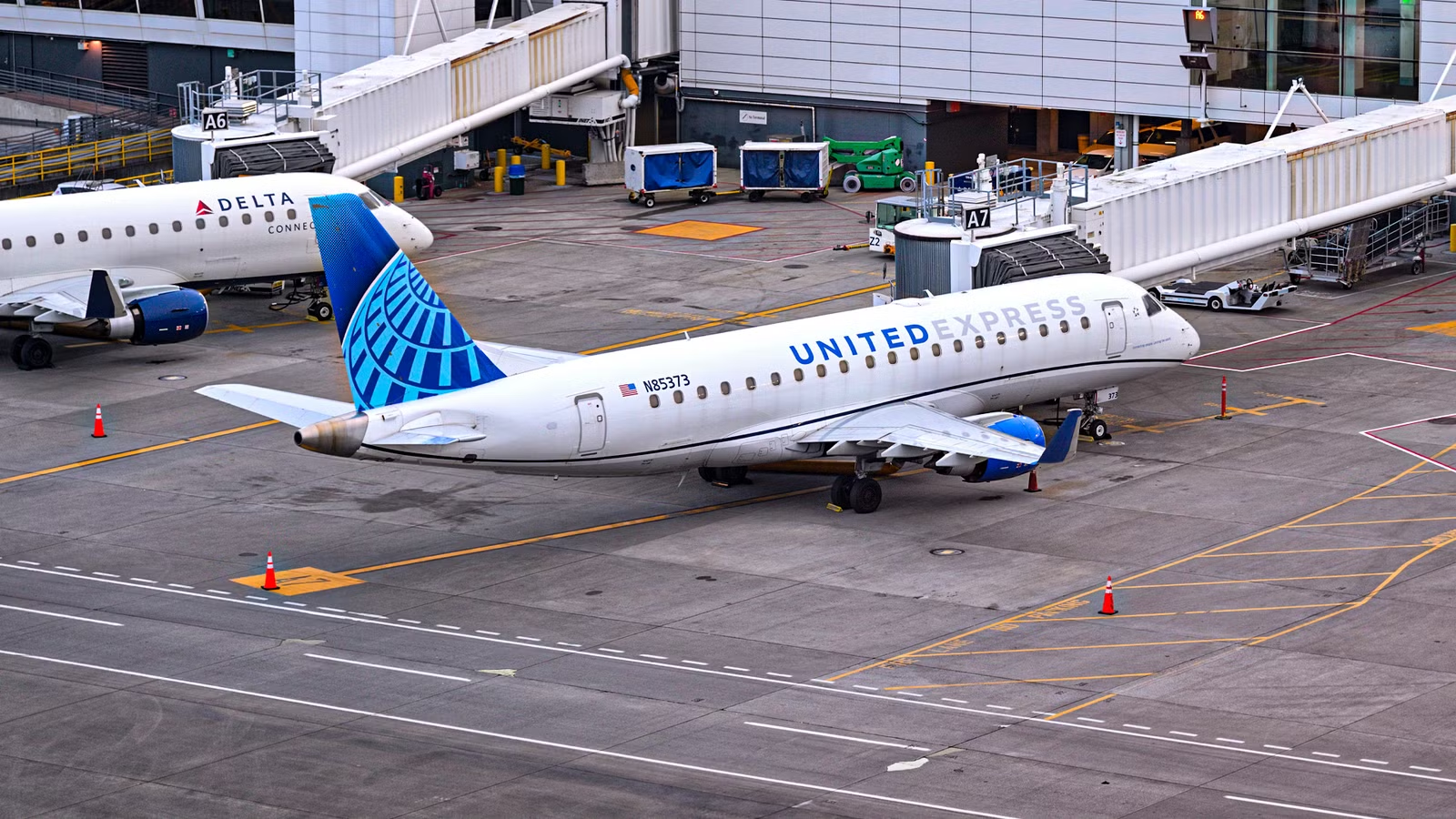
 United Airlines has deferred the launch of ten planned domestic routes from
  Chicago O’Hare International Airport (ORD) until late 2027 after the Federal Aviation Administration extended the airport’s scheduling cap through October 30 of that year. The decision leaves several Midwestern communities waiting for promised service, even as United continues expanding from its largest hub with new routes to leisure destinations and smaller western markets.
The change is not a straightforward reduction in United’s O’Hare network. The airline has also introduced 12 new domestic routes during 2026, including services to Santa Barbara, St. George, Idaho Falls, Cody, Key West, Lancaster, and Kearney. The contrasting decisions show how United is reallocating scarce aircraft movements under a fixed operational ceiling, favoring markets that may produce stronger yields or support broader strategic goals over thinner regional spokes.
The FAA’s 2,708-Operation Ceiling Remains In Place

Wikimedia Commons | Simple Flying
The FAA initially imposed the O’Hare limit in response to a schedule that exceeded the airport’s practical capacity during the 2026 summer season. More than 3,080 daily flights had been planned for peak days, representing a 14.9% increase over the previous summer. The agency determined that allowing the full schedule to proceed would risk severe delays and operational disruption.
The resulting order limits scheduled arrivals and departures at O’Hare to 2,708 daily operations between 6:00 AM and 11:59 PM Central Time. The restriction is allocated across individual half-hour periods, with limits ranging from 30 to 84 operations, depending on the time of day and expected runway configuration. The structure prevents airlines from concentrating additional flights into already congested periods. The original order was scheduled to expire on October 24, 2026. The FAA subsequently extended it through October 30, 2027, because airfield construction and related adjustments are expected to continue through the summer 2027 scheduling season. The agency said allowing the restriction to lapse would create a significant risk of renewed delays.
The extension removes the possibility that United could simply wait for the original deadline to pass before restoring its planned schedule. Instead, the airline must manage its O’Hare operation within the same constrained framework for another year, while ORDNext construction continues to affect taxiways, gates, and aircraft movement patterns.
Ten Regional Markets Have Been Pushed Back

United’s deferred domestic routes connect O’Hare with communities across the Midwest and nearby regions. The affected destinations are Bloomington-Normal and Champaign-Urbana in Illinois; Kalamazoo, Lansing, and Marquette in Michigan; La Crosse and Central Wisconsin in Wisconsin; Tri-Cities in Tennessee; Erie in Pennsylvania; and Rochester in Minnesota.
The routes were intended to strengthen United’s regional presence by linking smaller communities with its Chicago hub. For travelers in those markets, the planned services offered access to United’s broader domestic and international network without requiring a drive to a larger airport. Their postponement therefore affects more than the number of destinations listed in a timetable. It now delays new connecting opportunities for passengers who depend on regional air service.
United has tied the deferrals directly to the FAA’s continued capacity restrictions. The airline had originally planned to increase its O’Hare schedule substantially, but the available operating ceiling prevented the carrier from introducing every announced route while maintaining its broader network plan. The affected markets also depend on connecting passengers rather than large volumes of local traffic. A 50-seat regional jet can provide valuable connectivity, but it moves fewer passengers per airport than a larger aircraft on a stronger route. Under normal circumstances, that may still be worthwhile because a regional spoke supports the hub’s geographic reach. Under a strict movement cap, however, the opportunity cost becomes more visible.
United Is Adding Leisure And Western Routes Instead

While the regional routes have been delayed, United has continued to introduce new domestic service from O’Hare. Cirium data reported by Travelers Today identified 12 destinations added during the 2026 summer schedule that lacked comparable United service a year earlier. These destinations reflect a different network strategy from the deferred Midwest spokes. Several serve leisure demand, national parks, seasonal travel, or fast-growing western markets. Santa Barbara and Cody are associated with tourism, while Idaho Falls and Kearney provide access to smaller western communities that may have limited nonstop service from major hubs.
United’s 12 New ORD Routes in 2026 | ||
|---|---|---|
Destination | Airport Code | Launch Month |
Santa Barbara, CA | SBA | April |
Lancaster, PA | LNS | June |
Lynchburg, VA | LYH | March |
Clarksburg, WV | CKB | April |
Kearney, NE | EAR | April |
Shreveport, LA | SHV | October |
Owensboro, KY | OWB | October |
Idaho Falls, ID | IDA | May |
Monterey, CA | MRY | May |
Cody, WY | COD | May |
St. George, UT | SGU | May |
Santa Fe, NM | SAF | December |
The new routes also give United a way to broaden its customer base without relying exclusively on traditional business-oriented markets. Leisure travelers may be more willing to pay for nonstop access during peak travel periods, while western destinations can support both local demand and connections through Chicago. Performance will vary by season, but the network value may extend beyond the number of passengers carried on each flight.
Catch what other flight trackers miss
Emergency squawks, holds, NOTAMs — live signals, no signup.
Open tracker
Catch what other flight trackers miss
Emergency squawks, holds, NOTAMs — live signals, no signup.
Open tracker
The contrast with the deferred markets does not prove that United considers the Midwestern communities unimportant. Rather, it shows how the airline is selecting which opportunities to pursue first. When the number of available takeoffs and landings is fixed, adding a route requires either removing another service, reducing frequency elsewhere, or using a larger aircraft on an existing flight. United’s O’Hare choices suggest management is prioritizing markets that can generate stronger demand, higher average fares, or more distinctive network benefits. That strategic value may outweigh the advantages of maintaining a thin regional connection during a period of restricted growth.
Aircraft Size Is Becoming A Substitute For More Flights

United has also responded to the cap by adjusting aircraft size on existing routes. Rather than using every available movement for a new regional service, the airline can replace smaller aircraft with larger ones, allowing it to carry more passengers without increasing the number of departures. The strategy is particularly relevant at a hub such as O’Hare, where a single aircraft movement consumes scarce capacity regardless of whether the aircraft carries 50 passengers or more than 150. A larger aircraft can therefore improve passenger throughput while preserving the airport’s daily operating limit.
United reportedly reduced its planned third-quarter daily departures at O’Hare from approximately 780 to about 650, a reduction of roughly 16.7%. The carrier’s continued route additions must therefore be understood alongside a lower overall schedule than previously planned. The airline is not simply expanding in every direction, but reshaping the schedule within a smaller operating envelope. Upgauging also offers operational advantages. Larger aircraft can reduce the number of flights required to serve a market, simplify crew planning, and improve the economics of routes with consistent demand. The approach is less suitable for small communities that cannot reliably fill a larger aircraft, which helps explain why regional markets are vulnerable when a hub reaches its movement limit.
The trade-off is that passengers may receive fewer departure choices even when total seat capacity remains relatively stable. A community that previously expected several daily flights on a small regional jet may instead face a reduced schedule, while a larger market receives more seats concentrated into fewer departures. That outcome can improve the airline’s efficiency without preserving the same level of convenience for every traveler. United can increase capacity where demand is strongest, but it cannot use larger aircraft to solve every regional market’s needs. Some routes require frequency, not just seats, and those services are harder to justify when airport movements are limited.
O’Hare’s Constraint Is Intensifying The United-American Rivalry

The capacity issue affects more than United’s route map. O’Hare is a major hub for both United and  American Airlines, and each carrier must protect its position while operating within the same airport-wide ceiling. The FAA’s allocation process is based on approved historical schedules, which limits how freely either airline can claim additional peak-period capacity. That arrangement makes every schedule decision more consequential. A carrier that reduces a route may risk losing the opportunity to establish a stronger operating baseline in a future season unless it asks the FAA to preserve the unused timing.
United and American must therefore balance immediate commercial performance against long-term hub access. A route that appears marginal during construction may still have strategic value if abandoning it makes future restoration more difficult. Conversely, retaining a weak service can prevent the airline from deploying capacity on a route with stronger demand. The rivalry is also visible in the competition for gates, aircraft, and passenger loyalty. O’Hare’s construction program is intended to improve the airport’s long-term capacity, but the near-term restrictions create a period in which neither hub carrier can grow freely. Each must decide whether to defend existing markets, add new destinations, increase aircraft size, or preserve operating rights for later use.
The result is a more selective form of competition. United’s decision to add leisure and western routes while delaying ten regional markets suggests that the airline is using the cap to refine its network rather than merely shrink it. American faces the same basic constraint, making O’Hare’s future growth dependent not only on passenger demand, but also on how efficiently each carrier uses every available movement.
The Next O’Hare Expansion May Favor Frequency Over Geography

United’s deferred routes reveal how an airport capacity restriction can alter the geography of a major airline’s network. The airline has not stopped adding destinations from O’Hare, but it has delayed ten regional markets while introducing leisure and western spokes that may offer stronger commercial returns or broader strategic value. The FAA’s 2,708-operation ceiling will remain in place through October 30, 2027, giving United another year to operate under a constrained schedule. During that period, the airline is likely to continue using larger aircraft, selective route launches, and schedule reductions to protect the most productive parts of its hub.
As construction advances and the cap eventually changes, United may restore some deferred markets. However, the experience could permanently influence how the airline evaluates regional service. Future expansion may depend less on how many communities it can connect to Chicago and more on whether each flight earns its place within a limited movement budget.