dailynewsnblog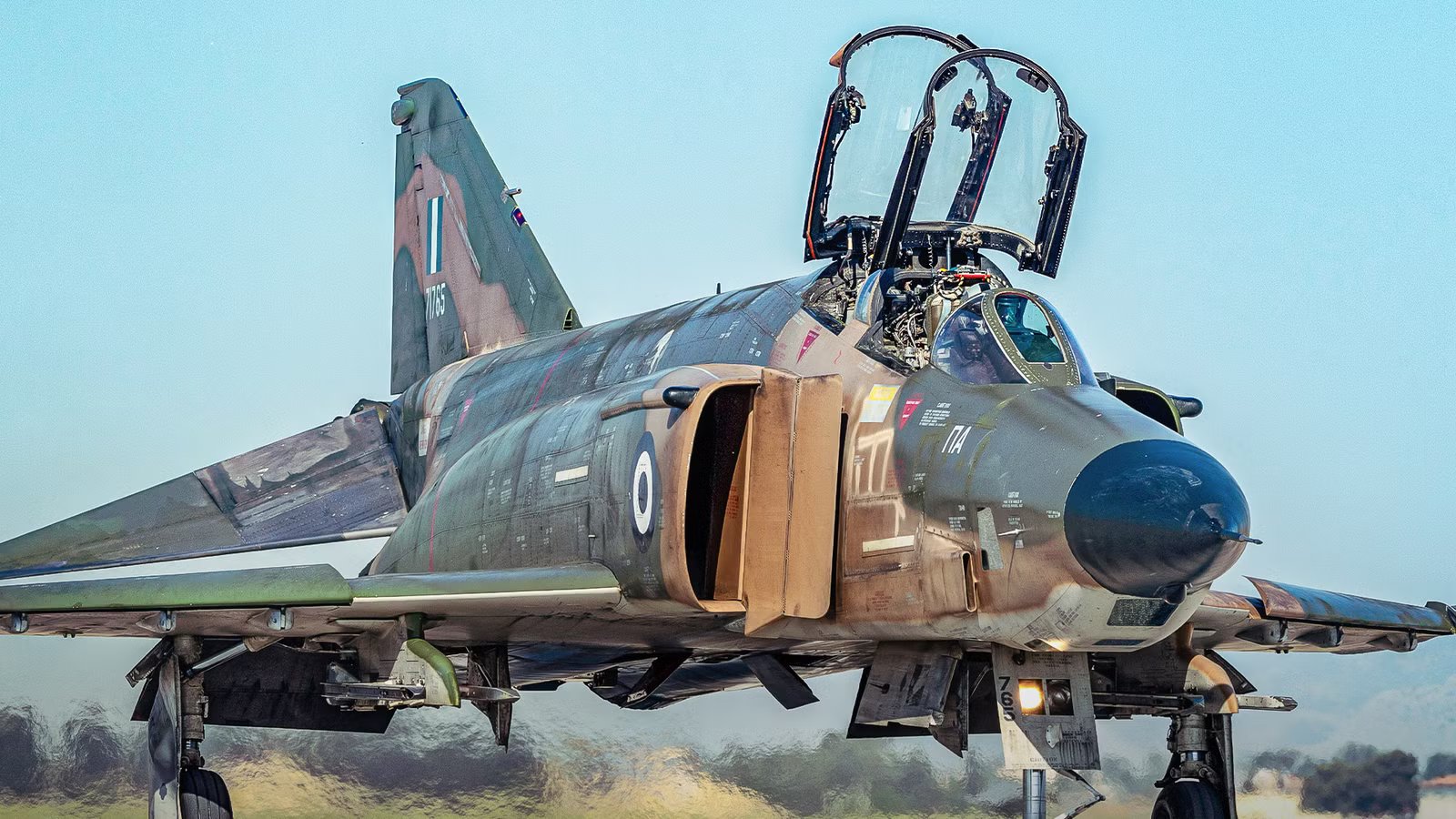
The McDonnell Douglas F-4 Phantom II was the most mass-produced supersonic fighter jet ever flown in the history of the United States of America. The last Phantom in service in the United States was retired in 1997, except for modified drone models. Yet, to this day, a handful of examples remain airworthy and in service with air forces such as Greece’s. Despite its checkered combat results in the skies over Vietnam after it first debuted, the Phantom was much loved by pilots and aircrew for its speed, power, and range.
The F-4 Phantom II was capable of such stunning speed that it set over a dozen world records during its first years of service. The trade-off for that eye-watering speed and power was sometimes equally impressive fuel consumption. Modern aviation shifted from aerodynamic brute force to stealth and electronics.
Aerospace engineers and military ‘top brass’ decided that burning thousands of gallons of fuel to fly at Mach 2 was incredibly expensive and inefficient. The F-4 Phantom was the apex predator of the speed and payload generation. Because modern warfare prioritized stealth over raw muscle, the military never built another heavy, non-stealthy, tri-service ‘flying brick’ quite like it.
The Triumph Of Thrust Over Aerodynamics: F-4 Phantom II

The F-4 Phantom II was essentially built around two massive turbojets. Throughout its entire production run, the aircraft was powered by the General Electric J79, with only one exception. The immensely powerful turbojets that allowed the Phantom II to achieve its performance were revolutionary in their time, featuring a technology called ‘variable stators’ that allowed the engine to adapt to different conditions and performance profiles.
Before the J79, jet engines suffered from compressor stalls when changing speeds quickly at high altitudes. The J79 solved this by introducing stator vanes that changed their angle automatically based on airspeed and altitude. These internal compressor blades allowed the engine to safely squeeze and compress massive amounts of air across a wide performance envelope. The Phantom did not use one J79; it used two. Together, they generated nearly 36,000 pounds of thrust in afterburner.
In the late 1950s and early 1960s, this level of power in a tactical fighter was unprecedented. It allowed a massive, 40,000-pound aircraft to shatter 16 world speed, altitude, and time-to-climb records, including reaching a top speed of Mach 2.23. Before the F-4, fighters relied on lightweight, nimble handling, as with the MiG-17. The F-4 changed the rules: if a pilot got into trouble, they didn’t try to out-turn the enemy; they engaged the afterburners and simply out-climbed and out-accelerated everyone else, weaponizing sheer energy.
How Many F-4 Phantoms Are Left?
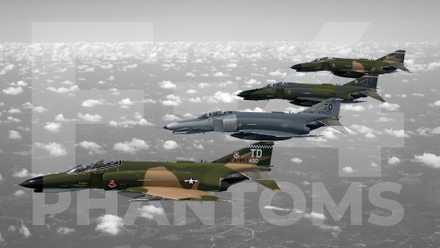
Almost 100 McDonnell Douglas F-4 Phantom IIs are still in service around the world today.
The Phantom’s Successor: Modern American Air Power

The legacy of the F-4 Phantom II is defined by its role as the template for the modern multirole fighter, establishing a design philosophy in which a single airframe could perform air-superiority, long-range interception, and ground-attack missions. No single aircraft since has simultaneously matched its footprint across multiple branches of the military. Even modern joint programs like the Lockheed Martin F-35 Lightning II require three completely different variants to satisfy each branch: the F-35A, B, and C.
Catch what other flight trackers miss
Emergency squawks, holds, NOTAMs — live signals, no signup.
Open tracker
Catch what other flight trackers miss
Emergency squawks, holds, NOTAMs — live signals, no signup.
Open tracker
The F-4 was an interceptor that was aggressively forced into becoming a multirole fighter-bomber. It could carry 18,000 pounds of weapons, or more than a WWII Boeing B-17 Flying Fortress. When it retired, its massive job description had to be broken up and distributed among separate aircraft types. The McDonnell Douglas F-15 Eagle succeeded in its role as a fighter-interceptor for the USAF, while the Grumman F-14 Tomcat took over for the Navy.
The General Dynamics F-16 Fighting Falcon became the true successor of the multirole platform used by a wide range of Air Forces around the world. The McDonnell Douglas F/A-18 Hornet, and later the Boeing Super Hornet, was also a successor to the multirole mission pioneered by the F-4, serving the USN primarily, but also international air forces like Switzerland and Australia. While the F-35 Joint Strike Fighter is officially meant to replace legacy multirole fighters like the F-4 and F-16, many argue it is not a true successor to the F-4 Phantom due to fundamental differences in design, performance, and tactics.
The F-4 Phantom earned the nickname ‘The Bomb Truck’ as it went from a fleet interceptor to a dogfighter, a heavy bomber, and a specialized radar-hunter, or ‘Wild Weasel.’ The F-35, by trying to satisfy every branch of the military from day one, had to accept major design compromises. Because of these drastic engineering differences, a Marine F-35B cannot easily share major structural components or maintenance pipelines with a Navy F-35C. The F-4 accomplished true tri-service uniformity; the F-35 achieved it mostly in name only.
The Phantom’s Record Production Streak

The F-4 was originally procured by the US Navy but later went on to be the primary fighter platform for the US Air Force and the US Marine Corps. Among the aircraft made by McDonnell Douglas, which include the F-15 Eagle, A-4 Skyhawk, and F/A-18 Hornet, the F/A-18 Hornet’s production run vastly overshadows that of the other two, nearly equaling the total production of all three of these equally iconic fighter jets. When the last example, an F-4EJ, rolled off the line at Mitsubishi Heavy Industries in Japan, the grand total came to 5,195 produced.
The only factory outside St. Louis, Missouri, that produced F-4 Phantoms was the Mitsubishi Heavy Industries facility in Japan. Of the 140 F-4EJ models, 138 were produced in Japan for the Japan Air Self Defense Force. Meanwhile, in the United Kingdom, there was no factory for the Phantom, but both the Royal Navy and the Royal Air Force installed Rolls-Royce Spey turbofan engines that were more powerful and larger than the General Electric J79s.
Of the total number produced, there were several variants. The initial USN and USMC F-4Bs were designed to fly high and fast with long-range missiles as their primary weapons. That design proved unreliable and impractical on a battlefield with complicated rules of engagement and real-world conditions that prevented the perfect performance of missiles in combat. It wasn’t until the F-4E in 1967 that the M61A1 Vulcan Gatling cannon would be integrated into the nose of the jet. This variant would go on to be the most popular, with 1,370 being made.
The F-4E was considered the ultimate version thanks to its internal gun as well as the leading-edge slats installed on later models, which significantly improved its maneuverability in dogfighting. The Phantom’s speed and heavy payload dwarfed those of its competitors in the 1960s, and it proved to be a highly versatile platform. The Phantom holds the unique honor of being the only jet flown by both flight demonstrations of the USAF and USN’s Thunderbirds and Blue Angels, respectively.
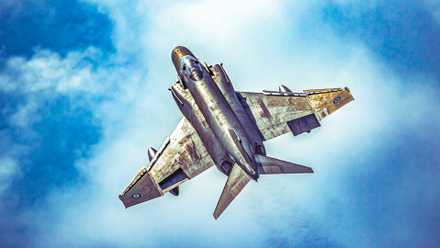
Is It True That The F-4 Phantom Is A Long-Range Supersonic Fighter?
For a period the F-4 was the workhorse of US airpower able to fill many roles thanks to its large aircraft, range, and supersonic flight.
F-4s Across The Pond: The Other Phantom II

There was one particularly powerful outlier in the F-4 variant roster, one that was exclusively flown by the United Kingdom. This aircraft was specifically designed to use the Spey turbofan, which was more powerful but had a lower top speed due to higher drag. The reason for the engine swap was to give the F-4K enough extra ‘punch’ to make it off the short deck of the HMS Ark Royal, which used a ‘ski ramp’ configuration as opposed to the catapult found on US Navy aircraft carriers.
The F-4K produced 12,150 pounds of thrust in cruising conditions with no afterburners and maxed out at 20,515 pounds of thrust running at full military power. To fit the larger Spey engines, the F-4K required massive structural changes that the F-4E did not need. Because of the extra drag from the larger intakes and the Spey’s temperature limitations at high speeds, the F-4K was limited to roughly Mach 1.9, while the F-4E could comfortably hit Mach 2.2 or more.
Specification | F-4B (Navy) | F-4E (USAF) | F-4K (Royal Navy / FG.1) |
|---|---|---|---|
Engine Type | 2 x GE J79-GE-8A/B/C | 2 x GE J79-GE-17 | 2 x RR Spey 203 |
Max Thrust (ea) | 17,000 pounds-force (75.6 kN) with afterburner | 17,900 pounds-force (79.6 kN) with afterburner | 20,515 pounds-force (91.3 kN) with afterburner |
Max Speed | Mach 2.23 / 1,472 miles per hour (2,369 km/h) | Mach 2.23 / 1,472 miles per hour (2,369 km/h) | Mach 1.9 / 1,386 miles per hour (2,231 km/h) |
Internal Fuel | 1,986 US gallons (7,518 L) | 1,994 US gallons (7,548 L) | ~5.84 imperial tons (5,934 kg) in main tanks |
Total Fuel (Max) | 3,328 US gallons (12,598 L) | 3,335 US gallons (12,624 L) | ~7.69 imperial tons (7,813 kg) including drop tanks |
Combat Radius | 400 miles (644 km) | 367 nautical miles / 422 miles (680 km) | 550 miles (885 km) approximately |
Max Range | 2,300 miles (3,701 km) | 1,885 miles (3,034 km) | 1,750 miles (2,816 km) |
Service Ceiling | 62,000 feet (18,898 m) | 62,250 feet (18,974 m) | 57,200 feet (17,435 m) |
The engine required a 20% greater air intake and increased the frontal profile, but produced 10% more thrust than the F-4E. Notably, owing to its more modern design, the F-4K’s Spey engines were roughly 10% to 15% more fuel-efficient than the F-4E’s J79s during subsonic cruise. But its high-thrust takeoff also used a massive ‘gulp’ of fuel right at the start of the mission.
Newer engines gave the British Phantom better ‘loiter’ time, which was crucial for Royal Navy carrier patrols. Yet, due to its higher thrust output and greater air volume intake, turning on the afterburners of the Spey engines could actually drain the fuel tanks of the F-4K faster than the F-4E would with its J79. The ski-jump launches slightly offset its cruising efficiency, which meant the F-4E would often have the same or better actual endurance time.