dailynewsnblog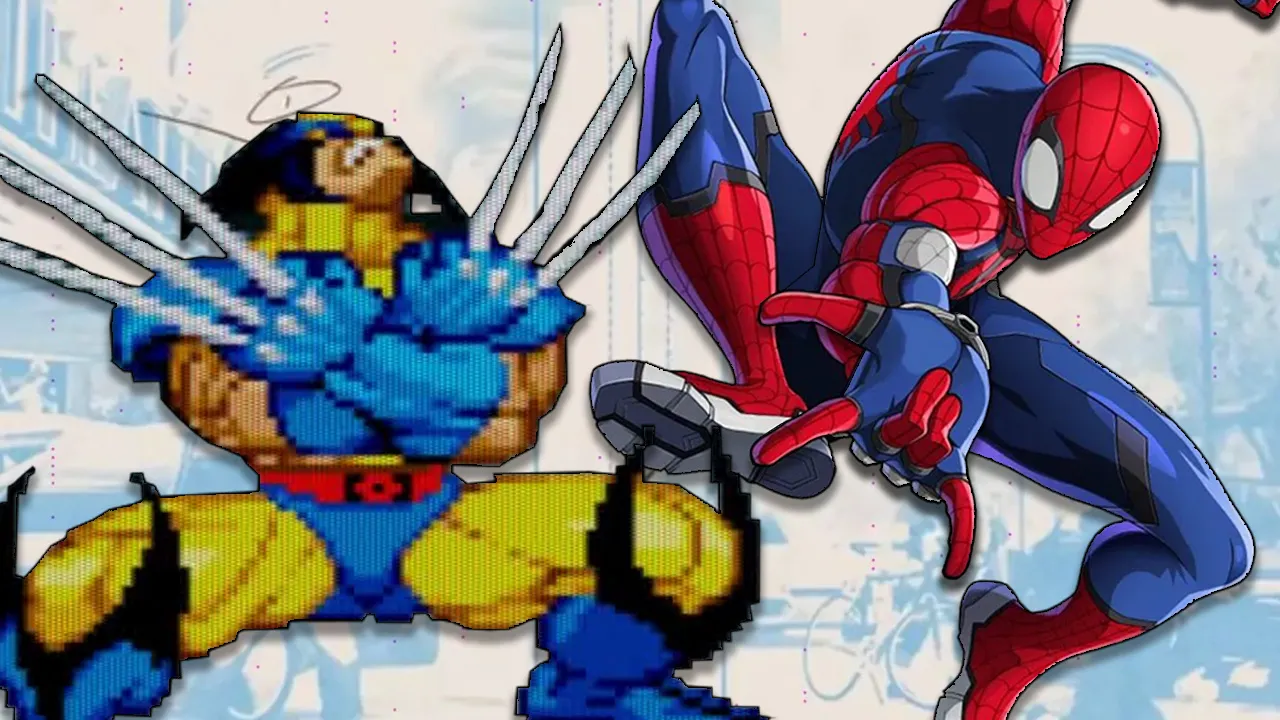
Marvel Comics and video games have had a long, storied, and oftentimes turbulent relationship. Spanning a variety of genres, Marvel games have taken us to many different places, from the thrilling open worlds of Insomniac’s Spider-Man series to the terrible beige-tinged shooting galleries of Punisher No Mercy. But there’s one genre in which Marvel Comics has seen undeniable success: fighting games.
Marvel has been in the business of kicking ass in 2D arenas for over three decades, and in that time we’ve seen many twists, turns, smash hits, and fumbles. So buckle up, true believers, as we take you for a ride through the evolution of Marvel fighting games.
X-Men: Children of the Atom (1994)
The early ‘90s were not a great time for Marvel. Despite successful X-Men and Spider-Man comic runs (and their beloved accompanying Saturday-morning cartoons), a series of costly business blunders and an industry bubble burst left Marvel filing for bankruptcy. It famously turned to flogging everything that wasn’t nailed down to keep the Arc Reactor powered up.
In contrast, fighting game aficionado Capcom was flying high. Street Fighter 2 was munching quarters left and right, and arcades were flooded with copycats.
After a successful collaboration on a Punisher beat-em-up that earned critical acclaim thanks to its satisfying, meaty combat, Marvel and Capcom – in an effort to capitalise on the success of the Street Fighter formula – decided to work together on the very first fighting game starring Marvel characters, X-Men: Children of the Atom.
Despite being built on the bones of Street Fighter 2 Turbo, this was no simple re-skin. Gone were the World Warriors, and in was a roster of Earth’s mightiest mutants. The simple fireballs and firebreath attacks of Capcom’s prize fighter no longer felt adequate, so new special moves were introduced, dominating the screen with strobes and particle effects that were more befitting of the superheroic cast.
But it wasn’t just extra spectacle that was needed. Children of the Atom also introduced a unique take on combos and movement. It was significantly speedier compared to Capcom’s previous fighters, altering the rhythm of the action by a considerable degree. Along with added super jumps and air combos, these X-gene influenced adjustments helped Children of the Atom quickly carve out its own identity in the fighting game space.
Even the most cynical fighting game fans responded well to this formula shake-up, positioning Children of the Atom as the hottest new fighting game when it arrived in 1994. It was just as technical and complex as Street Fighter, but far more approachable for newcomers. The design proved so successful that PlayStation, Sega Saturn and MS-DOS systems all saw ports of the arcade hit. This popularity allowed Capcom to follow up with Marvel Super Heroes, which built on the principles of Children of the Atom and further refined them, expanding the roster to include more Marvel characters beyond the X-Men.
Avengers in Galactic Storm (1995)

While the Osaka-based Capcom was experiencing huge success with its new comic book fighting formula, a few hundred miles away in Tokyo, developer Data-East was putting together its challenger. A year later it stepped up to the plate with Avengers in Galactic Storm, an obscure fighting game that is now largely forgotten, lost in the sea of fighting-game hopefuls that filled Arcades in the mid-to-late ‘90s.
Despite its lack of success, Avengers in Galactic Storm was the first game to introduce a mechanic that would go on to form the backbone of an entire sub-genre of fighters: the Assistant Character. When selecting your character, you’d be presented with a second unique roster of characters – this would be your “assist”.
Today, we see assistant characters as a foundational mechanic for any “tag-fighter”, but back in 1995 the idea was completely revolutionary, despite being pretty basic compared to the tag-team mechanics of today. Back then, your assistant character had one move tied to your super meter; upon activation, they’d spring onto the screen and perform this signature attack. It was a simple addition, but as an idea, it grew and blossomed into a fundamental mechanic we frequently see today.
A roster full of nobodies and garish graphics meant that Avengers in Galactic Storm quickly disappeared from the fighting game scene. Although its death was swift, it left a significant impression on what was to come…
X-Men vs. Street Fighter (1996)
After only two years of partnership, Marvel and Capcom took another bold swing with X-Men Vs. Street Fighter, once again evolving the format with a new feature that would impact the fighting genre for years to come. X-Men Vs. Street Fighter expanded the battle from 1v1 to 2v2 while pairing two titans of pop culture. (We’ve mentioned the title twice now, so you probably already know the two franchises involved.)
The Street Fighter cast, although themselves somewhat supernaturally powered, were fairly grounded compared to their mutant rivals. To remedy this imbalance, Capcom gave the World Warriors a significant upgrade. Super fireballs were turned into Dragon Ball Z-style beams, rising uppercuts became erupting pillars of flame, and every strike seemed to cause the hit counter to skyrocket.
The addition of a second character wasn’t a revolution for the genre; King of Fighters had made 3v3 the core of its identity since 1994. But where KoF operated in a team battle style, where you used a character until they were eliminated, X-Men Vs Street Fighter was the first to present your characters as a unified team. Switching at any time was actively encouraged, as your tagged-out character could restore their health while your second hero fought on. It was the first time in the genre that health was recoverable, and it gave you a vital reason to keep switching. Your teammate could even be tagged in directly when performing a duo-hyper combo, summoning them in to perform their signature move alongside your own, causing high damage and flashy visuals.
The tag system and refined combos that Capcom had been tinkering with since Children of the Atom helped create an arcade darling. Players lined up quarters and a competitive scene blossomed around the game, with fans eager to push the limits of what could be done in the arena.
Marvel vs. Capcom: Clash of Super Heroes (1998)
After a slight misstep in 1997 with Marvel Super Heroes Vs Street Fighter, which disappointingly recycled content from past games while reducing the spectacle, Capcom’s next swing managed to recapture the magic of Marvel while also exploring beyond the boundaries of Street Fighter. In 1998 we were treated to the oft-celebrated Marvel Vs. Capcom: Clash of Super Heroes.
At the time, Clash of Super Heroes’ gameplay was widely considered to be the formula perfected, combining all the lessons Capcom had learned since beginning its Marvel partnership. The combos and hypercombos reached new heights of effects-driven spectacle. The addition of special partner and duo team attacks, which gave you a limited-use partner attack akin to the Assistant Character from Avengers, and the ability to pilot both of your characters at the same time added new wrinkles to master.
These additions became the extra spice required to make Clash of Super Heroes stand out among the fighting game crowd. But there was one additional feature that really sparked the game’s popularity: While special partners were randomised by default, through a hidden code, you could select a specific character to bolster your strengths or cover your weaknesses. Thanks to this important addition, competition around Marvel Vs. Capcom: Clash of Super Heroes exploded. Capcom once again struck on a formula that fighting game fans not only loved, but were willing to invest in.
Marvel vs. Capcom 2: New Age of Heroes (2000)
Due to the success of Marvel Vs. Capcom, everyone was keen for another return of the format. Feeling that it had reached the ceiling with what it could do with 2v2, Capcom decided to shake up the series with the sequel.
Marvel vs Capcom 2 took the next logical step when it smashed into arcades in the year 2000: it upgraded its 2v2 format to 3v3. Special partners were also removed in favour of a new version of the assist system, and the roster skyrocketed from just 15 characters to a massive 56. Most immediately obvious, though, was that the game completely switched its visual aesthetic to a more generic style, removing the Capcom and Marvel iconography it had used in the first game. As if that wasn’t enough changes already, Marvel Vs. Capcom 2 also featured a complete overhaul of its controls. With so much significant change, it was perhaps inevitable that fans initially hated it. En masse, a large portion of hardcore fans immediately opted to go back to the original Marvel vs Capcom.
Some stuck with it, though, experimenting with this complete reinvention and discovering that there were near-endless tactical possibilities. The new assist system invited players to build their teams around not just what their characters could do when they’re on point, but what they could do as an assist. Each of the 56 characters had three assist modes, all with specific attacks. With three characters on a team, the combo possibilities began to feel truly limitless. Arguably better than any fighting game before it, Marvel Vs. Capcom 2 truly let you build your own identity as a competitive player.
Onlookers began to notice dedicated players performing wilder and wilder combos. They became entranced by the incredible speed of the gameplay. Suddenly, the wider fighting game community started to come around. Now, in 2026, Marvel vs Capcom 2 is widely regarded as one of the greatest fighting games of all time and is still played competitively today, 26 years later.
Marvel vs Capcom 2 would, however, be the last in the series to release in arcades. Home consoles were becoming more sophisticated, and the days when the arcade was the best place to play were coming to an end. Series like Tekken, Soul Calibur and Mortal Kombat had successfully navigated the switch from the arcade scene to the living room, but Capcom had so far not been as fortunate. The success of titles like Resident Evil and Devil May Cry at home was outpacing its ports of arcade fighters, and as a result, Capcom decided to partially retreat from the fighting game scene.
Marvel vs. Capcom 3: Fate of Two Worlds (2011)
The 2000s saw few attempts to pick up where Marvel vs Capcom 2 left off, with games like X-Men Next Dimension fusing 2D game mechanics with 3D environments and yielding middling results. Capcom largely sat out of developing new fighting games at the end of the sixth console generation. But with a new generation on the horizon, it decided to return in a big way. 2008’s Street Fighter 4 burst onto the scene with a bold new art direction and a back-to-basics setup with new mechanics. It was a smash hit out of the gate, demonstrating there was a whole new generation of fighting game fans and competitive players ready to reignite the genre.
The time apart had also been fruitful for Marvel, which was experiencing unprecedented success with its cinematic universe. The stars had once again aligned, and it was the perfect time for the return of Marvel vs Capcom.
Marvel vs Capcom 3’s arrival was hotly anticipated, and Capcom felt immense pressure to deliver on fans’ expectations. Although the character roster was smaller than Marvel Vs. Capcom 2’s ludicrous 56 heroes, the developer focused on delivering a wishlist of characters who’d previously not made the cut. MvC 3 would finally introduce long-requested fighters such as Dante, Deadpool, and Wesker.
Marvel Vs. Capcom 2’s lofty status meant Capcom elected to keep the game as close in feel to its predecessor as it could, refraining from altering the formula while adding enough new elements to sweeten the pot. Additions like aerial tag combos, which let you link from one character to another, blended seamlessly into the existing systems, making it feel like they’d always been there.
There was one addition, though, that would prove controversial.
X-Factor was the newly introduced comeback mechanic, providing a speed and damage boost where the duration and effectiveness was proportional to the number of characters you had left on your team. X-Factor activation could happen at any time and would cancel any animation, resulting in specific X-Factor combos that could destroy an enemy life bar, but also open the door to comebacks where a single character could decimate an entire team. While it added a certain level of volatility to the game, heightening the excitement, purists took issue with the addition of a comeback mechanic. It was a minor setback in what was generally considered to be another fighting game masterpiece.
A second, “Ultimate” version of Marvel Vs. Capcom 3 would release less than 11 months later and include an all-new balance patch, new UI, new characters, and new stages. But it was a new, budget-friendly release operating outside the confines of the original, so fans who had bought the first version of MvC 3 were left out in the cold. Ultimate Marvel vs Capcom 3, while having its own merit, was seen as a bad deal for the early adopters.
Ultimate Marvel Vs. Capcom 3 became the new standard for competitive play and, over time, saw significant success. But due to the nature of the Ultimate edition and its poor sales, Capcom deemed it as somewhat of a failure and once again allowed the Marvel license to expire.
Marvel vs. Capcom: Infinite (2017)
Ultimate Marvel vs Capcom 3 would become a staple of fighting game events, but fans still yearned for something new. In 2017 they would get their wish, but not quite in the way they’d hoped.
Marvel Vs. Capcom Infinite was a bold new direction for the series that restored its 2v2 roots, brought back the Infinity Stones from Marvel Super Heroes, reinvented the battle mechanics and, for the first time ever, introduced a full cinematic story mode.
The new battle system was a dramatic shift from the past, completely upending the assist system in favour of “Active Tag”. Previously, tagging in an ally safely required very careful spacing and timing, as the incoming character would perform a pose before being able to block. The new Active Tag system was more generous, allowing you to quickly swap your point character, provided you were not being hit or blocking. The Infinity Stones took the place of the third team member, offering a standard “Infinity Surge” and a super “Infinity Storm” attacks. Using Infinity Surge and taking damage would fill your Storm meter, and each of the six Infinity Stones would offer unique attributes based on their namesake.
While met with skepticism, fans were ready to take their favourite heroes and villains for a spin with this new system… provided they were still available, that is. Because of the ongoing success of the MCU, Marvel Vs. Capcom Infinite was more closely aligned with the silver screen roster of the time, which meant none of the X-Men or Fantastic Four. This was long before the MCU’s awkward Multiverse Saga.
These missing fighters had already disappointed many in the leadup to release, and others quickly followed thanks to the abandonment of the series’ striking comic book aesthetic in favour of a more semi-realistic art style.
Capcom was once again on the back foot, a situation only made worse when Arc Systemworks, developers of the BlazBlue series, revealed Dragon Ball FighterZ; a 3v3 tag-fighting game, featuring fan-favourite Dragon Ball characters, that not only used a bold anime-inspired art style, but also borrowed many of Marvel Vs Capcom’s mechanics. Here was a direct competitor that not only looked better, but also felt familiar to fans of old-school Marvel vs Capcom. The unsettled audience quickly moved on from MvC Infinite, which, in turn, ended its post-launch support only 3 months after launch.
That’s not to say Marvel Vs. Capcom Infinite was without merit, though. The Active Tag mechanic allowed players incredible freedom to approach encounters and to structure combos. But the surrounding package and poor visuals under-delivered, and interest in the series waned. Marvel Vs. Capcom Infinite was the first in the series to skip the main stage of fighting game tournament Evo in 2018, something previously considered unimaginable. Marvel vs Capcom, once a titan of the genre, had been dethroned.
Marvel Tokon Fighting Souls (2026)
All hope is not lost for Marvel fighting game fans, though. In June 2025, during PlayStation’s State of Play showcase, Arc Systemworks, developers of Dragon Ball FighterZ, shocked the world by announcing Marvel Tokon Fighting Souls. The first Marvel fighting game in nearly a decade, it’s also the first ever 4v4 fighting game.
It’s early days for Marvel Tokon Fighting Souls, but the signs look extremely positive, suggesting this could be the evolution of the formula we’ve desperately been waiting for. The pedigree is there, and the modern alterations lead us to believe Marvel Tokon will be a unique take on the Marvel fighting game formula, blending the successes of the past with fresh ideas for the genre that will hopefully lead it into the future. And with an already locked-in appearance at Evo France in October 2026, the competitive future is looking bright.
From the humble beginnings of X-Men Children of the Atom to the unexplored reaches of 4v4 in Marvel Tokon Fighting Souls, the journey Marvel fighting games have taken has been full of dizzying highs and terrifying lows. But with Marvel Tokon primed for release on August 6, we’re excited to see what the next step looks like. One thing we know for sure is that there’s a dedicated Marvel fighting game fanbase that’s more than ready to assemble.
Written by Jack Gash, IGN’s UK Syndication Editor and fighting game obsessive.