dailynewsnblog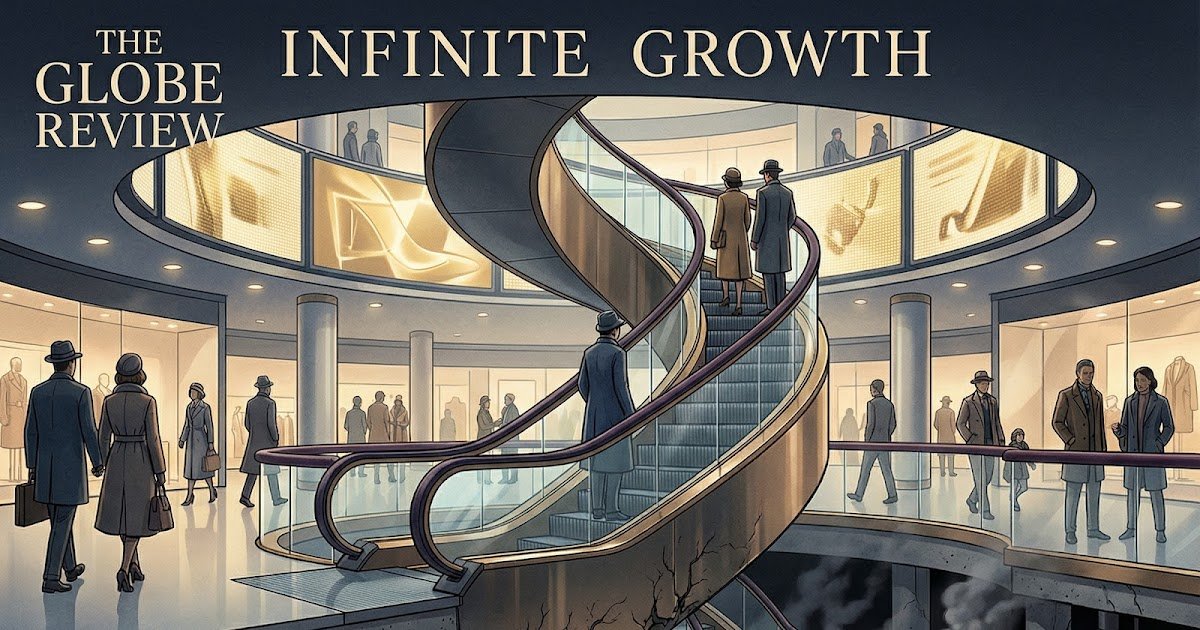

How the enchantments of consumer society keep us attached
to a failing world-system
There is something eerie about living in a civilization that
cannot stop doing what is destroying the conditions of its own survival.
Every day, the machine whirs on. Planes take off. Data
centers hum. Supply chains pulse. Platforms refresh. Markets open. New products
appear. Old ones are discarded. Forests burn. Oceans warm. Extraction deepens.
The atmosphere thickens. And still the dominant instruction remains unchanged:
grow, consume, expand, optimize, repeat.
We are told this is realism. We are told this is simply how
the world works. We are told there is no alternative to an economy built on
accumulation, mass consumption, and fossil-fueled growth. Yet the deeper one
looks, the less this order appears realistic — and the more it appears absurd.
I have been thinking of a phrase for this condition: modern
futility.
By modern futility, I mean the condition in which a
civilization continues to organize itself around goals that are materially
impossible, spiritually hollow, and politically resistant to correction, even
when their failure becomes increasingly visible. Modern futility is not just
pessimism. It is not merely a feeling of burnout or alienation. It is the
structural contradiction of a world that keeps accelerating toward outcomes it
cannot survive, while remaining emotionally, culturally, and institutionally attached
to the very patterns driving the crisis.
On one level, modern futility names the futility of the
system itself. It is futile to build an economy on the fantasy of infinite
accumulation on a finite planet. It is futile to organize collective life
around ever-rising throughput of energy and materials when the biosphere that
absorbs the waste and supplies the inputs is under mounting strain. It is
futile to imagine that endless expansion can be reconciled with ecological
limits simply because the machinery of finance and technology is sophisticated
enough to postpone visible breakdown for another quarter, another election
cycle, another news cycle.
The contradiction is obvious once stated plainly. A
civilization cannot indefinitely expand material consumption while undermining
the ecological basis that makes civilization possible. Yet modern societies
treat this contradiction as negotiable. They frame planetary limits as market
challenges, innovation gaps, or policy inconveniences. They speak the language
of adaptation while preserving the underlying logic of the system. The result
is a bizarre spectacle: an order that presents itself as rational while
behaving irrationally at the highest level.
But modern futility has a second dimension, and this one may
be harder to confront. It is also the futility that emerges in resistance to
the system. It is the dawning recognition that it is extraordinarily difficult
to persuade people who are enthralled by the enchantments of late-stage
capitalism that fundamental change is necessary.
This is not because people lack intelligence. Nor is it
simply because they lack information. Many people know, at some level, that
something has gone profoundly wrong. They know the climate is destabilizing.
They know endless consumption is hollow. They know the social fabric is
fraying. They know that convenience has become a form of dependency and
distraction. But knowledge alone does not break enchantment.
That is where an older idea becomes surprisingly useful.
In 1928, Paul H. Nystrom, a Columbia University marketing
professor, published Economics of Fashion, coining the phrase “philosophy
of futility” to describe a modern disposition shaped by industrial life:
boredom, narrowed interests, weakened larger purposes, and a resulting appetite
for novelty, fashion, and goods whose attraction lies less in utility than in
stimulation and change. Nystrom saw that consumer culture was not driven only
by need. It was also driven by a restless, unsatisfied psychology that could be
continually reactivated by new commodities and shifting styles.
What Nystrom diagnosed in the early twentieth century now
looks less like an observation about fashion and more like an early diagnosis
of the consumer self under capitalism. He understood that a society emptied of
richer forms of meaning could become increasingly dependent on novelty as
compensation. People would not merely buy what was needed. They would buy
because dissatisfaction itself had become productive — because boredom and
emptiness could be converted into demand.
That insight lands with even greater force today. In our
time, the old philosophy of futility has become digital, financialized, and
embedded in the infrastructure. The cycle is no longer confined to clothing,
décor, or periodic fashion trends. It has expanded into feeds, devices,
subscriptions, self-branding, lifestyle optimization, platform migration,
algorithmically induced desire, and the endless production of minor
dissatisfaction. The system no longer waits for boredom. It manufactures it,
tracks it, and monetizes it.
This is why I think we need the broader phrase modern
futility.
Nystrom’s phrase helps explain the psychology of the
consumer. Modern futility helps explain the logic of the civilization that now
depends on that psychology. It is no longer only a matter of people buying too
much because they are spiritually undernourished. It is a matter of a
world-system that requires perpetual agitation of desire in order to sustain an
economically normal order that is ecologically pathological.
In this sense, modern futility is closely tied to what I
have elsewhere called imperial capitalist modernity. The capitalist
element matters because accumulation has no internal stopping point. The
imperial element matters because the costs of this arrangement are unevenly
distributed, displaced onto sacrifice zones, exploited populations, future
generations, and other-than-human life. The modern element matters because the
whole arrangement continues to justify itself in the language of development,
innovation, and progress. The story remains triumphant even as the material
reality grows more brittle.
And this is where the concept becomes especially sharp.
Modernity often presents itself as disenchanted, pragmatic, sober, and
scientific. Yet late modern societies are not free of enchantment. They are
saturated by it. Commodity enchantment. Technological enchantment. Financial
enchantment. The enchantment of convenience. The enchantment of speed. The
enchantment of personalized identity performed through consumption. The
enchantment of being connected to everything while feeling rooted nowhere.
People do not merely assent to this order intellectually.
They inhabit it sensually. They derive pleasure, status, orientation, and
relief from it. Even when they can see its destructiveness, they remain caught
within its infrastructure of rewards. This is why argument alone so often
fails. One is not simply debating propositions. One is contending with a system
that organizes desire itself.
This is the real force of modern futility. It describes not
just a broken economic model, but a civilizational loop. The system is
unsustainable, yet it continues to produce the attachments that sustain it. It
is self-undermining, yet still affectively compelling. It is visibly
destructive, yet remains difficult to leave behind. It kills the world while
continuing to glitter.
To say this is not to surrender to despair. Naming futility
clearly is not the same as embracing it. In fact, it may be the beginning of a
more serious realism.
If the problem were simply ignorance, then more information
would solve it. If the problem were simply policy, then better regulation would
be enough. If the problem were simply greed, then moral denunciation might
suffice. But modern futility points to something deeper. It suggests that we
are dealing with an entire structure of meaning, desire, habit, infrastructure,
and enchantment. That means any serious alternative must be more than critical.
It must also be generative.
People cannot be expected to detach from the enchantments of
late capitalism only by being told to consume less, want less, travel less, and
shrink their aspirations. Another way of living must become sensually and
socially real. It must offer dignity, beauty, belonging, and a different kind
of enchantment, one not organized around extraction, stimulation, and status.
Critique can unmask the present order. But only a more compelling form of life
can loosen its hold.
Perhaps that is the deepest challenge. The current order is
both impossible and seductive. It is a civilization of overshoot sustained by
infrastructures of fascination. Its failures are increasingly plain, yet its
enchantments remain powerful. That is why modern futility names both a
diagnosis and a threshold. It describes the point at which the reigning logic
no longer deserves our faith, even if it still commands our habits.
Nystrom saw, nearly a century ago, that an impoverished
philosophy of life could feed an economy of endless novelty. We are now living
inside the planetary expansion of that insight. The philosophy of futility has
scaled up. It has become modern futility: the condition in which a civilization
continues, with immense technical sophistication, to reproduce forms of life
that are incompatible with its own future.
And perhaps the first step is simple, though not easy.
Stop calling modernity progress.