dailynewsnblog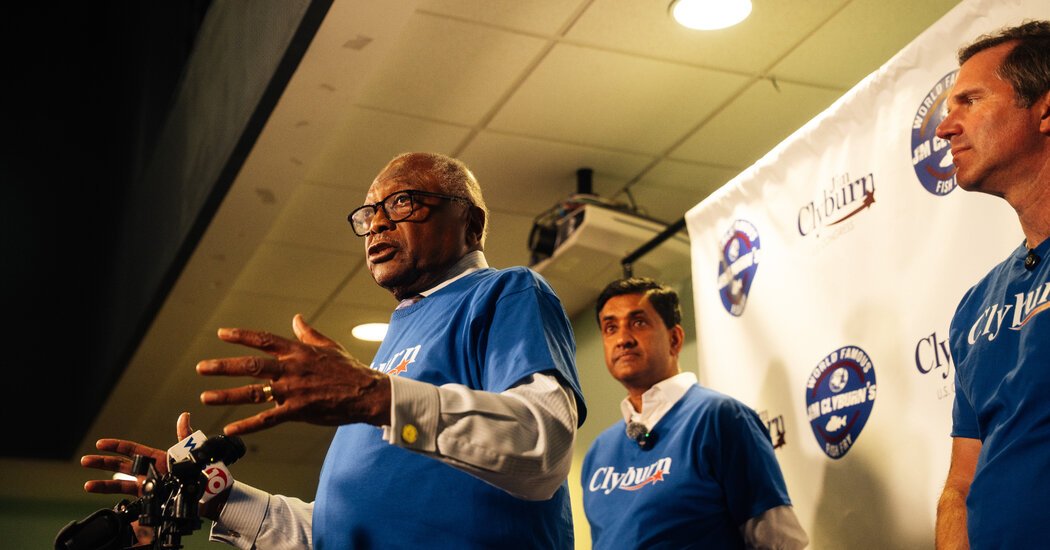
South Carolina Democrats at Representative James Clyburn’s “World Famous Fish Fry” on Friday were feeling triumphant.
Mr. Clyburn, South Carolina’s longest serving Black lawmaker and the state’s lone Democrat in Congress, had survived a failed redistricting attempt by state Republicans determined to act after the Supreme Court weakened protections under the Voting Rights Act for majority-Black districts. So as the sun set on a terrace above the Congaree River, in Columbia, a crowd of Black women line danced to 803Fresh’s “Boots on the Ground,” while hot grease popping in deep fryers sent a thick smell of fish through the late-spring air.
But the next act in the drama over Black representation will be driven in part by Democratic leaders, some of them Black, who face a difficult decision. Do they preserve the majority-Black, overwhelmingly Democratic districts in blue states like New York, Illinois, Maryland and New Jersey? Or do they maximize Democratic representation in the House by diluting urban districts dominated by Black voters and expanding their boundaries into the suburbs. Doing the latter would allow them to target Republican House members in those states.
Those new districts would remain Democratic, though less so, but they may no longer be majority-Black. So Black voters could lose power in two ways — by losing the number of districts they dominate and by losing the number of Black voices in Congress.
It could be an agonizing choice, but with Republicans determined to maximize their own representation, many Black Democrats at the grass roots, state and federal level are firmly in the camp that the party should do what is necessary to expand its power. Black representation is important, but they consider this moment an emergency.
“We’re not going to sit back and just accept this cheating and gerrymandering,” said Representative Gregory Meeks, a close ally of fellow New Yorker Hakeem Jeffries, the House Democratic leader. Both men are Black.
In the weeks since the Supreme Court’s Voting Rights Act decision, which lowered the bar on what it considered unconstitutional racial gerrymandering, Republican states in the South have led a furious effort to dilute or eliminate congressional districts where majorities of Black voters have typically elected Democrats.
Majority-Black districts in Tennessee and Louisiana are gone. One seat long-held by a Black Democrat in North Carolina is teetering. The Supreme Court on Tuesday night gave Alabama Republicans permission to eliminate one majority-Black seat. Georgia and Mississippi are likely to target such seats ahead of 2028.
Beneath the jubilation at his fish fry, Mr. Clyburn seemed to acknowledge the anger.
“I want all of the energy that’s here tonight to be harnessed, much like we harnessed the atom in order to make the atomic bomb,” he implored the crowd from the stage.
Beyond anger, Democrats are pondering the path back to political power and how far the party should go to attain it. Mr. Jeffries last month took on maximalist tones as he rattled off seven states — New York, New Jersey, Washington, Colorado, Oregon, Illinois and Maryland — that Democrats would redistrict in response to Republicans “to wipe out any structural advantage that they’re trying to get themselves” in the South.
A central calculation will have to be the value of Black representation and whether Democrat-controlled states should protect highly concentrated urban seats in New York, Newark, Baltimore, Minneapolis and Chicago, rich in Black voters, or push the boundaries of those districts into whiter suburbs to go after Republican seats.
Mr. Meeks was clear on which way he wanted to go: “We can look at seats like mine, for example,” he said.
Redrawing districts in Long Island would mean moving voters from his overwhelmingly Democratic district in Queens into two marginally Democratic districts in the western part of the island. That would give them better chances of ousting two Republicans to the east.
“We can then win two more seats on Long Island,” Mr. Meeks said.
Likewise, pushing Democratic voters south from the heavily Black Brooklyn districts represented by Mr. Jeffries and Representative Yvette Clarke would endanger the Staten Island seat held by Representative Nicole Malliotakis, a Republican.
“We can win seats in upstate New York,” Mr. Meeks said. “We can win seats on Staten Island.”
Similarly, reconfiguring Representative Jonathan Jackson’s Democratic district on the South Side of Chicago to the south and west would push more Democratic voters into a district now held by a Republican, Representative Darin LaHood. Representative LaMonica McIver’s overwhelmingly Democratic district in New Jersey could be drained of some voters to target the swing district held by a Republican, Representative Thomas Kean Jr.
Representative Ilhan Omar’s overwhelmingly Democratic district in Minneapolis could be expanded into the Twin Cities’ Democratic suburbs, starting a chain reaction that would push Democratic voters into a district held by Representative Tom Emmer, a Minnesota Republican.
Maryland Democrats are likely to extend Representative Sarah Elfreth’s Democratic district around Annapolis across the Chesapeake Bay into the Eastern Shore to endanger the last Republican House member in the state, Andy Harris. But to do it, they may want to send some voters in Representative Kweisi Mfume’s strongly Black Democratic district around Baltimore to shore up Ms. Elfreth, who is white.
“This is not the game we want to play,” Mr. Meeks said, “but this is the game that we are compelled to play.”
The price for such moves is already playing out in Florida, where state Republicans redrew House districts to their advantage in November. The South Florida district of Representative Debbie Wasserman Schultz, a senior Democrat who is white, was redrawn to heavily favor Republicans, so she has decided to run instead in one of the remaining Democratic seats where Black voters remain powerful. That has enraged Black Democratic politicians who want to represent the seat and have demanded that Democratic leaders speak out against Ms. Wasserman Schultz’s move.
“We have been supporting every single Democratic person on the ballot, and for them not to support us in this moment is totally ridiculous, and we’re not standing for it,” former Representative Sheila Cherfilus-McCormick told The Miami Herald this week.
Mr. Clyburn was hesitant to engage in the debate. He is not just one of the most powerful Black elected officials in America; he is a fierce defender of the South, and he insisted the Republican effort to redistrict the region offends its people. The decision by South Carolina’s State Senate to leave the state’s congressional map alone, for now at least, is proof of that, he said.
“The South, I think, is doing a great job of searching for a more perfect union and getting there, and that’s what insulted some of the members of the South Carolina Republican Party,” Mr. Clyburn said in an interview.
Mr. Clyburn prides himself on the relationships he has built with South Carolina Republicans and is complimentary of those Republicans who joined Democrats to block redrawing his district. He pointed to the rebellious streak of the southern psyche, which resisted President Trump’s demand that the state gerrymander away its last Democratic House seat.
“I cannot in good conscience surrender this authority that has been preserved to, for and by the states and merely take orders from those who are not in South Carolina,” Shane Massey, the Republican leader of the South Carolina Senate, said during a May floor speech.
But Mr. Clyburn is also a student of history. And he spoke of the end of Reconstruction, when America abandoned its commitment to the southern freedmen and the courts nullified laws protecting Black civil rights.
Having a diverse Congress isn’t just good for Black people, Mr. Clyburn argued. “The value is to the country,” he said. It is essential for a legitimate multiracial democracy.
There is real trepidation about losing that racial diversity, whether it is done by Republicans or Democrats.
“Every state should be drawing maps based on their actual constituents,” said Angela Crittenden, a Black South Carolinian at the fish fry. “Our representation is minimal, and it’s because of the illegal gerrymandering of the maps, that’s historically already been enacted upon our maps in South Carolina.”
Democratic leaders say Black voices would not be silenced simply because they are moved into districts where they are no longer dominant.
“Communities that have either been marginalized or don’t have a seat at the table should always be a consideration,” Ms. Clarke, the chairwoman of the Congressional Black Caucus, said, but. she added, “we have dozens of C.B.C. members who represent districts that have very small Black populations.”
Those include Representatives Lauren Underwood of Illinois, Joe Neguse of Colorado and Lucy McBath of Georgia. The four Black Republican House members, Byron Donalds of Florida, Wesley Hunt of Texas, John James of Michigan and Burgess Owens of Utah, also fit the bill.
The gerrymandering wars would not sideline Black voices, State Senator Deon Tedder of South Carolina said at the fish fry.
On the contrary, “Black voters woke up and realized their power,” he said.
“We have to fight,” Mr. Tedder said. “Our constituents want us to fight. If we continue to sit on the sidelines and go along to get along, we will continue to lose seats, and we will continue to lose power, and we will continue to disenfranchise our own voters.”