dailynewsnblog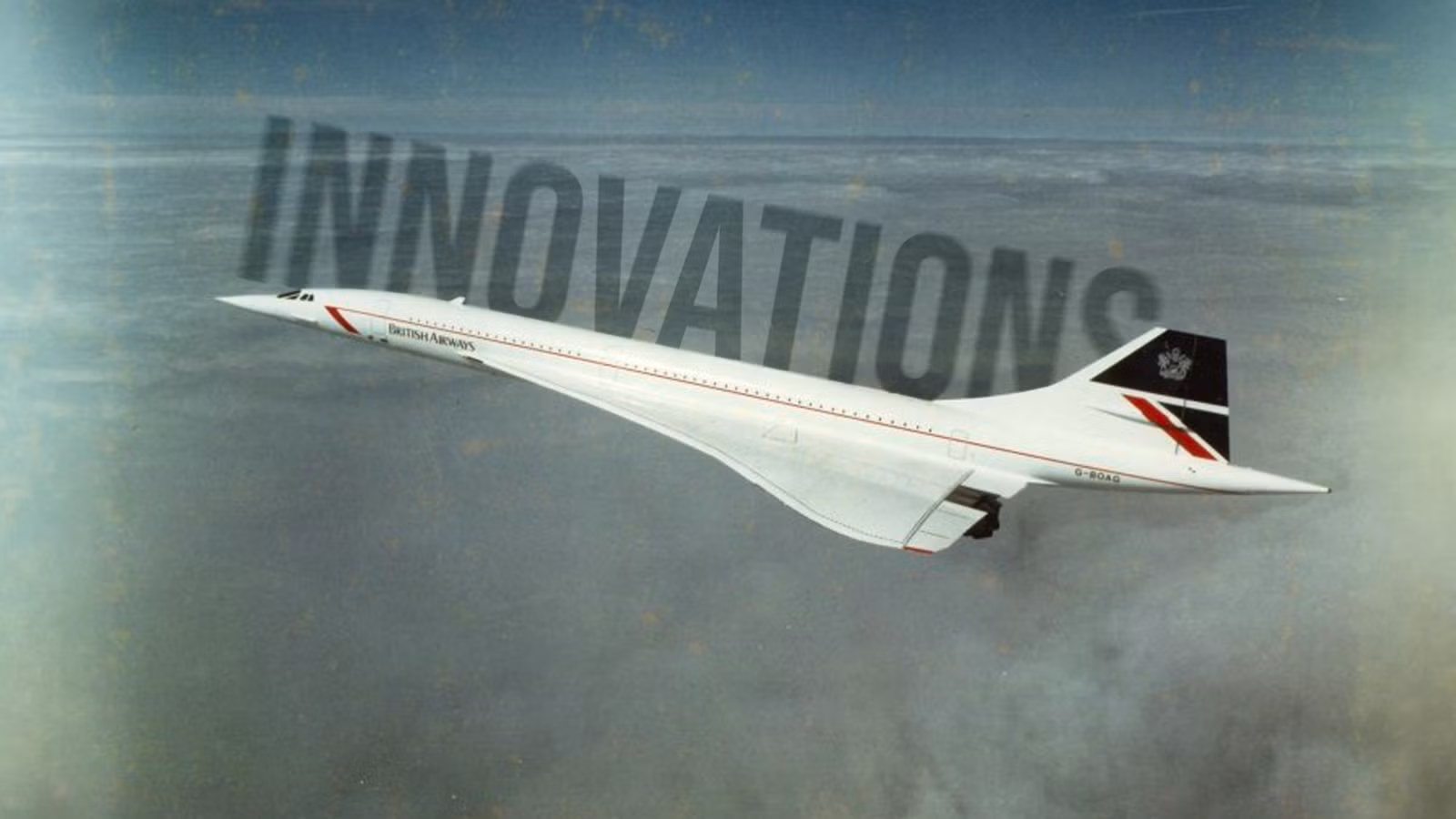
The Aérospatiale/BAC Concorde was essentially a high-performance laboratory flying at twice the speed of sound. To survive the brutal friction of Mach 2 and safely stop its massive weight on the runway, engineers had to throw out the traditional aviation rulebook. Although it may not be obvious at first, the technology developed to make legendary Concorde supersonic transport safe and efficient at Mach 2 became the baseline blueprint for every modern airliner we fly on today.
While the Concorde’s commercial supersonic travel speeds did not survive into the 21st century, its pioneering engineering completely redefined modern aviation. One of the most important elements of the Concorde design that lives on in modern jetliners is fly-by-wire controls, followed by its electronic engine controls. These replace the mechanical cables and pulleys with electrical signals and hydraulic actuators to give pilots more power and precision on the throttle.
Concorde was also the first plane to feature automatic fuel trim and center of gravity management systems, which have been applied to modern long-haul airliners with the Airbus A330, A350, and A380. It was also one of the first planes built with composite materials, carbon fiber brakes, anti-lock brakes, and even radial tires. The aircraft became the testbed for advanced landing gear and many more technologies that are now standard on every commercial airliner produced today.
Fly-By-Wire On Every Sortie

The economic model behind the Concorde was undermined by high fuel consumption, route restrictions, and immense maintenance costs, but the technology in the plane has left an indelible mark on modern aviation. Debatably, the most important innovation that resulted from the design of the iconic supersonic jet is its fly-by-wire electronic throttle control. This was crafted out of unavoidable necessity to make the jet flyable at all.
The aerodynamic forces that pilots faced when flying supersonic speeds in a passenger plane were simply too great for analog control. Before Concorde, every commercial airliner relied on heavy steel cables, pulleys, and pushrods to manually pull control surfaces in the wings and tail. At Mach 2, the aerodynamic forces hitting the plane were too violent for simple cables, and the precision required to keep the aircraft stable was beyond human reaction speeds.
Another deciding factor in the engineering decision to invest in inventing FBW was the thousands of pounds in weight savings gained by substituting steel cables and pulleys with copper wires. Concorde used a solid-state electronic system. Not only has this technology made flying safer, more precise, and easier for aircrew, but it has also been valuable in the never-ending pursuit of better fuel efficiency.
The pioneering electronic engine control system in the Concorde was developed to control its immensely powerful Rolls-Royce/Snecma Olympus 593 engines with extreme accuracy. At Mach 2, managing an engine is highly volatile. A sudden surge of fuel could cause an engine surge or flameout, destroying the engine instantly. Concorde’s electronic throttles automatically modulated fuel flow in sync with altitude, air temperature, and intake pressure to ensure the ideal throttle setting.
Staying Balanced For The Long Haul

The incredible intensity of the aerodynamic forces on the Concorde necessitated extremely precise management of the plane’s physics in flight. Throughout the full flight regime of the Concorde, its center of lift could shift by as much as six feet (two meters), which would make it extremely nose heavy if left uncorrected. To keep up with the shifting center of lift as the SST accelerated from subsonic to supersonic flight, the engineers pioneered automatic fuel trim and center of gravity management systems.
The accepted engineering solution for subsonic jetliners before the Concorde was to simply deflect rear elevators or trim tabs on the wings in order to compensate for the less pronounced shift in CoL. However, doing this at Mach 2 creates immense aerodynamic drag, which would destroy fuel efficiency and either prevent the plane from ever reaching its destination or waste an immense amount of money.
The elegant solution was to use the jet fuel as a dynamic ballast system managed by a flight engineer. Out of the nearly 100 tons of jet fuel carried by the Concorde, the FE could move it between its 13 fuel tanks as needed to keep the CoG in check during every flight. Trim tanks were located at the wingtips as well as forward and aft of the main tanks to provide counterweights that could balance out lift forces on the jet.
Concorde’s fuel-trimming innovation completely changed how long-haul airliners are designed today. While modern subsonic airliners don’t experience the massive lift shift of Mach 2, they still experience a gradual shift in the center of lift as they burn fuel during 10-to-15-hour flights. Long-haul wide-body jetliners like the Boeing 747 or 777X feature trim tanks that mimic the Concorde system. Although they no longer require an FE, computers automatically pump fuel into the tail tank during takeoff and cruise to shift the CG rearward and back forward during landings.
Maximizing Stopping Power On The Tarmac

In 1974, Concorde became the first commercial aircraft to enter service utilizing structural carbon-fiber brake discs, developed by Dunlop. Carbon brakes can handle temperatures exceeding 1,000°C without losing braking efficiency. Before Concorde, all commercial airliners used heavy steel brake discs. However, Concorde landed at an incredibly high speed of 187 mph (300 km/h). In an emergency rejected takeoff at full weight, steel brakes would melt or weld themselves shut under the intense friction.
Today, every single modern airliner in production uses carbon brakes thanks to their greater effectiveness and the massive weight reduction that once again saves fuel inflight. The superior cooling properties also make it easier for modern jetliners to conduct higher tempo operations without waiting for brake cooldown periods. More than that, Concorde also pioneered anti-lock braking that prevented the tires from skidding and reduced blowout risk.
Concorde introduced an early analog brake-by-wire system. When the pilot pressed the brake pedals, instead of pushing hydraulic fluid through long tubes, they activated electrical sensors. These sensors sent signals to an analog computer system called SPAD. This was a pioneering aviation ABS that monitored wheel rotation speeds. Building on this early foundation, modern aircraft use fully digital brake-by-wire systems tied into advanced autobrake computers.
Pioneering The Standard For System Redundancy

All the innovative technology in the Concorde was exciting but also gave engineers pause and led them to get another pioneering solution for flight safety. Because lives depended on wires that could short-circuit or computers that could fail, Concorde significantly furthered the design philosophy of fault-tolerant, multi-layered redundancy. When they built the world’s first SST, it didn’t just have a backup for the primary system – it had backups for the backups.
Catch what other flight trackers miss
Emergency squawks, holds, NOTAMs — live signals, no signup.
Open tracker
Catch what other flight trackers miss
Emergency squawks, holds, NOTAMs — live signals, no signup.
Open tracker
Concorde was the first airliner to implement a three-channel flight control system. It divided its fly-by-wire signaling into three distinct channels: blue, green, and yellow. The main electrical system that handled day-to-day flying, sending pilot inputs via analog computers to the hydraulic control surfaces. A completely separate electrical circuit, the green channel, ran through different routing paths in the airframe. If the blue channel lost power or suffered a glitch, the system automatically and instantly switched to green without the pilots needing to flip a switch.
As a final safety net, Concorde retained highly streamlined, lightweight backup cables. This was the yellow channel. If a catastrophic lightning strike or total electrical failure took out both blue and green channels, the pilots could still mechanically fly the aircraft. In addition to the layered electrical redundancy, Concorde also had triple redundant hydraulic systems in parallel. It also featured one electrical generator per engine to create quad redundancy.
Throttle by wire in the Concorde also had a backup system that could constantly cross-check the calculations of the main input channel. If an error was detected by the monitor lane, it would immediately shut down the main lane and take over. Today, modern airliners have removed the mechanical backup entirely. Instead, planes like the A350 or Boeing 777 use triple or quadruple digital computer networks running different software to ensure a software bug cannot crash all systems simultaneously.
Paving The Way For Composite Aerostructures

While Concorde’s main fuselage was built from a specialized high-temperature aluminum alloy to withstand atmospheric friction heat, it heavily pioneered the use of early composite materials where metals were too heavy or rigid. Concorde used resin-bonded glass fiber and early carbon-fiber composites for complex aerodynamic shapes where saving weight was critical. This included the rudder, the elevons, the engine structures, and interior cabin floor panels.
Concorde proved that composites could withstand the highest stresses of commercial flight. Today, the aviation industry has transitioned from using composites for small control surfaces to building entire airplanes out of them. The 787 Dreamliner and A350 are made of over 50% carbon-fiber reinforced polymers, allowing them to be lighter, completely immune to rust, and strong enough to support massive, hyper-efficient wings.