dailynewsnblog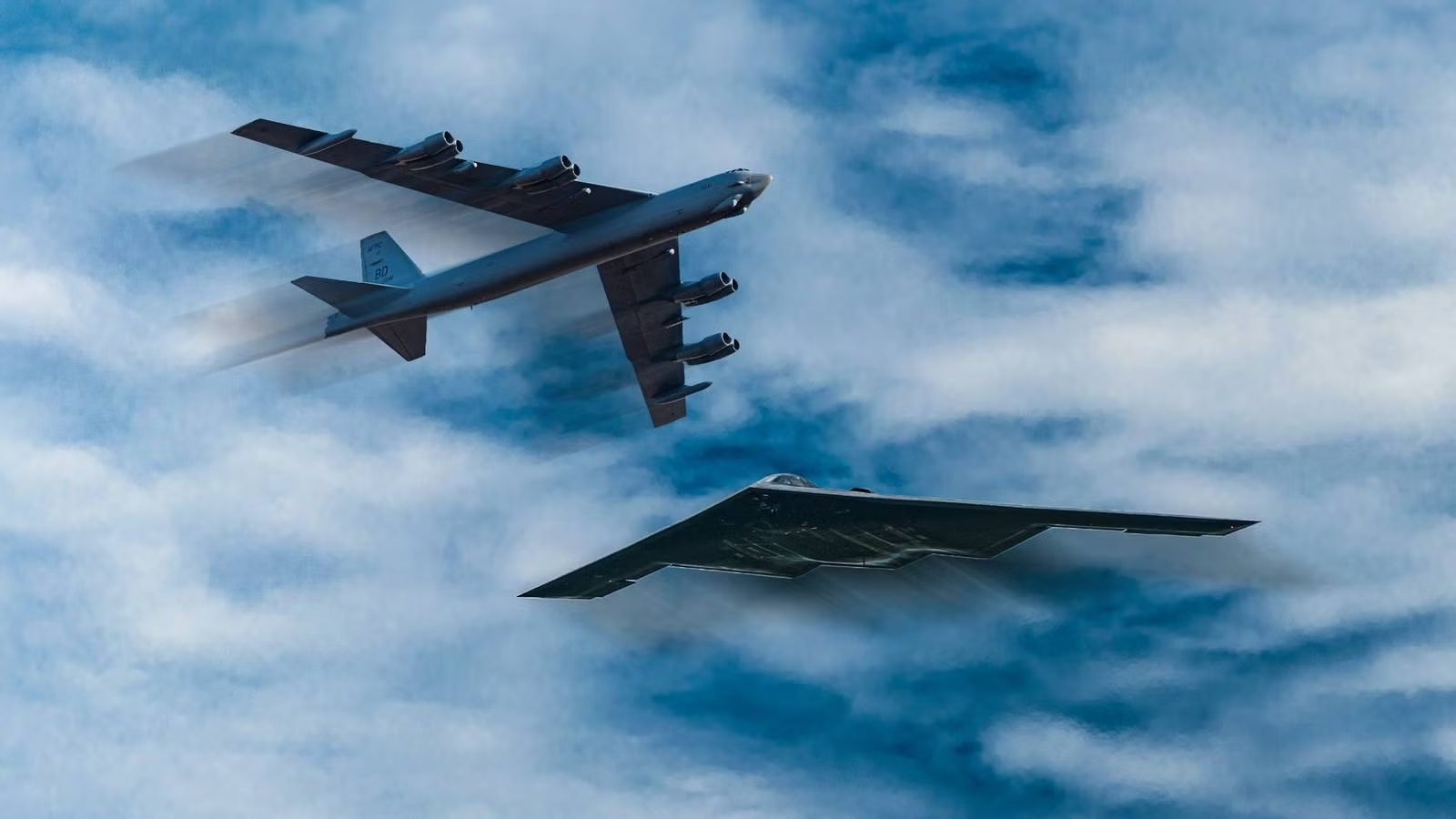
At first glance, it might seem obvious which one of the aircraft in the US Air Force (USAF) bomber fleet has the largest capacity for ordnance. The tough part is that the answer is likely unexpected, and the ranking may surprise those unfamiliar with the Air Force Global Strike Command. While most assume the ‘biggest’ bomber is the Boeing B-52 Stratofortress, the heaviest hauling, highest capacity plane is actually the supersonic, swing-wing Rockwell B-1 Lancer.
Perhaps more notably, the world’s first stealth bomber, the Northrop Grumman B-2 Spirit flying wing, is not far behind. The B-52 has a total payload capacity of 70,000 pounds (31,500 kilograms), the B-2 comes in at 60,000 pounds (27,216 kilograms), or just under 15% lower capacity. Taking the top spot for bomb loads, the B-1 is slightly higher, with a maximum carrying capacity of 75,000 pounds of munitions.
Notably, the B-2 payload was listed as 40,000 Pounds for many years on the US Air Force fact sheet available to the public online, according to Sandboxx News. Then, without a press release or public announcement, the Air Force quietly rewrote the B-2’s number earlier this year. Speculation circulates that subterfuge and strategic deception drove the misleading specification listings. However, the most likely cause of the change stems from operational doctrine.
Why The B-2’s Number Moved

For nearly all the B-2 Spirit’s operational history, the Air Force’s own documentation put its payload at 40,000 pounds, a number that first appeared in the service’s earliest B-2 fact sheet in 2017 and stuck for years afterward. A 50% jump in a published specification, with no accompanying announcement, is not how the Pentagon typically communicates a genuine capability upgrade, which raises the question of what actually changed.
Nothing about the B-2 itself changed. What changed was that the Air Force got caught understating it. On June 21 and 22 last year, seven B-2 Spirits flew from Whiteman Air Force Base to strike Iran’s Fordow and Natanz nuclear facilities in Operation Midnight Hammer, the largest operational B-2 strike in history. Each aircraft carried a pair of GBU-57A/B Massive Ordnance Penetrators, 30,000-pound bunker-buster bombs, Air and Space Forces Magazine reported.
The planes that took off to deliver that massive aerial bombardment had a combined payload of 60,000 pounds per aircraft, with 14 MOPs dropped in total across the two target areas. That loadout revealed a 20,000-pound discrepancy with the Spirit’s long-standing unclassified maximum. So, in May, the Air Force revised its fact sheet.
Northrop Grumman, notably, has continued to describe the aircraft’s capacity more conservatively as “more than 40,000 pounds,” and the National Museum of the US Air Force still cites typical combat loads around that older figure, meaning the 40,000-pound number likely reflects a standard maximum-fuel, maximum-range mission profile, while 60,000 pounds represents what the airframe can physically carry when the fuel load is reduced to make room for it.
Payload and range trade against each other on both bombers, but the B-2’s number was always closer to a mission-dependent ceiling than a fixed specification. That is why the difference in how the B-2 and the B-52 carry weapons is a bigger distinguishing factor. Not just their gross tonnage, to truly understand what each number actually means in practice.
Two Different Ways To Haul A Bomb

The B-52’s 70,000 pounds and the B-2’s 60,000 pounds do not measure the same kind of capacity. The Stratofortress carries its ordnance both internally, on a rotary launcher, and externally, on underwing pylons. The Rotary-equipped bomb bay lets it carry up to 20 air-launched cruise missiles, along with a mix of gravity bombs, mines, and smart bombs.
That external carriage is exactly what a stealth design cannot tolerate. Hanging weapons outside the fuselage destroys the radar cross-section reduction the whole airframe is built around. The B-2 instead carries everything inside two internal bays fitted with rotary launchers and bomb-rack assemblies. These are capable of holding up to 80 precision-guided 500-pound JDAMs, or 16 2,000-pound JDAMs. It can also accommodate up to 16 B61 or B83 nuclear bombs, or two of the 20.5-foot-long GBU-57 MOPs with one fully occupying each bay.
The BUFF has a more conventional design because of its older engineering legacy and non-stealth mission. The B-52 buys raw carrying capacity and mission flexibility by accepting a large radar signature. Meanwhile, the B-2 buys survivability against modern air defenses by constraining every weapon it carries to fit inside a flying wing’s internal volume. That difference in design philosophy is what guides how the two aircraft are deployed in combat.
How The Difference Plays Out In Practice

The B-52’s payload advantage has translated into raw bomb tonnage delivered against permissive or suppressed air defenses. During Operation Desert Storm, B-52s delivered 40% of all the weapons dropped by coalition forces, and the type went on to fly roughly 1,800 combat sorties against ISIS targets in Syria and Iraq between 2016 and its later campaigns.
The B-2’s operational record makes the opposite case: it exists specifically for missions where the B-52 cannot survive, like Midnight Hammer. General Dan Caine, Chairman of the Joint Chiefs of Staff, said afterward that “Iran’s fighters did not fly, and it appears that Iran’s surface-to-air missile systems did not see us throughout the mission.” Reportedly, zero shots were fired at the strike package. No B-52 could have flown that profile.
The B-2 has also been steadily adding standoff reach to its penetrating role. Northrop Grumman disclosed in 2022 that the aircraft had successfully test-launched the AGM-158B JASSM-ER, a stealthy cruise missile with a range over 500 miles, making the B-2 capable of striking from outside some defended zones entirely rather than only penetrating into them.
The B-52, for its part, already carries the baseline JASSM and JASSM-ER on its external pylons and remains the fleet’s primary standoff-missile truck, a role suited to an aircraft that trades stealth for volume. Both aircraft, in other words, are converging somewhat on standoff precision strike, but from opposite ends of the technical and tactical spectrum.
The Force Structure Both Aircraft Are Headed Toward

Neither bomber force is remaining stagnant in 2026 either. The numbers behind each modernization program underline how the Air Force values them as the backbone of the bomber fleet into the future. The 76-strong BUFF armada is in the middle of the Commercial Engine Replacement Program, swapping each bomber’s eight 1960s-era Pratt & Whitney TF33 engines for Rolls-Royce F130 turbofans, alongside a new radar and other subsystem upgrades that will see the type redesignated the B-52J.
The program cleared its Critical Design Review in May after delays that triggered a Congressional cost review on the radar-upgrade portion of the effort. The first two re-engined aircraft are scheduled to begin ground and flight testing at Edwards Air Force Base later this year. The Air Force aims for the refreshed fleet to be lower-risk and lower-cost while preserving an aircraft. It is already well suited to the agile combat employment Doctrine it is optimizing its future fleet for.
The B-2, by contrast, is not being modernized for a long future but rather a temporary lifetime extension as it is being replaced. The AFGSD has stated the B-21 Raider will replace both the B-1 and the B-2, with initial operational capability targeted for 2028, though fiscal 2027 budget documents show the service now planning to keep the older Bombers in service longer than originally expected.
The Bomber Fleet & ACE Tactics

The air force of the future will have a strategic strike fleet composed of just two types. Notably, the B-21, which is replacing the B-2, is expected to have a smaller payload than its predecessor. As the world’s first sixth-generation stealth bomber, the Raider will have a smaller wingspan and just two engines compared to the four found on the B-2. That’s because the plane’s role is evolving, as are the tactics the Air Force will use on the battlefield of tomorrow.
As the US military pivots toward the Pacific, the need to disperse aircraft and operate at longer ranges with over-the-horizon strike capabilities has become more important than ever. To that end, the B-52J is a badly needed missile truck to support the future fleet of B-21s. This strategy mirrors how the Lockheed Martin F-35 Lightning II acts as a stealth node in contested airspace while the Boeing F-15EX Eagle II lobs long-range missiles from beyond visual range.
Therefore, each of these bombers is optimized for maximum sensor capability, detection range, data-link power, and standoff strike. The B-52J will likely have a 150%, or greater payload, compared to a B-21. The figures remain undisclosed, but that estimate is based on the fact that the raider appears to have between two-thirds and three-quarters the ordnance capacity of a Spirit.
The eventual plan is a two-bomber force built around the B-52J and at least 100 B-21s. Based on growing endorsements from the top brass of the Department of Defense, the Air Force and Northrop Grumman have already received a 25% production funding increase, while the original fleet cap is under negotiation. Speculation suggests the total number of B-21 Raiders could climb to 145 or even 185 before the assembly line is shuttered.