dailynewsnblog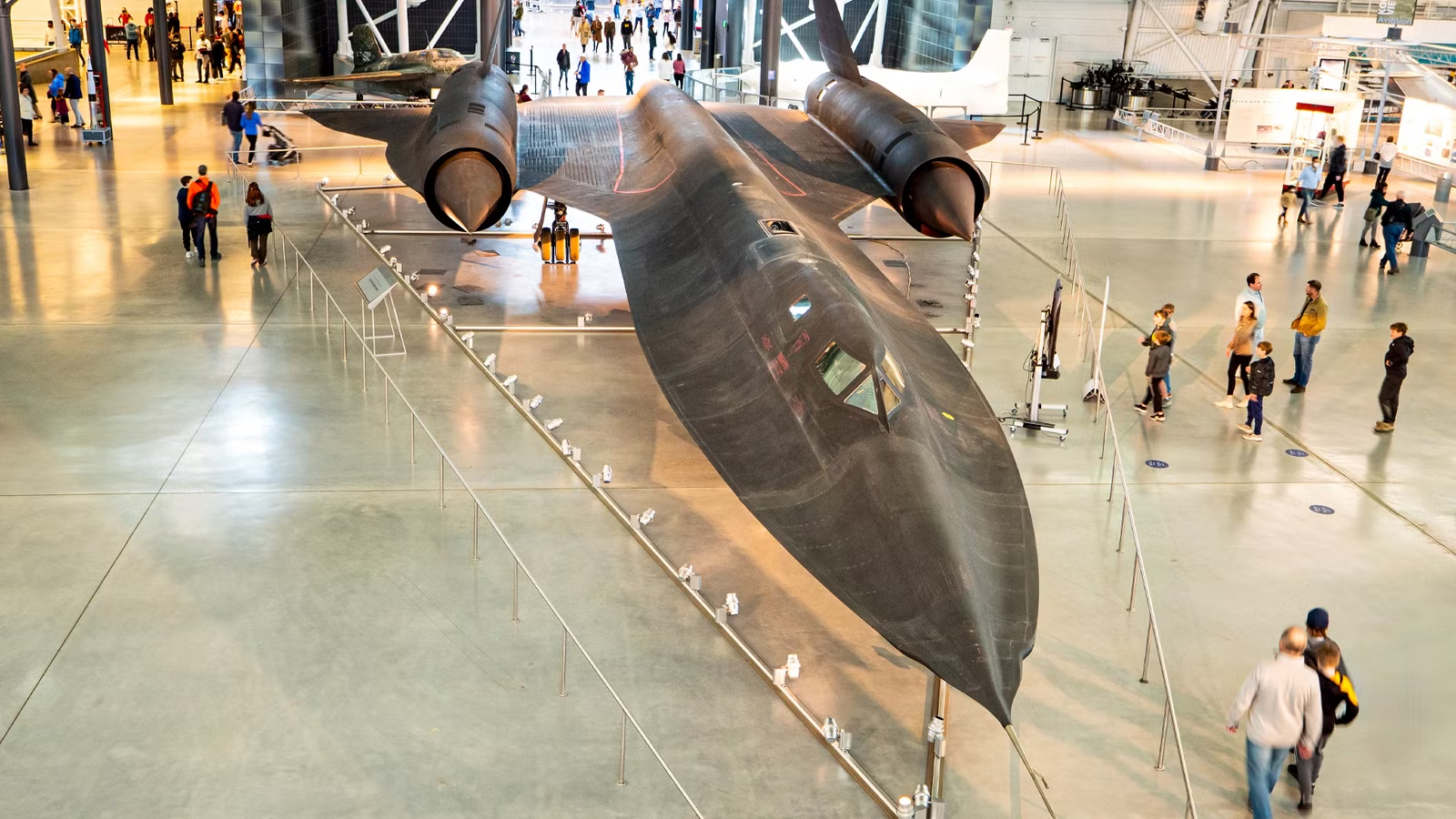
To this day, the Lockheed SR-71 Blackbird remains the fastest manned, air-breathing aircraft ever to enter service. The aerodynamics of the plane and the unique titanium alloy that Skunk Works crafted it from were crucial elements and enabled this incredible plane to fly as fast as it did, but its engines are also one of a kind. The Pratt & Whitney J58 was one of the strangest, most counterintuitive machines ever built. Formally classified by its engineers as a ‘Recovered Bleed-Air Turbojet,’ many still disagree on the correct technical description for how these incredible power plants worked.
Flying at a cruise speed of Mach 3.2, the wind hitting the SR-71 wasn’t just air; it was a kinetic wall. The massive, forward-facing inlet spikes controlled the airflow into the engine and actually contributed 80% of total thrust just by ramming air through at high speed. Then there were six massive, curved bypass tubes surrounding the J58 engine core. These tubes performed the bleeder recovery, which served to cool the engine core before it was dumped into the afterburner and used to increase the thrust.
The air in the tubes bypassed the main burner, so it still contained all of its original oxygen. When it dumped into the afterburner, it mixed with a fresh spray of JP-7 fuel and ignited. This is when the Blackbird J58s stopped acting like a traditional Turbojet, and the entire nacelle turned into a ramjet. To this day, the extremely unusual behavior of the plane’s propulsion leaves it in a gray area of engine design that continues to inspire debate over its true classification in the world of aerospace.
Skunk Works’ Unusual Bird: The Blackbird’s Quirks

In many ways, the J58 engines in the SR-71 broke the rules. Every pilot in the Air Force was trained that the afterburner is an emergency drag-race button. You light it to dogfight or escape a missile, and you turn it off after 30 seconds before you burn through all your fuel or melt your tailpipes. The Blackbird just completely ignored this and instead demanded that you fly the entire mission with afterburners continuously lit.
One of the most novel features of the design was that the faster the plane flew, the more fuel efficient it actually became. Because the ramjet effect took over via the recovered bleed tubes, the engine used less fuel per mile at Mach 3.2 than it did at Mach 2. The J58 engine was only responsible for 17% of the thrust at top speed. The other 83% of the thrust was generated by the air pressure dynamics inside the inlet nacelle, according to tech laboratories.
Not only did the Blackbird throw out the rule book on flying in the USAF, but it also totally upended maintenance and ground handling procedures with its bizarre quirks while sitting at a standstill. When sitting on the tarmac, cold, the engine components and fuel tanks didn’t fit together tightly. The plane literally leaked high-flashpoint JP-7 fuel onto the ground. Maintainers used to standard, pristine aircraft look at an SR-71 on the ground and think it was broken, but it was behaving exactly as intended.
The Black Magic Inside The SR-71

The engine in the SR-71 simply did not follow the same rules that other turbojets in the rest of the US Air Force fleet did. Maintainers were used to working on ‘engines’ as self-contained boxes. If a normal jet engine has an issue, you fix the engine. The engine was instead dependent on a complex, invisible dance of shockwaves through the air that heavily relied on its variable air inlet ducts.
If the spike miscalculated by a fraction of an inch, the shockwave would violently pop out of the intake. The engine would instantly lose all air and stall. Because the system relied so heavily on aerodynamic fluid mechanics rather than just purely mechanical rotating machinery, it felt unpredictable. The Aviation Geek Club recounted how the J58 was sometimes described as ‘black magic’ by the people who worked on it.
The Blackbird program alone pioneered several breakthroughs in aviation engineering. The Skunk Works team had to essentially invent a new branch of metallurgy to make the Blackbird possible. Then, the design team went on to create a jet fuel that simultaneously served as a heat sink and even a kind of pressurization system for mechanical components in the engine.
JP-7 is practically impossible to ignite with normal methods. Ground crews famously demonstrated their safety by dropping lit matches directly into buckets of fuel. It would not burn without extreme pressure and temperature. To ignite the fuel, the SR-71 injected triethylborane into the combustion chamber. It could safely sit inside the uninsulated titanium skin tanks of the Blackbird while the airframe glowed red-hot before it erupted into a signature bright green flame.
Why The SR-71 Blackbird’s Titanium Airframe Will Be Nearly Impossible To Replicate
The fallout of shuttering Skunk Works’ unique factory.
How The Ultimate Supersonic Airplane Was Made

The development of the SR-71 Blackbird and its J58 engine was one of the most intense, secretive, and high-stakes collaborations in aviation history. It forced Kelly Johnson, the legendary leader of Lockheed’s Skunk Works, and Pratt & Whitney into a marriage of necessity that nearly fell apart multiple times. He was notorious for bypassing executives and walking straight onto the test stands to interrogate the engineers. This collaboration led to the breakthrough of the Recovered Bleed-Air system.
Kelly Johnson operated Skunk Works under 14 strict management rules, and rule number one was absolute simplicity and small teams. He hated corporate bureaucracy and expected Pratt & Whitney to operate the same way. Johnson practically embedded himself at Pratt’s Florida test facilities. This hyper-focused pressure forced P&W to treat the J58 not as a standard corporate project, but as a wartime emergency. The equally legendary engine-makers eventually formed their own ‘Skunk Works style’ elite team specifically to deal with Kelly’s demands.
In the late 1950s, Kelly Johnson knew the U-2 spy plane was becoming vulnerable to Soviet missiles. He designed a radical titanium airframe around P&W’s unfinished JT11D-2 engine blueprints for a canceled Navy attack bomber, according to SR71Blackbird.com. As the design progressed, both teams realized they had miscalculated. The engine was getting too hot, and the airframe was too heavy, which jeopardized the plane’s core goals. It was only because the two teams were so closely integrated that they were able to achieve a two-pronged engineering solution that produced a plane that remains the fastest crewed, air-breathing jet to ever fly.
Aviation’s Greatest Engineering Breakthrough Of The Last Century
A closer look at the industry’s most impactful leap forward in the last 100 years.
Not So Typical Air-To-Air Tanking In The SR-71

The Blackbird fleet flew extremely clandestine missions, especially the earliest examples, which were designated A-12 under the Central Intelligence Agency’s Oxcart program. Their complex flight routes originated and terminated at Beale Air Force Base despite the far-flung targets that they flew over on their surveillance missions around the world. That demanded that the incredible Mach 3 supersonic jets be able to perform air-to-air tanking just like many other military aircraft. This simple requirement demanded a customized solution.
The Air Force had to assemble a dedicated fleet of Boeing KC-135Q Stratotanker aircraft with isolated fuel tanks and specialized plumbing that could deliver JP-7 along with liquid nitrogen. During the aerial refueling process, as JP-7 pumped into the aircraft, the tanker’s system worked in tandem with the Blackbird’s onboard environmental controls to purge all oxygen. As the SR-71 took on fuel, the space inside its tanks created a severe hazard.
At Mach 3, the friction heat radiating from the titanium skin would ignite even the tiniest trace of fuel vapor if oxygen were present. The jet flooded its tanks with liquid nitrogen during aerial refueling and topped off tanks on board that would be used to keep the tanks safe as the plane burned its fuel on the mission.
The tanker jets not only had to have specialized hardware in order to refuel the SR-71, but the incredible performance disparity between the two planes demanded a unique rendezvous maneuver in order to complete midair refueling. The Blackbird was flying dangerously close to its subsonic stall speed at the maximum speed of 0.80 Mach, which a Stratotanker could fly. After the hookup, the tanker pilot would pitch the nose down into a shallow descent to assist both aircraft. Gravity helped the tanker maintain its top speed while allowing the heavy SR-71 to maintain enough lift and engine airflow to stay plugged in.

The SR-71 Blackbird’s Final Flight Set 4 Speed Records In Just 64 Minutes
The final day that the legendary jet streaked through America’s skies.
The Legacy Of The Blackbird: Icon Of Airspeed

The SR-71 Blackbird holds several world records, many of which remain unbroken over 45 years later. Its most famous achievements were set in July 1976 during official record attempts and in March 1990 during its record-shattering final retirement flight, according to the SR-71Blackbird.com records. Even before these legendary streaks, the SR-71 set a world record for endurance flight in 1971 when Major Thomas Estes and Dwayne Vic flew over 15,000 miles in 10 hours and 30 minutes with multiple midair refuelings along the way.
In 1976, near Beale Air Force Base in California, the Blackbirds had an absolute speed record at 2,193 mph (3,529 km/h) and an absolute altitude record of 85,068 feet (25,929 meters). It also achieved a record on a closed circuit with a 2,092 mph (3,367 km/h) average speed over a 621-mile (1,000 km) distance. Already, in 1974, the Blackbird set the record for fastest transatlantic crossing, which still stands today, at 1 hour and 54 minutes with an average speed of 1806 mph (2,906 km/h).
On its final flight from Palmdale, California, to the Smithsonian’s Udvar-Hazy Center in Washington, D.C., the Blackbird set four speed records in a single trip. The SR-71 set the record for flight time from Los Angeles to DC at 64 minutes and 20 seconds with an average speed of 2,144 mph (3,450 km/h). It also set the transcontinental, or coast-to-coast, record as well as the record from Kansas City to D.C. and St. Louis to Cincinnati.