dailynewsnblog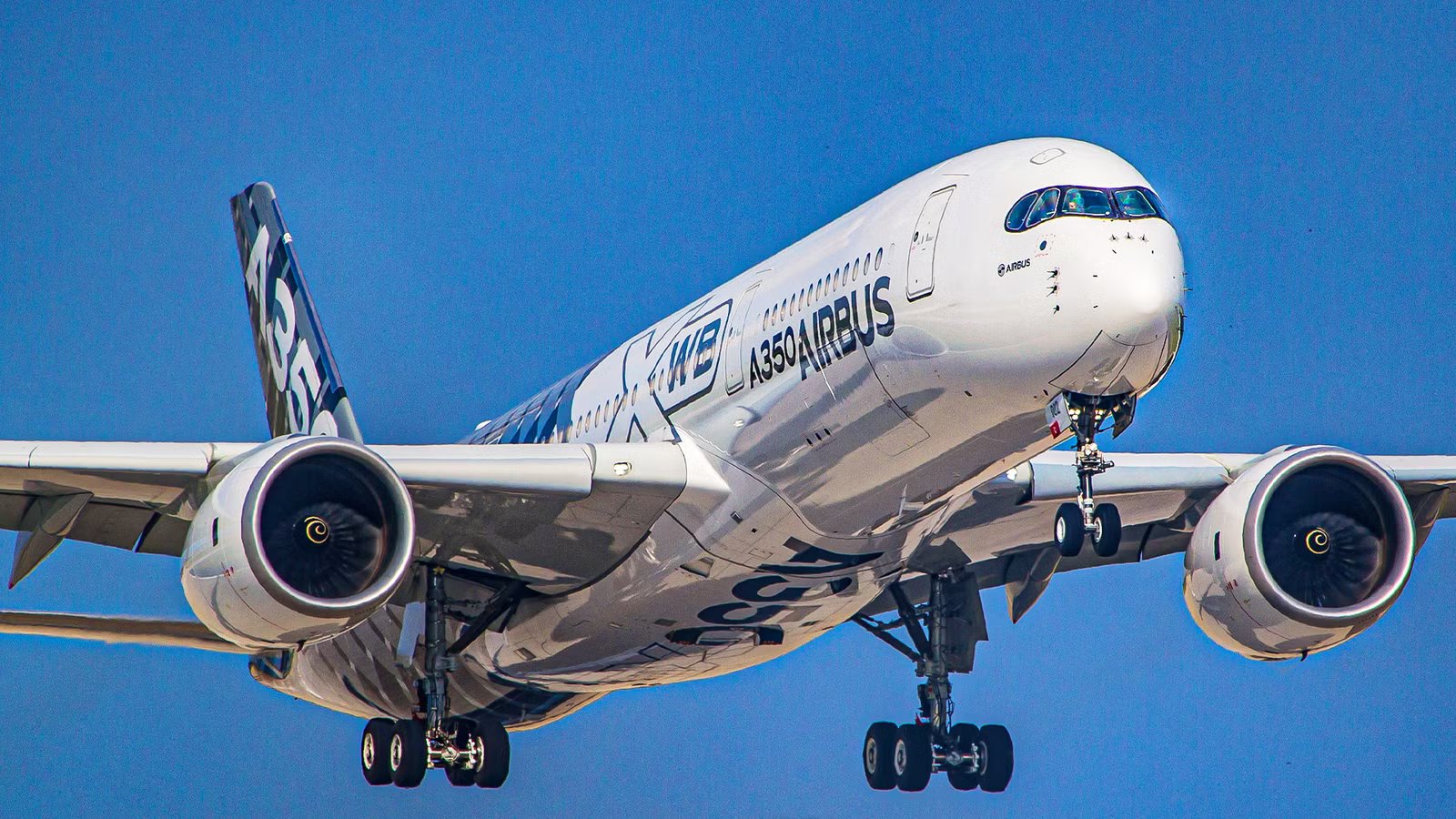
In June 2018, Airbus launched the Autonomous Taxi Takeoff and Landing project and began a path towards transforming aviation technology. The Titanic European plane maker aims to bring a paradigm shift in the form of software-defined aircraft that decouple hardware from the programs they run to transform next-generation airliners. While Airbus was a pioneer of fly-by-wire technology in the 1970s, the latest watchword is ‘Fly by Code’ under this campaign to make airliners upgradeable, hyper-connected digital platforms.
The vessel of this ambitious initiative is an Airbus A350-1000 flight demonstrator. This unique test bed was made in 2016 and stamped with serial number 059, registered as F-WMIL. The jet successfully completed a world-first fully autonomous vision-based takeoff under the ATTOL test campaign. Then, in 2022, MSN059 took part in the Airbus UpNext campaign as the Dragonfly demonstrator using 360-degree cameras to detect obstacles during landing.
Today, MSN059 is being transformed as the flight test instrumentation flagship for the software-defined aircraft, or SDA, program that will incorporate Airbus’s new Mistral artificial intelligence algorithms. It is already successfully performing automated instrument landing system approaches and autonomously navigating taxiways under Dragonfly. Now, with Mistral onboard, the jet will trailblaze the path to fully autonomous flight with over-the-air updates that can eliminate any room for error in an AI-enabled jetliner.
Fly By Code On The Airbus A350-1000

To be clear, the goal of the Airbus SDA program is not to remove pilots from the cockpit but rather to significantly enhance safety and support aircrew. Airbus’ philosophy centers on pilot augmentation. Airbus is developing SDA technology to create a hyper-capable digital copilot, acting as a safety net that protects the flight crew, reduces their mental workload, and eliminates human errors during high-stress scenarios.
MSN059 and Mistral AI will craft the path towards certification for automating tasks like navigating complex airport taxiways or calculating diversion routes during an inflight emergency. This system is meant to free up the pilots to focus on decision-making rather than dedicating their energy to administrative flight deck tasks or ‘stick and rudder skills.’ Maud Delourme, head of multi-systems engineering and integration at Airbus spoke about the aircraft.
“The goal of our software-defined architecture is to elevate the pilot. By scaling up computing power, we can automate high-workload tasks. This moves crew responsibility from operational flying to strategic management. They are then fully equipped to make critical safety decisions when human judgment is irreplaceable.”
To achieve this reality, MSN059 will make its test flights to gather real-world data that is then circulated through a feedback loop back to Mistral AI, which can perform many more calculations than the jet will ever be able to fly. By proving what works and what doesn’t on the A350 test bed, the Mistral data can be refined and proven until Airbus can mathematically prove to aviation safety regulators that its technology is ‘bulletproof.’
The Next Steps In A Long Journey Ahead

The official partnership between Airbus and Mistral AI was announced in May 2026, with the first flights expected sometime next year. The current program is a 5-year campaign that is presently focused on building a certified digital twin of the vision system in the A350-1000. Once that is ready, it will kick off a series of millions of AI simulations in a testing environment that is minutely accurate to real-world conditions.
Catherine Jestin, Executive Vice President Digital at Airbus, was quoted as giving these remarks in the announcement of the joint program.
“This partnership paves the way for the deployment of high-impact, high-value use cases of trusted and responsible AI in aerospace. Thanks to the high-performance models and made-to-measure support of Mistral AI experts, we are building the foundations necessary to power our current and future products and services, enabling us to serve our customers better.”
To achieve this goal, MSN059 is currently flying tests dedicated to automatic object recognition that will teach the software how to navigate under adverse conditions like reliably spotting runways and bad weather. Meanwhile, the integration with Mistral AI is happening on the ground. Airbus is currently feeding MSN059’s massive historical flight logs and vision data into Mistral’s models to train and audit the software-defined architecture before flashing it back onto the physical plane.
Airbus aims to establish the core framework of SDA architecture by 2030 and fully certify its OTA system with the FAA and EASA. After this stage is completed, all of its next-gen aircraft programs will incorporate technology based on the engineering breakthroughs made by MSN059 and Mistral AI.
Certifying AI On The Flight Deck

Airbus has a daunting task ahead of it despite the great leaps in progress made under the ATTOL and Dragonfly autonomous vision-based flight tests. AI is an inherently probabilistic model that will need to be brought into alignment with the deterministic requirements of the Federal Aviation Administration and European Aviation Safety Agency. These authorities will not just audit the final code inside the SDA system but look at the data used to train it.
Inspectors will require Airbus to prove exactly how the SDA flight computers will react to every single input. Machine learning models, like the computer vision used on MSN059, evaluate the data in front of them and make a statistical guess based on probabilities. This is the crux of the issue with certifying an AI-enabled jetliner. Because this system is based on probability, it is non-deterministic.
That means, if a single pixel changes color due to a drop of rain or a shadow, the AI’s mathematical ‘guess’ can deviate from previous results under virtually identical conditions. The FAA and EASA can audit every line of code to prove it is mathematically impossible for the computer to surprise the pilot. The Mistral AI generative algorithms use large language models to automate the reverse-engineering of safety documentation and build hyper-complex validation frameworks to ensure the autopilot never makes a ‘bad call.’
The FAA and EASA safety codes require Airbus to visually prove that 100% of the code has been tested and behaves exactly the same way every single time. Because a machine learning model is probabilistic, Airbus cannot use traditional testing. Airbus is using MSN059 and Mistral AI to act as a bridge, taking autonomous flight computers beyond their current limitations and showing Airbus engineers the mathematical envelope of where the AI is safe to operate and where it isn’t.
Catch what other flight trackers miss
Emergency squawks, holds, NOTAMs — live signals, no signup.
Open tracker
Catch what other flight trackers miss
Emergency squawks, holds, NOTAMs — live signals, no signup.
Open tracker
SDA: Over-the-air Updates Anywhere, Anytime

One of the most important elements of making autonomous airliners a reality is enabling instantaneous updates no matter where the plane is. Under the SDA architecture, the vision landing system will become a modular software application decoupled from physical avionics. Airbus intends to push out the autonomous landing capability, real-time safety patches, and computer vision updates via over-the-air updates across an entire fleet of aircraft simultaneously.
OTA updates are the critical pipeline that makes the SDA model commercially viable. The way avionics software updates are currently conducted is on the ground with a dedicated technician physically boarding and installing a software patch. They manually upload the data to each individual system box. This process grounds the aircraft, takes hours, and is also prone to human deployment errors. OTA will reduce this process to a simple download while the plane is sitting at a jet bridge.
OTA updates are the only way to realistically replace expensive ground-based instrument landing systems. Through OTA updates, Airbus can push hyper-accurate, updated 3D visual airport profiles to an aircraft’s software architecture right before a flight takes off. This ensures that even if a remote airport changes its runway layout, the plane’s software is already aware of it before entering its airspace. This is the ultimate goal of the SDA project that MSN059 and Mistral AI support.
Cybersecurity On The Tarmac

As with every new era of aerospace technology, radically new capabilities bring new risks and hazards. In aviation, cybersecurity is now classified directly as an airworthiness safety issue because a digital compromise can lead to catastrophic physical failure. Transitioning to an architecture that updates a commercial airliner, OTA introduces an entirely new frontier of safety threats and cybersecurity vulnerabilities. The FAA and EASA require absolute proof from Airbus that its aircraft cannot be hacked, corrupted, or digitally crippled.
Because future jetliners that use the technology and development under SDA will stream data from satellites or cellular networks during updates, a hostile actor can intercept that signal and inject malicious code. Should that computer virus deceive or manipulate the vision-based autonomous landing system into misidentifying its surroundings, the results could be disastrous. Even without malice, simply corrupted downloaded data also presents the same danger.
Then there’s the physical risk of vision-based autonomous flying equipment. An adversarial attack using visual patterns on the ground to spoof camera systems could confuse the AI calculations. Once again, if the autonomous jetliner proves fallible in such a scenario, aviation authorities will not certify it for passenger operations. This is another crucial area in which Airbus’ unique A350 test bed will help advance the current state of the art to the next level and make the SDA’s AI model and OTA protocols ‘smarter’ than all of these threat vectors.