dailynewsnblog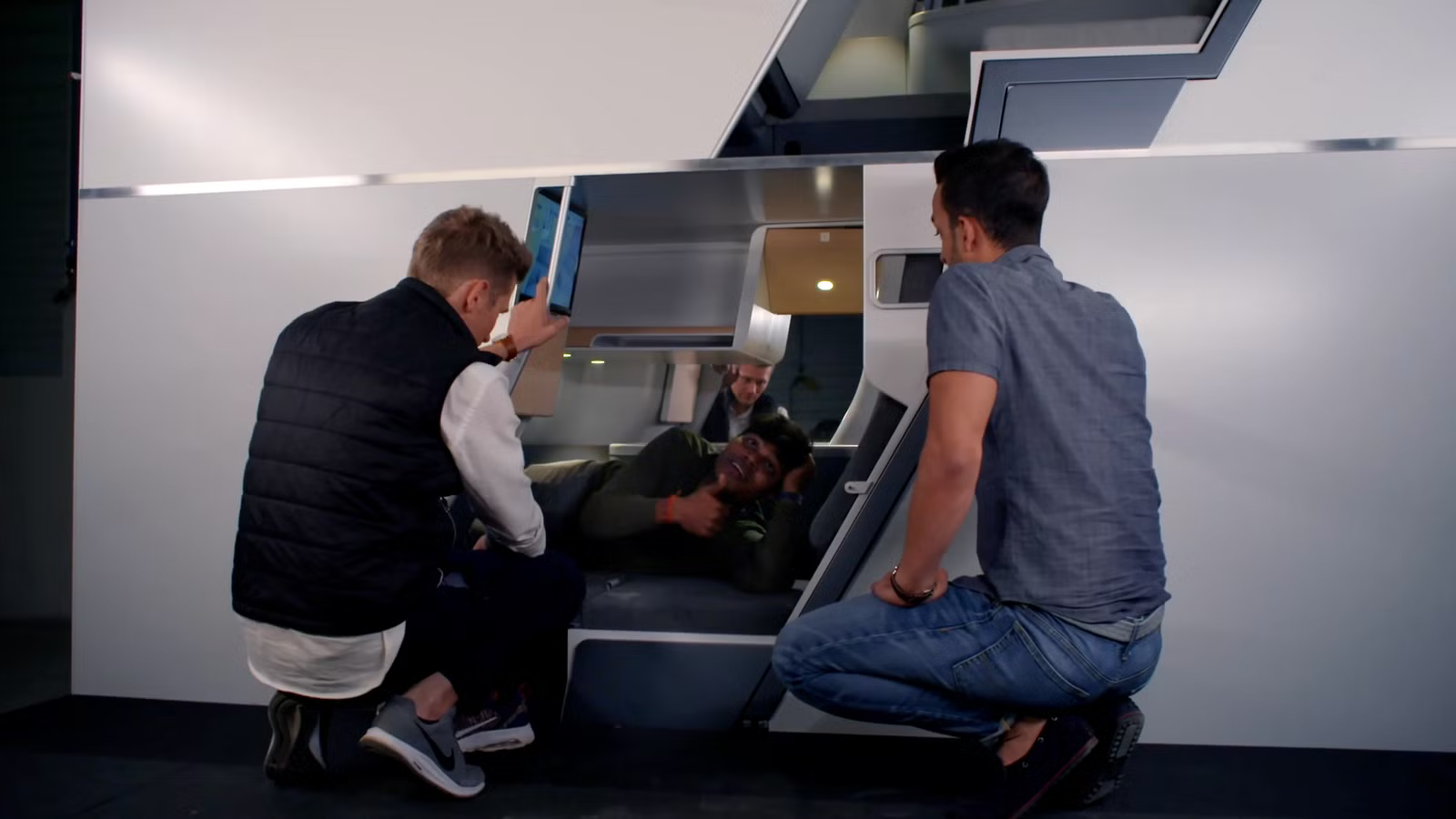
Founder of Zephyr Aerospace, Jeffrey O’Neill, was inspired to design a radical new seating concept for airliners as he was struggling to sleep aboard the world’s longest commercial flight. It was less than halfway through the 19-plus hour journey from Singapore to New York aboard a  Singapore AirlinesAirbus A350-900 ULR when he began to envision a true middle ground between business and economy class.
The Zephyr seat utilizes the third dimension inside the cabin for seating instead of baggage storage. To some, it may sound like a dystopian ‘double-decker’ travel nightmare, but what the radical seat design achieves is the creation of a 78-inch lie-flat bed in the same footprint as current premium economy cabin configurations. Additionally, the product is premium economy on long-haul flights, and the unit can be installed at a fraction of the cost of business class equipment.
Unfortunately, the startup has been stalled by a Federal Aviation regulation from the 1960s that dictates it must be possible for all occupants of an airliner to evacuate in under 90 seconds. Due to the revolutionary design of the Zephyr seat, no engineering model exists to validate that the unique ‘bunk bed’ style configuration can satisfy the rule. Despite the resounding success of the company’s first crowdfunding campaign in 2021, there remains a greater financial barrier to prove its product can satisfy the Federal Aviation Administration.
The Grounded Zephyr Seat: Pre-production Purgatory

Zephyr Aerospace was founded in 2018 after O’Neill formally filed and established the company in San Francisco. Almost immediately, the new start-up received an endorsement from Paul Wylde, an elite aviation designer who created British Airways’ first lie-flat business class seat and JetBlue’s highly rated Mint premium suite. After creating its first physical mock-ups, the company teamed up with Dynamic Safety to begin pursuing a path to certification.
Zephyr raised 700% more than it originally hoped to in 2021, bringing in almost $800,000 to kickstart the road to production. Still, the compounding costs of certifying multiple innovative technologies mean that the business will need millions to cross the finish line and receive approval for active service. Among the costly endeavors required are destructive testing trials, simulated evacuation drills, and much more.
The most likely path forward is through collaboration with an established seat maker or major carrier. However, there has been no announcement of an official partnership to date. The stringent requirements of the FAA require multiple crash testing rounds which would completely destroy seating units worth $100,000 for analysis. It would also need designated airworthiness representatives and extensive engineering facilities to complete all the trials.
By The Book: Abiding By The Code Of Federal Regulations

Zephyr Aerospace is being hindered by CFR 25.803, which requires the 90-Second Evac Rule. This holds true for any aircraft that can accommodate more than 44 passengers, and the timeline is not random; rather, it is a result of expensive lessons learned in the past. Due to defects in the fuselage design that prevented survivors from escaping, several incidents during the beginning of the jet age resulted in fatalities that could have been prevented. Thus, a 120-second escape threshold was instituted in 1965.
In 1967, that window was cut down to 90 seconds after studies showed that smoke or flash fires can engulf an entire cabin in less than two minutes. While the double-decker Boeing 747 passed these trials for its debut in 1968, there has never been a study of a plane with stacked seating on the same floor level. The hazard concern is that a multi-level pod creates a scenario where an upper-deck passenger could fall onto lower-level flyers, causing a human pile-up.
Passengers in the top berths of the Zephyr seat must descend a telescoping ladder system or an integrated step to get to the aisle. Climbing down a vertical ladder naturally hinders egress and causes a bottleneck in the aisle in a smoke-filled, dark emergency cabin when people are in a panic. Following the 2024 EVAC Act, Congress is putting tremendous pressure on the FAA to increase the rigor and practicality of evacuation testing.
The Case For Bunk Beds In Premium Economy

The Zephyr seat still has a realistic path forward on paper, but it is stubbornly blocked by a severe capital bottleneck and unprecedented legal changes to the certification process that only make matters harsher. There is a strong market appetite for innovative products to expand the premium economy on airliners thanks to the strong demand for the relatively new airfare class since the end of the COVID-19 pandemic.
Premium economy is currently the most profitable real estate on a commercial wide-body aircraft. Airlines earn significantly higher margins per square inch on these seats compared to standard economy and sometimes more than the larger, albeit higher-priced, business class suites. Zephyr’s 2-4-2 layout allows airlines to monetize vertical space that is currently empty or under-utilized since there are only luggage storage bins.
The market has already proven that multi-level sleep concepts can work. Air New Zealand successfully brought its Skynest economy sleep pods to market. However, Skynest bypassed the hardest regulatory hurdles by operating as a shared bunk room that passengers book for four-hour slots, meaning passengers are never in the bunks during taxi, takeoff, or landing. Zephyr’s concept requires passengers to stay in the stacked pods for the entire flight, which would trigger much harsher safety rules.
The EVAC Act’s Blow To Zephyr’s Dream

The Emergency Vacating of Aircraft Cabin Act was codified into law under the FAA Reauthorization Act of 2024. It introduces a massive shift in how aircraft cabins are certified. The new policy does away with the historical practice by the FAA which allowed manufacturers to pass the 90-second evacuation rule under laboratory conditions. The EVAC Act forced the FAA to rewrite its criteria to mandate real-world emergency simulations. It has made the path to production for the Zephyr seat exponentially more difficult and costly as a result.
Manufacturers of aircraft seats and cabins used to be able to conduct evacuation tests with groups that were limited to healthy, physically fit persons under 60. The FAA is specifically required by law to assess how evacuation timeframes are impacted by newborns, small children, senior persons, and anyone with significant physical limitations. According to the new regulations, the entire cabin layout will fail the 90-second timer if a single vulnerable passenger finds it difficult to get out of the higher bunk, bottlenecking the row.
While a young, athletic test subject can easily climb and descend Zephyr’s 4.5-foot telescoping ladder system, an older traveler or someone with restricted mobility will significantly impede the column’s exit speed. Under the prior technique, evacuation test runners would drop everything and run down completely spotless, empty aisles. The FAA must now account for the existence of carry-on luggage, personal belongings, and even language problems.
Zephyr’s double-decker layout eliminates traditional overhead bins to save vertical space, which means that baggage must be stored under the lower berths or in centralized closets. In a real-world scenario where panicking passengers try to pull luggage from lower-deck floor cubbies, bags will inevitably spill into the aisles.
The FAA Do-Over on Seat Pitch and Layouts

Zephyr relies on a highly unconventional, staggered 2-4-2 multi-level grid to maintain premium economy density. The driving force behind the EVAC Act was a fierce backlash against the FAA’s previous claim that shrinking seat sizes and tighter spacing did not impede evacuations. Congress explicitly demanded a complete reevaluation of cabin geometry.
Because the EVAC Act subjects non-traditional layouts to extreme analysis, any design that creates complex vertical angles or forces a passenger to step into someone else’s personal space to reach the main aisle will face intense scrutiny.
The FAA is under strict congressional oversight to enforce ultra-realistic, highly complex, and unpredictable physical human trials. The agency has also been ordered to set definitive minimum standards for seat width, seat pitch, and aisle dimensions specifically framed around safety. Before the EVAC Act, a startup might have hoped to squeeze through using mathematical computer models, but the present conditions are far more adverse for a small company.
The Right Innovation At Almost The Right Time

To get approved by the FAA without a massive engineering redesign, Zephyr may have to abandon the idea of using these seats during taxi, takeoff, and landing. If they re-pitch the double-decker structure as an in-flight-only premium sleep lounge, like Skynest, they can work around the most complex EVAC Act constraints.
Since there has been ‘radio silence’ from the company over the past couple of years, it seems that Zephyr has ground to a halt in the gears of regulatory machinery. There are no recent reports or operational updates confirming physical progress from Zephyr Aerospace. Public activity, company statements, and investor reporting on their Republic Crowdfunding Portal have completely stopped.
The company has likely entered an operational freeze. With minimal cash on hand, they cannot build anything new. It’s possible that licensing the intellectual property to a Tier-1 aircraft interior giant like Safran, RECARO, or Collins Aerospace could see the innovative seat reach the market.
Catch what other trackers miss
Emergency squawks, holds, NOTAMs — live signals, no signup.
Open tracker
Catch what other trackers miss
Emergency squawks, holds, NOTAMs — live signals, no signup.
Open tracker