dailynewsnblog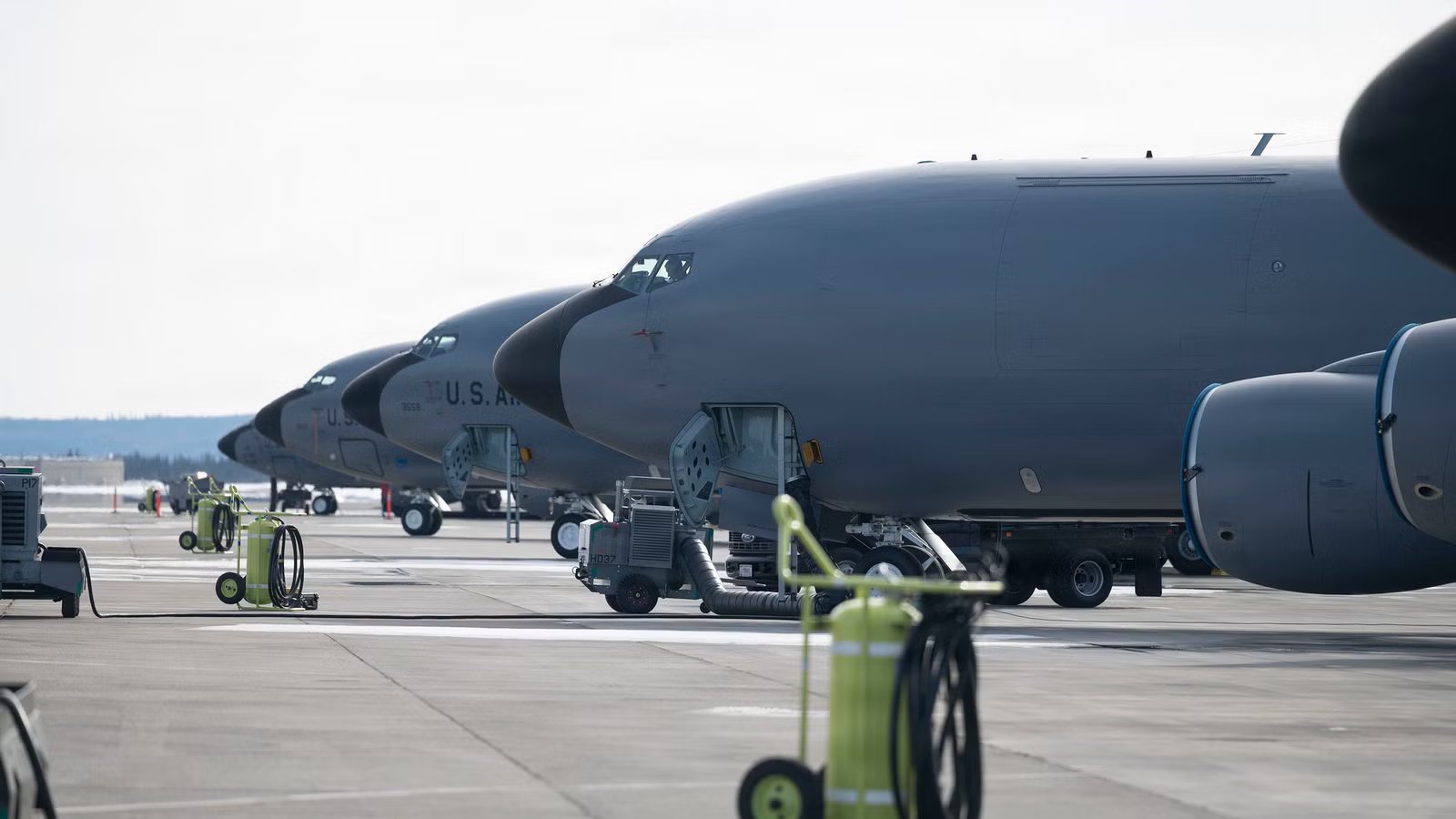
The Boeing KC-135R Stratotanker registered 57-1419 is famous for being the oldest jet aircraft in US Air Force combat service. As the first two numbers of its registration indicate, the aircraft was built in 1957, although its original Pratt & Whitney J57 engines have been replaced with more modern CFM F108 turbofans. The final KC-135 was delivered to the United States Air Force in 1965, by which time Boeing had produced 732 examples for the service.
Today, the Air Force’s fleet of roughly 370 remaining KC-135s is between 61 and 69 years old. With the Air Force set to keep some portion of the fleet operating through the 2030s and 2040s, some airframes may serve for close to 100 years. These old tankers are set to outlive the B-1B Lancer and B-2 Spirit bombers and serve the B-21 Raider deep into the 2040s. A future 2030 raid could see the Air Force’s newest and most cutting-edge combat aircraft enabled by an early Cold War relic.
Why The Air Force Is Purchasing More KC-46s

The Air Force is grappling with multiple pressures. One is that the KC-135 is aging, and some airframes need to be retired; another is a lack of funds to develop a next-generation replacement. There is also the issue that the interim KC-46 Pegasus has teething developmental issues that isn’t expected to be solved before 2030. Yet another pressure is that Congress raised the minimum number of tankers the Air Force is required to have from 466 to 502 by October 2028.
The United States Air Force had planned to only purchase 179 KC-46 Pegasus tankers to prevent a capability gap between the legacy KC-135 and KC-10 tankers and the planned future stealthy NGAS (Next-Generation Aerial Refueling System) tanker. However, the USAF has run into budgetary problems affording the NGAS, and it is unclear when, if ever, it will be available. At the same time, JetZero is developing a blended-wing-body demonstrator for the Air Force that could serve as a next-generation tanker. The first demonstrator is expected to fly in 2027.
The KC-46 is the only feasible tanker on the market, and so the Air Force has no choice but to buy more to grow the fleet and offset KC-135 retirements. The Air Force now plans to purchase 259 KC-46As, allowing it to retire some of its aging KC-135s, and it is even mulling increasing that order to 319. The Air Force’s Fiscal 2027 budget proposal includes funding requests for 15 more Pegasus tankers. The Air Force also wants Boeing to increase its annual KC-46 tanker production to 18 annually in the period 2028 to 2031.
Slowing Down KC-135 Stratotanker Retirements

While the Air Force retired the last of its KC-10 Extender tankers in 2024, it is in no position to retire its entire fleet of KC-135 Stratotankers. Even if the Air Force were to procure the full proposed fleet of 319 KC-46s, they wouldn’t be fully delivered until deep into the 2030s at the earliest. Additionally, 319 is not enough to meet the requirement of 502 tankers.
In its Fiscal 2027 budget proposal, the Air Force is requesting the divestment of another 20 KC-135 tankers. This will represent a change from its previous one-for-one swap, where it retired one KC-135 for every KC-46 it received. The Air and Space Forces Magazine reported, “The Air Force is planning to retire more tankers than it buys in its fiscal 2027 budget, but an increase in deliveries of new KC-46s next year will cover the gap to ensure the service satisfies a congressional mandate to build up the overall refueling fleet.”
The publication also quoted the Air Force Vice Chief of Staff as saying that the Air Force was “previously retiring a KC-135 every time a KC-46 came off the line. We’re no longer doing that so that we can grow our tanker capacity from 466 to 502.” So while the Air Force will continue retiring and phasing down its KC-135s, it will slow the process down. The Air Force might not be able to fully retire its KC-135 fleet before the 2050s.
From KC-97 To KC-46: A Brief History Of US Air Force Tankers
The first tanker was propeller-driven and today they are based on airliners (the Boeing 707 and 767), but this is soon set to change.
Increasing The KC-135’s Capabilities

While the Boeing 767-derived KC-46 can be understood as a fully military aircraft, built from the ground up as a military jet with structural reinforcing, PW4000 engines, an armored cockpit, etc., the KC-135 is much closer to an adapted civilian airliner. KC-135s are not survivable near contested airspace, while the KC-46 has at least some self-defense and other capabilities. This said, the KC-135s lost in the 2026 Iran air campaign were lost on the ground or in midair collisions.
In June 2026, a US Air Force KC-135R was spotted in the United Kingdom with a new antenna mounted on top of the rear of the fuselage. The antenna is seen as part of an effort to upgrade the networking capabilities of the Air Force’s tankers and cargo aircraft. This includes installing Starshield, a government relative to the commercial SpaceX Starlink.
Boeing KC-135R Stratotanker (per US budget documents) | |
|---|---|
Total procured | 732 |
Number remaining in inventory | Approx. 370 |
Planned Fiscal 2027 divestment | 20 |
Requirement minimum | 502 (by 2028 with KC-46s) |
Planned retirement | Incrementally year-by-year through 2040s |
Even if the Air Force were able to purchase a next-generation stealthy NGAS tanker, it would still have a use for conventional tankers like the KC-46 and KC-135. Most tanker missions are for exercises, to provide an intercontinental bridge, or refueling in permissive skies away from contested airspace. Only a percentage of the fleet would need to be highly survivable, stealthy tankers.
The First B-21 Raider Refueling Image

In March 2026, the US Air Force released the first images of the KC-135 refueling the incoming B-21 Raider. The Air Force stated, “As the most fuel-efficient bomber ever built, the B-21 consumes a fraction of the fuel used by legacy aircraft. This significantly reduces demand for theater tanker logistics and provides commanders with greater flexibility in force packaging.“
Being fuel-efficient is important as it provides more flexibility in mission planning. The Raider can carry more fuel, less payload, and reduce its need for refueling near contested airspace. Or the B-21 can carry less fuel, increase its payload, and/or increase its need for refueling. As a strategic bomber, the B-21 needs the range to strike targets deep behind enemy lines, intercontinentally.
The first two pre-serial production B-21s have been delivered to the Air Force and are undergoing rapid testing to bring the type into service in 2027. According to comments made by Trump (referencing “updated B-2s”), the government may have ordered as many as 28 Raiders. The Air Force plans to purchase at least 100 B-21s and possibly 150 or more. The program appears to be progressing quickly, mostly on time and on budget.
The KC-135 To Fuel The B-21

In its 2023 request for information, the US said, “Anticipated initial operational capability for NGAS is 2040.” That date could slip, although it remains to be seen. For now, the B-21 is set to enter service in 2027 and will depend on the KC-135 and KC-46 for refueling through the remainder of the decade, into the 2030s, and into the 2040s.
As the 2040s progress, it is possible that a mature next-generation stealth tanker may become available. It is plausible that in the 2040s, the B-21s could be refueled by all three tankers on a single mission. If the Raider conducts an intercontinental raid as the B-2 did against Iran in 2025 and 2026, it would require multiple refuelings.
During Operation Midnight Hammer, the B-2 Spirits were refueled almost immediately after takeoff (after gaining altitude). They were later refueled as they transited the Atlantic, over the Mediterranean, and again before heading for the bombing run over enemy territory. A plausible 2040s scenario could see the B-21s refueled by KC-135s over the United States, by KC-46s as they fly intercontinentally over oceans, and then finally by NGAS as they approach contested airspace and make their penetration raid.
5 Fast Facts On The USAF KC-135 Stratotanker Replacement
The KC-135 is being partially replaced by the KC-46A and may be replaced by next-gen aircraft like JetZero BWB and Stunk Work’s NGAS.
Not The Tanker For Combat

As indicated, the KC-135 will continue to serve the Air Force in dwindling numbers through the 2040s. However, its role will increasingly shift and change as more advanced KC-46s become available and as (if) the NGAS eventually enters service. Increasingly, the Stratotanker is likely to be used in domestic and permissive zones, with the KC-46A handling strategic oceanic routes and efforts closer to the frontline.
When the NGAS eventually enters service, it would likely be used in contested/penetration zones where the KC-135 and KC-46 would not be survivable. It is possible that the Air Force could rapidly develop tanker drones before 2040 if an urgent need arose. That said, the only tanker drone on the market is the Navy’s new MQ-25 Stingray.
The Navy’s incoming carrier-based Boeing MQ-25 Stingray drone is set to be a valuable asset. However, it is the wrong aircraft for the Air Force. The Stingray is designed to provide around 15,000 lbs of fuel at 500 nautical miles from the tanker. The USAF’s KC-46A has a capacity for over 212,000 lbs of fuel. For reference, the B-21 is estimated to have an internal fuel capacity of between 110,000 and 120,000 lbs.