dailynewsnblog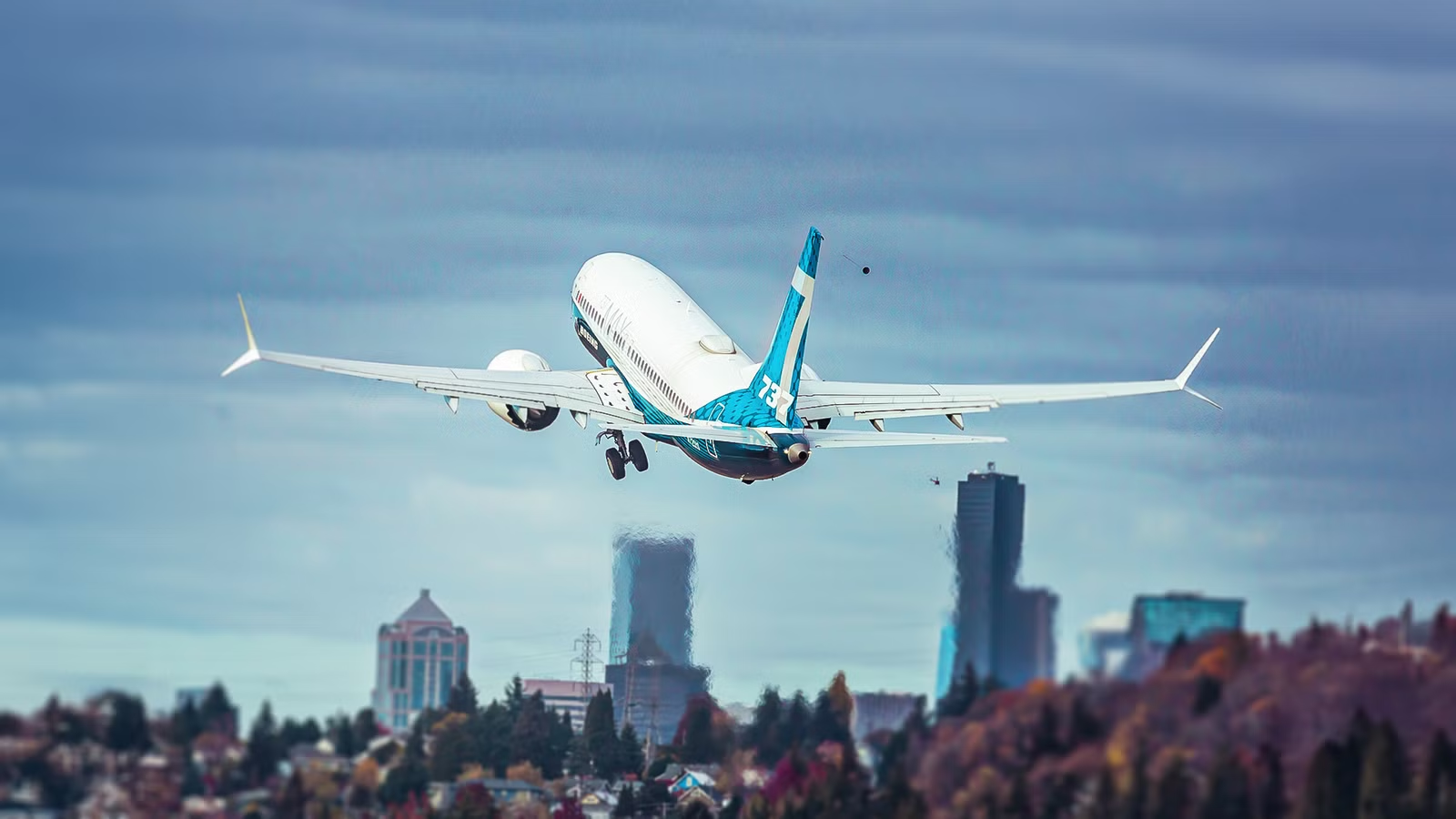
Most people will remember the two fatal crashes involving Boeing 737 MAX aircraft: Lion Air flight 610 in 2018 and Ethiopian Airlines flight 302 in 2019. These accidents exposed a flight-control system that, at the time, was largely unknown outside Boeing’s engineering community: the Maneuvering Characteristics Augmentation System, or MCAS. The US planemaker introduced MCAS on the 737 MAX after identifying changes in the aircraft’s pitch characteristics associated with its larger engines and their position on the airframe.
The system was intended to help stabilize the aircraft’s pitch under specific flight conditions. Indeed, this helped the aircraft maintain its intended handling characteristics. However, the two crashes exposed serious problems with the system’s design, its reliance on angle-of-attack (AOA) data, and the way its operation had been communicated to pilots. Following the crashes, the manufacturer updated the system and introduced several changes to its design.
Why Boeing Introduced MCAS

When Airbus launched the A320neo, the aircraft quickly secured major orders from airlines around the world. Boeing was therefore keen to offer a competitive alternative without investing in an entirely new aircraft design. Thus, it updated its existing 737 platform and launched the 737 MAX family. Notably, the new aircraft introduced larger engines than those used on earlier 737 variants, but the 737’s low ground clearance meant that the engines could not simply be mounted in the same position.
To accommodate their larger diameter, the US planemaker positioned them higher and further forward on the wing. However, this changed the aircraft’s aerodynamic characteristics and affected its pitch behavior during steep climbs or high-power maneuvers. During testing, the 737 MAX showed a tendency to pitch up more aggressively than earlier 737 variants. If the difference in handling characteristics had been significant enough, regulators could have required additional simulator training or a separate pilot type rating.
Boeing didn’t want to do that, so it instead opted for a software-based solution intended to preserve handling commonality with the 737NG. That system was the MCAS. It could automatically adjust the horizontal stabilizer to lower the aircraft’s nose if it began to pitch up too aggressively. However, this same system was responsible for both fatal 737 MAX crashes in 2018 and 2019.
Introduction Of The 5.5-Degree Rule

MCAS relied on input from a single AOA sensor. The sensor sent data to the 737 MAX’s flight-control software, which could command the aircraft’s nose down if it detected a high angle of attack that suggested an approaching stall. However, AOA sensors can fail, and in both crashes, incorrect data from a sensor caused MCAS to repeatedly command the aircraft’s nose down even though the aircraft was not actually approaching a stall.
In fact, former Boeing engineers and aviation analysts interviewed by CNN also criticized the original software design for relying on data from a single AOA sensor, arguing that the devices were vulnerable to defects. That being said, since the initial crash, Boeing has been updating the MCAS software on the 737 MAX. The manufacturer enhanced MCAS in three ways. One of the main changes is that the system would compare information from both sensors instead of relying on one before activating.
If the difference between the two readings exceeds 5.5 degrees, MCAS will stop working, and pilots will be alerted by an “AOA Disagree” warning message built into the cockpit display. This warning is now always enabled, regardless of whether the airline has the optional AOA Gauge, whereas previously it was optional. Additionally, the redesigned MCAS can activate only once during a high-AOA event and does not provide more nose-down input than a pilot can manually counteract using the control column alone.
Boeing Also Changed Pilot Training

Furthermore,  Boeing also improved the training procedures for 737 MAX pilots. At the time of the two crashes, the pilots were unaware of the MCAS system and had not been properly trained or briefed on how it could behave. Investigations later revealed that MCAS had been excluded from pilot manuals and training materials.
In fact, CBS News reported at the time that US pilots were initially given just 56 minutes of training on the iPad regarding the differences between the 737 MAX, which entered service in 2017, and earlier 737 models. In both crashes, the pilots were responding to something they did not expect, and assumptions about how flight crews would react under pressure failed to hold. The system’s repeated nose-down inputs overwhelmed the control yoke, and using the manual trim wheel to recover the aircraft proved extremely difficult within the available time and energy conditions.
The two crashes led to the global grounding of the 737 MAX. Since then, Boeing has added comprehensive training with new requirements that were evaluated and validated by regulators. This includes new computer-based training modules, updated documentation and simulator training designed to give 737-type-rated pilots a better understanding of the MAX’s flight-control systems, the effects they could have on the flight deck and the procedures required to respond to them.
Boeing And The FAA Missed Key Warning Signs During Certification

Had Boeing and the Federal Aviation Administration (FAA) been more careful during the original certification process, the outcome could have been very different. A July 2020 report by the Department of Transportation’s Inspector General found that Boeing had downplayed the power and scope of MCAS during the 737 MAX’s certification, while the FAA’s delegation system had left the original single-sensor design without meaningful independent oversight.
MCAS was initially presented to the FAA as a relatively minor modification of the 737’s existing speed trim system. Boeing described the system as one that would not activate often, meaning it did not receive the same level of detailed review or discussion that a more significant flight-control system might have received. So, as certification work progressed, the regulator focused on other changes to the 737 MAX, including its larger engines and modified landing gear.
But the problem became even more significant when the manufacturer expanded MCAS so that it could operate during a wider range of flight conditions, including low-speed stalls. It failed to fully disclose later changes that significantly increased MCAS’s ability to command the aircraft’s nose down. The FAA had already approved an earlier version of the system, and the later changes were not subject to a second review because they were not classified as affecting critical performance characteristics under the existing regulations.
Boeing’s Next Step For AOA Monitoring

Currently, Boeing is working on further enhancements to the 737 MAX’s AOA monitoring systems. After the crashes, the European Union Aviation Safety Agency (EASA) pushed for the addition of a third sensor to independently calculate an AOA reading and supplement the two existing sensors. However, in January 2021, the agency agreed to allow the 737 MAX to return to service after Boeing committed to developing a “synthetic” sensor that would calculate AOA data using information from different sources.
Boeing is now flight-testing the synthetic AOA system on the 737 MAX 10. The system uses multiple aircraft parameters to determine whether an AOA signal is accurate. It is intended to provide another layer of protection by identifying erroneous readings before they can trigger unwanted flight-control responses. In 2021, a Boeing official told Aviation Week that the system would monitor five different parameters to determine whether an AOA signal was erroneous. If the system identifies an incorrect signal, it can suppress it.
The US planemaker has also been working on additional monitoring systems and a switch that would allow pilots to disable the stick shaker if it were activated by an erroneous AOA indication. The manufacturer is currently flight-testing the technology on the 737 MAX 10, as it continues work towards certification. Both the 737 MAX 7 and MAX 10 aircraft have faced repeated delays, although FAA Deputy Administrator Chris Rocheleau recently told Reuters that the MAX 7 certification was “literally around the corner”, with the MAX 10 expected to follow.

To conclude, AOA sensors play an important role on the 737 MAX because they send data to the aircraft’s flight-control systems, including information that can trigger MCAS to push the aircraft’s nose down if it detects an imminent stall. It is therefore important that the data they provide is accurate. The FAA has received at least 216 reports since 2004 involving AOA sensors that failed or required repair, replacement, or adjustment.
Around one-fifth of those reports involved Boeing aircraft, and in some cases faulty sensors triggered stall warnings that forced pilots to reject takeoffs or make emergency landings. The two 737 MAX crashes showed the consequences of faulty AOA data. Boeing has since changed how MCAS uses sensor information and added further safeguards to the system.
The 5.5-degree rule is one of the most important changes to MCAS and provides an additional layer of protection. If the two AOA sensors produce readings that differ by more than 5.5 degrees, MCAS is automatically disabled. This prevents conflicting AOA data from triggering the system and repeatedly commanding the aircraft’s nose down, as happened in the two fatal crashes.