dailynewsnblog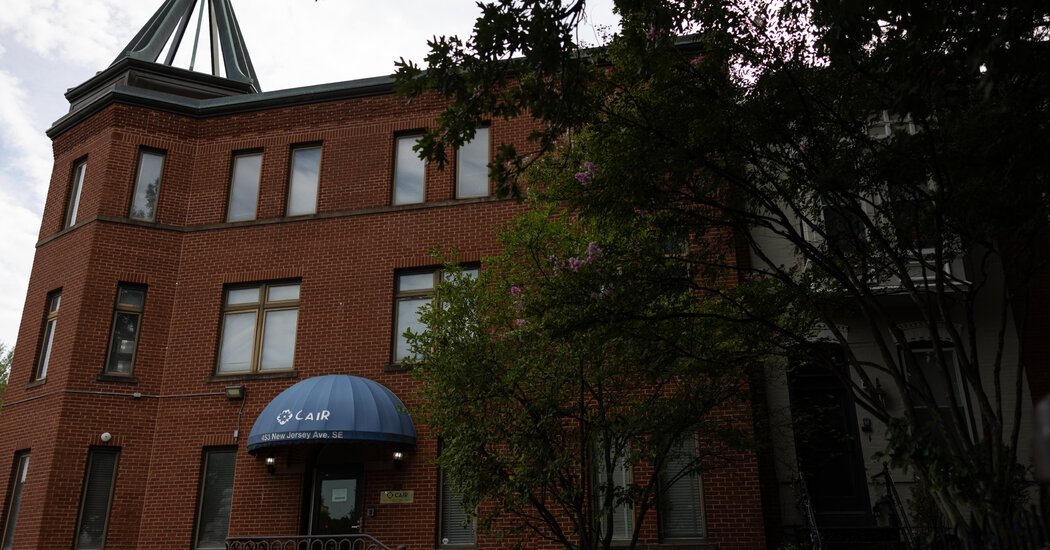
In the United States, determining whether a group should be labeled a terrorist organization has largely been the domain of the federal government, which, in making such decisions, can draw on its vast domestic antiterror infrastructure and globe-spanning intelligence services.
Now some Republican governors are getting into the game. In recent months, the leaders of Texas and Florida have officially designated a handful of groups as terrorist organizations. And notably, in a time of rising Islamophobia, both states have conferred the designation on the Council on American Islamic Relations, or CAIR — one of the largest Muslim civil rights groups in the country.
This new state-level effort has triggered fresh civil liberties concerns from some legal scholars. For CAIR, a 32-year-old nonprofit with headquarters in Washington and chapters in more than 20 states, the terrorism labels open a challenging new front in its long-running feud with American conservatives, many of whom accuse the group of having ties to violent extremists, despite its many protestations to the contrary.
CAIR is challenging the Texas and Florida terror designations in court, arguing that they violate its rights to free speech, assembly and due process. The stakes are high, particularly in Florida, where a new law makes it a felony to knowingly offer “material support” for a designated terrorist organization, and allows the state to dissolve such groups in some situations. If the law survives, it is likely to force the permanent closure of CAIR’s Tampa-based state affiliate, which says it represents a Muslim community in Florida that numbers more than half a million people.
Gov. Ron DeSantis did not respond to requests for comment for this article, nor did numerous sponsors of the new Florida law. In addition to addressing terrorism, the law also nods to conservative fears of Islamic influence by limiting the use of Muslim religious rules, known as sharia, by courts and certain other government bodies.
In a social media post promoting the law, Mr. DeSantis wrote, “We have a responsibility to defend and reinvigorate Western Civilization and that means protecting against creeping sharia in all its forms.”
Lawyers for CAIR, in court documents, wrote that the group does not “engage in ‘terrorist activity,’” and accused Mr. DeSantis and other Republican state officials of being motivated by anti-Muslim bias. Representatives of CAIR declined requests for an interview.
Whether CAIR should be viewed as a benign civil rights group, a group with an unsettling history of connections to Hamas and the Muslim Brotherhood, or something in between is a matter of debate that has dogged the group for decades.
In court documents, the group’s lawyers say that CAIR’s mission is “to enhance the public’s understanding of Islam, protect civil rights, promote justice, and empower American Muslims.” On its website, the group condemns “all acts of violence against civilians by any individual, group or state,” including those carried out by Hamas. It also declares itself to be “a natural enemy of violent extremists.”
But both governors have noted that the group was listed, along with 200 other groups and individuals, as an unindicted co-conspirator in a terrorism financing case against a charity, the Holy Land Foundation, which resulted in the 2008 conviction of the charity and five of its leaders. CAIR was not accused of a crime in the case; more broadly, CAIR’s lawyers say the group has “not committed, or even been charged with, a crime.”
In December 2023, the Biden White House condemned CAIR’s director, Nihad Awad, after it was revealed that he had told a group, American Muslims for Palestine, that he was “happy to see” Palestinians “break the siege, the walls of the concentration camp, on Oct. 7,” the day of the Hamas-led attack on Israel, killing roughly 1,200 people. Mr. Awad, who declined through lawyers to comment for this story, has said that his remarks were taken out of context.
More recently, some Republicans in Washington have taken to targeting CAIR, at a time when prominent conservatives have been portraying Islam as incompatible with American values. In 2016, Mr. Trump, in an interview, stated, “I think Islam hates us.”
Earlier this year, the Department of Health and Human Services launched an investigation of CAIR’s use of federal money that was meant to aid in Afghan refugee resettlement. Last year, Senator Tom Cotton called upon the Department of Education to “ensure that CAIR is not given an opportunity to push its radical, pro-terrorist, anti-Israel ideology on American schoolchildren.” In January, Representative Jason Smith, chairman of the House Ways and Means Committee, asked the Internal Revenue Service to revoke the tax-exempt status of CAIR’s California chapter for, among other things, supporting pro-Palestinian student protesters on college campuses.
“CAIR is probably at a place where it’s in the most danger than it’s ever been before,” said Farid Senzai, an associate professor of political science at Santa Clara University who studies Muslims in America.
The states are shaping up as potential battlegrounds. This year, bills were introduced in a number of Republican-led states, including Louisiana, Oklahoma and Arizona, that would have given state officials the power to designate groups as terrorist organizations, according to Elly Page, a senior legal adviser with the International Center for Not-for-Profit Law. Those proposals did not become law, but in Indiana, a new law allows the governor to designate groups as “affiliates” of federally designated terror groups.
Some legal scholars fear that state governments could designate groups as terrorist organizations without access to the classified intelligence and other expertise that the U.S. State Department relies on for its official list of foreign terrorist organizations. The State Department list includes Mexican drug cartels, a number of regional and country-specific affiliates of ISIS and branches of the Muslim Brotherhood in Lebanon and Sudan.
At the state level, “it’s unvarnished politics all the way through,” wrote Darryl Li, a legal scholar who teaches at the University of Chicago, and Shirin Sinnar, a professor at Stanford Law School, in an article earlier this year.
In an interview, Ms. Sinnar, who filed a friend of the court brief opposing the Florida law, said that conservatives should be wary of state laws that could, under Democratic governance, be wielded against groups that they tend to favor. In 2019, she noted, the San Francisco board of supervisors labeled the National Rifle Association a domestic terrorist organization. (The city pulled back after the N.R.A. sued on First Amendment grounds).
In Texas, Gov. Greg Abbott designated CAIR as a terrorist organization in November, citing testimony from the Holy Land Foundation trial in which an F.B.I. agent described CAIR as a front group for Hamas. (The group denies the accusation.)
Mr. Abbott said his designation bans CAIR from buying or acquiring land in the state. It also authorized Ken Paxton, the attorney general, to sue to shut the group down. Mr. Paxton, a fellow Republican, filed such a suit in February.
In a statement, Andrew Mahaleris, a spokesman for Mr. Abbott, said the governor’s actions “are targeted at radical groups who support terrorism or that seek to forcibly impose sharia law on Texans.”
CAIR is challenging the designation and Mr. Paxton’s lawsuit. But some Texas Muslims say they already feel the effects.
Azfar Saeed, 52, a former board president of Islamic Center of Frisco, Texas, said that several mosques and Muslim groups are trying stay away from CAIR, for fear of being entangled in any sort of financially crippling legal trouble.
Mr. Saeed said that there is nothing to the assertion that CAIR supports terrorism. “It’s so obviously politically motivated,” he said. “What is that new fear that can deliver voters? Obviously, Muslims are the new boogeyman here.”
In Florida, Governor DeSantis, a staunch supporter of Israel, has a long history of feuding with CAIR Florida, which has proclaimed its support for Palestinians and their “fundamental right to be free from the Israeli occupation.”
Soon after Mr. DeSantis took office in 2019, the group criticized the governor for threatening to retaliate against Airbnb over its short-lived policy that banned property listings in the occupied West Bank. In 2023, in the middle of intense campus protests over the Israel-Hamas war, CAIR sued Mr. DeSantis and other state officials on behalf of a local chapter of Students for Justice in Palestine after the state tried to shut down the group at two public universities.
In December, Mr. DeSantis issued an executive order declaring CAIR to be a terrorist group, but the move was temporarily blocked by a federal judge in March.
The next month, Mr. DeSantis signed the new terror law, which allows the head of the Florida Department of Law Enforcement to recommend the designation to the governor and his cabinet for approval.
He later signaled his intention to declare CAIR, the Muslim Brotherhood and Antifa, a loose movement of left-wing activists, as terrorist groups under the new law.
CAIR sued, which has temporarily delayed the law’s implementation.
If the designation eventually takes effect, CAIR supporters like Salma Khan fear that it would leave a vacuum for Muslims in Florida. Ms. Khan, 30, a consultant in the biopharmaceutical industry, lives in Boston but grew up in Florida. In November 2023, she said, she was in the Fort Lauderdale-Hollywood International Airport after visiting her parents when a man began verbally harassing her. She said that CAIR’s Florida chapter helped pressure local law enforcement to bring charges against him.
“I think this could be catastrophic, to be honest,” Ms. Khan said. “I’d be deeply concerned about young Floridian Muslims in public schools.”