dailynewsnblog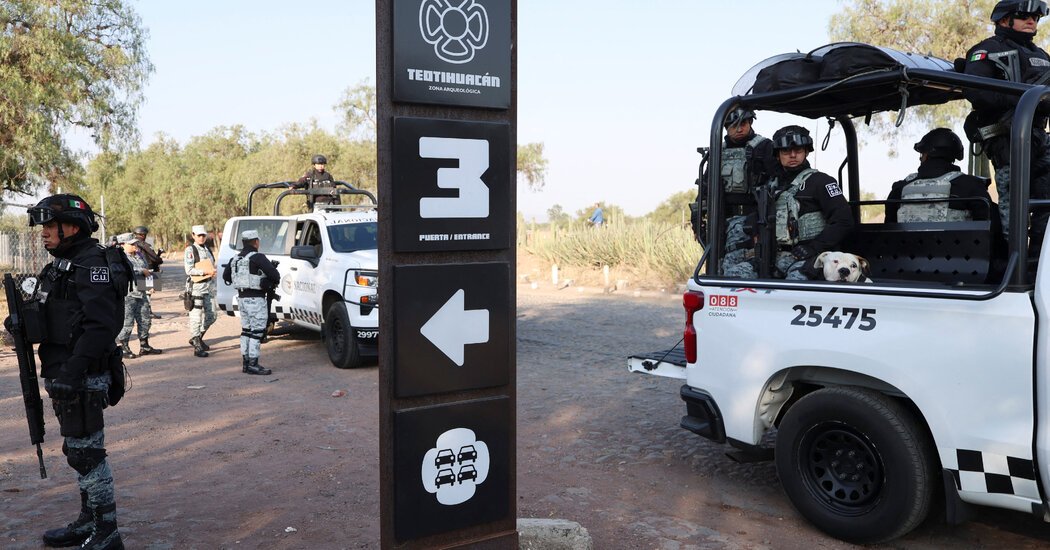
On Sunday, Julio César Jasso Ramírez checked into a hotel near one of Mexico’s most popular tourist destinations, the Teotihuacán pyramids, Mexican officials said on Tuesday. The next morning, he took an Uber to the archaeological site, climbed up the Pyramid of the Moon, which in ancient times was used as a stage for performing ritual sacrifices, and opened fire.
Mexican officials are still trying to piece together what led Mr. Jasso, 27, to shoot into a crowd of tourists, killing a Canadian woman and wounding several other foreign visitors.
But some details revealed by the authorities on Tuesday point to a troubled man who may have drawn inspiration from the perpetrators of previous massacres in the United States.
“He acquired weapons, knives, backpacks, gloves, goggles — all the equipment he thought would be useful for carrying out his objective,” José Luis Cervantes Martínez, the attorney general of the State of Mexico, said at a news conference.
After security forces responded to emergency calls and set up a perimeter around the Pyramid of the Moon, Mr. Jasso fired down at the soldiers from above. Two Mexican National Guardsmen and a municipal police officer maneuvered to the sides and back of the pyramid “to bravely and riskily climb” the structure, said Guillermo Briseño Lobera, the commander of the National Guard.
As the soldiers and officer reached the gunman on the pyramid’s second tier, he climbed even higher up the steep stone steps. A National Guardsmen then shot him in the leg, Mr. Briseño said, immobilizing him.
Mr. Jasso, a Mexican citizen from Guerrero state, then grabbed his handgun, a .38-caliber revolver, and took his own life.
In his backpack, which he carried with him during the attack, the authorities found literature, photos and notes on scraps of paper “allegedly related to violent events that are believed to have occurred in the United States in April of 1999,” Mr. Cervantes said. He did not provide further details, saying that the content of the messages was part of the investigation.
The notes may have been a reference to the Columbine High School massacre, in which 12 students and one teacher were killed on April 20, 1999, exactly 27 years earlier. But according to data compiled by the Violence Prevention Project Research Center, another U.S. shooting also took place in April 1999. In that one, two people were killed in Salt Lake City.
“The evidence gathered so far suggests a psychopathic profile of the aggressor,” Mr. Cervantes said, “characterized by a tendency to copy situations that occurred elsewhere, at other times and involving other individuals.”
Preliminary evidence, including the notes in the backpack, suggested that Mr. Jasso worked alone to carry out the shooting and that he planned extensively for it, visiting the pyramids multiple times before the attack, the authorities said.
The authorities said they were investigating how the shooter obtained the gun and the bullets he used during the attack, noting there were more than 50 unfired rounds found in his bag.
The cartridges used in the attack were made by a Mexican manufacturer, which produces them for the exclusive use of the Mexican military and the police, according to Mr. Cervantes. The gunman could have acquired them in a number of ways, he added, including on the black market.
A video circulating on social media, which was verified by The New York Times, captured the audio as some of the tourists on the Pyramid of the Moon were crying and lying on the ground while Mr. Jasso threatened them.
“If you move, I will sacrifice you,” he said, using several expletives and speaking in a distinctive Peninsular Spanish common in Spain. “This was built for sacrifice, not for you to come and take your little photos.”
A woman is heard whispering, “Don’t turn around, don’t turn around.”
Mr. Jasso then addressed a tourist, telling him to leave and tell the authorities that he had hostages on the pyramid. “And if they try to come up,” he said, “I’ll kill them.”
The Mexican authorities said that 13 people, including six Americans, were injured during the episode. Seven of them sustained gunshot wounds, including two minors from Colombia and Brazil. The Canadian Embassy in Mexico City said that it could not share any personal information about the woman who was killed because of the country’s privacy laws.
The shooting at the Teotihuacán pyramids, which last year drew 1.8 million visitors, is believed to have been the first such violence at any major Mexican archaeological site in modern history.
President Claudia Sheinbaum of Mexico said on Tuesday that the authorities were still trying to understand Mr. Jasso’s motives, but that he had been influenced by events beyond Mexico.
“We’d never seen anything like this in Mexico,” she said. “This is not something linked to organized crime, but rather the act of an individual who made this decision.”
Mass shootings not related to cartel violence are uncommon in Mexico, where gun laws are very restrictive and where there are only two legal gun shops, both operated by the military. The latest example occurred late last month, when a 15-year-old student in Michoacán state, in western Mexico, took an AR-15-style rifle to his high school and opened fire, killing two teachers.
Since 2000, there have been at least 143 incidents involving firearms in schools across Mexico, according to Víctor Sánchez, a Mexican security researcher. Twelve people were killed during that period.
Arijeta Lajka contributed reporting.