dailynewsnblog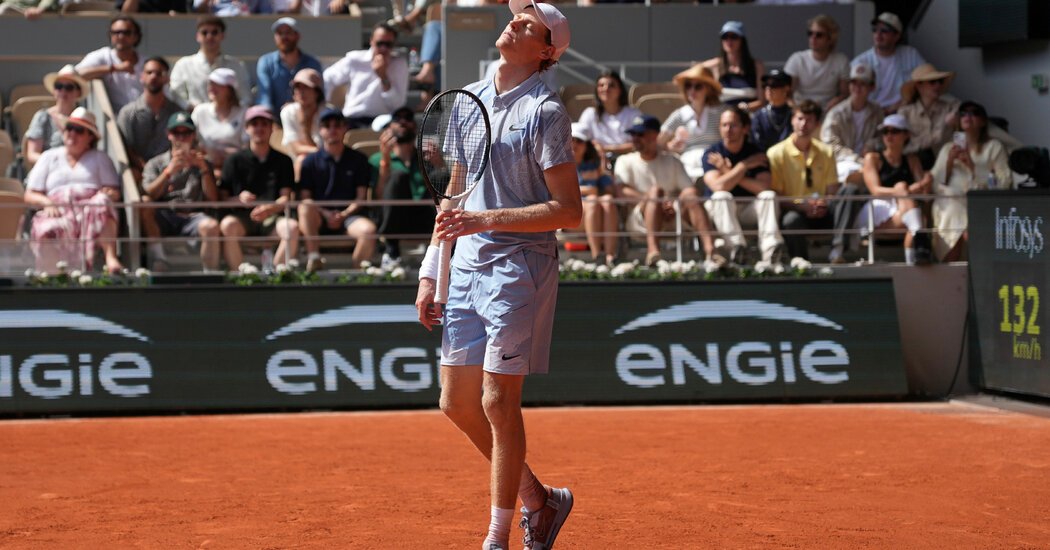
My head is already halfway in the World Cup that kicks off Thursday (more on that below). But before that, another big sporting event wraps up this weekend: the French Open. And things have gotten weird there.
Tennis fans say this year is unlike anything they’ve ever seen. None of the big-name players will be in the finals. (Imagine a World Cup where all the big teams — Spain, Brazil, Germany, France, Argentina, England — are eliminated in the group stage.) The result, writes my colleague Adam Pasick, is tennis that has been very confusing — but also very exciting.
Something peculiar is happening to the world’s best tennis players in Paris. They’re losing.
The pinnacle of professional tennis is usually stable. On the men’s side, Italy’s Jannik Sinner and Spain’s Carlos Alcaraz have dominated the four big Grand Slam tournaments for the last few years. Novak Djokovic, arguably the best men’s tennis player ever, is, at 39, hanging in through sheer force of will. Only one other man currently in the top 20 has ever won a Slam (The full list: the Australian Open; Roland Garros a.k.a. the French Open; Wimbledon; and the U.S. Open).
For the women, there’s more variability at the top — 10 different women have won a Slam in the last five years. But there’s still an established pecking order, with Aryna Sabalenka of Belarus currently at the top.
All of that was upended at this year’s French Open.
Alcaraz did not play because of a troubling wrist injury. Then, an earthquake: Sinner, who had been on a dominant winning streak, was only four points from victory when he wilted in the extreme heat. He lost 18 straight points and fell in five sets to Argentina’s Juan Manuel Cerúndolo, ranked 56th in the world.
The upset wave was only just getting started. Djokovic uncharacteristically gave up a big lead and lost to the talented Brazilian teenager Joao Fonseca. The men’s field now has only one highly seeded player remaining: Germany’s Alexander Zverev. He has never won a Grand Slam, and the three other remaining men have never even made it to a semifinal before.
On the women’s side, top seeds including Iga Swiatek, a four-time French Open champion, and Coco Gauff, the defending champion, were all knocked out early. That left Sabalenka — but then she, too, suffered a disastrous collapse. She lost 12 of the last 13 games to the Russian Diana Shnaider.
On Thursday, Shnaider was in turn defeated in the semifinal by Maja Chwalinska of Poland, who became the lowest-ranked player in 40 years to make the French Open final. She’ll face another Russian, Mirra Andreeva.
The run of upsets has been a mixed bag for fans: They have seen high drama and genuine surprises, but will not get to see the biggest stars play in the tournament’s biggest moments.
The French Open has been thrown wide open. This is the biggest year for upsets at the tournament in more than half a century.
‘Upsets can be contagious’
Tennis is usually predictable: The favorites win more than 70 percent of the time, the most of any major sport.
But there are some unusual factors at play in this tournament.
It was 32℃ when Sinner lost, clearly suffering from cramps and heat exhaustion. Sabalenka was undone by high winds. Injuries were also a factor. Many top players didn’t make it to Paris, or were beaten by younger, healthier upstarts.
But Sinner’s opponent was playing in the heat too. There may be more mysterious forces at work. “Upsets can be contagious,” the tennis writer Christopher Clarey said in his newsletter. “The 2026 French Open is officially nuts.”
Roger Federer, another contender for the title of greatest men’s tennis player of all time, once gave a speech to a group of college graduates about the inherent unpredictability of the sport — and of life itself.
“In the 1,526 singles matches I played in my career, I won almost 80 percent,” he said. “What percentage of points do you think I won in those matches? Only 54 percent. When you lose every second point, on average, you learn not to dwell on every shot.”
“The truth is,” he concluded, “whatever game you play in life, sometimes you’re going to lose.”
MORE TOP NEWS
Remembering Marjane Satrapi
Marjane Satrapi, the Iranian-French author of the graphic novel series “Persepolis,” has died at 56. Her work, which was adapted into an Oscar-nominated animated film, introduced millions to the struggles of ordinary Iranians during the Islamic Revolution.
Satrapi was one of the best-known exponents of a form of graphic novel — influenced by Art Spiegelman’s “Maus” — that combined political history and memoir. She wrote frequently about her perpetual sense of dislocation. In 2009, she wrote, “I call Iran home because no matter how long I live in France, and despite the fact that I feel also French after all these years, to me the word ‘home’ has only one meaning: Iran.”
TOP OF THE WORLD
The most clicked link in your newsletter yesterday was about Winston Churchill’s paintings.
SPORTS
World Cup: Mehdi Taj, the president of Iran’s soccer federation, described in a rare interview how he’s working to get his team to Mexico for the tournament.
Formula 1: As the Monaco Grand Prix kicks off, here’s what to know about one of the jewels in F1’s crown.
ONLINE COMMUNITY OF THE DAY
That’s the term coined by a group of influencers who have amassed large followings by sharing their experiences with unimaginable loss. Often discouraged from expressing their pain in real life, they have turned to social media to break the silence.
MORNING READ
Pommelien Thijs is one of Belgium’s biggest pop stars. And she’s virtually unknown in roughly half of her country.
Thijs, 25, is from Flanders, the Dutch-speaking part of Belgium. She recently played five sold-out shows in arenas packed with 20,000 fans. Her song “Atlas” last year topped a major pop chart for 22 weeks. Yet in Wallonia, the French-speaking part of Belgium, people are asking: Who is this woman?
It highlights how language can still be a dividing line in pop music. In an interview, Thijs said she found nothing unusual about being a star in only half of her country. “It is what it is,” she said with a laugh. Read more about the star, and the language barrier.
AROUND THE WORLD
The last straw
A feud is dividing the “master thatchers” who make and maintain straw roofs for traditional English country cottages.
For purists, the only acceptable thatch is “long straw,” typically from cereal straws like wheat. It’s believed to be England’s original roofing material, dating back to the Bronze Age. Then, there’s water reed, the more durable alternative that’s cheaper and increasingly imported from places like Eastern Europe and China.
To the untrained eye, the difference is hard to discern — one reason long-straw roofs are threatened with extinction. But for the master thatchers, the reed-versus-straw debate provokes enormous emotion and even fisticuffs. See if you can tell the difference.
RECIPE
A playful take on the classic tiramisù, this recipe swaps espresso-soaked ladyfingers for ones soaked in cranberry juice. Cranberry sauce drizzled between the airy cream layers delivers a tart, fruity bite.
WHERE IS THIS?
Where is this beach?
BEFORE YOU GO …
It’s almost World Cup time. I don’t know about you, but in my family we’re literally counting down the days with a calendar on the fridge. My son has been working for weeks to complete his World Cup sticker book. My daughter is bouncing around the house in a Germany cap (luckily Wales didn’t qualify, so there’s no conflict). My brother has set up a family sweepstakes.
The World Cup is this moment every four years when proper football fans and excitable part-timers like me become totally obsessed.
It’s not just about winning (though it is, of course — Germany’s 1-0 triumph over Argentina in extra time in the 2014 final was the best). It’s also the magic of millions of people uniting in the thrill and joy of the beautiful game, geopolitics and division and even war notwithstanding.
A new book tries to capture this unifying power: “We Are the World (Cup)” by Roger Bennett, a football-crazed Englishman who now lives in America.
“When two teams take the field, their nation’s history and politics and culture take the field alongside them,” Roger told me in an email. Football “always holds a mirror up to the society that surrounds it,” he said.
But it manages to transcend societies, too — at least most of the time. We’ll see at the end of this particular tournament what ended up being a bigger deal, the politics or the football.
The other thing that brings people together during the World Cup is, of course, the anthem. It’s not the first time that Shakira is doing the honors. Get in the mood with “Dai Dai” by her and Burna Boy. (Although the unofficial anthem by IShowSpeed might win on vibes!)
Have the best weekend! — Katrin
TIME TO PLAY
Here are today’s Spelling Bee, Mini Crossword, Wordle and Sudoku. Find all our games here.
Adam Pasick was our guest writer today.
We welcome your feedback. Send us your suggestions at theworld@nytimes.com.