dailynewsnblog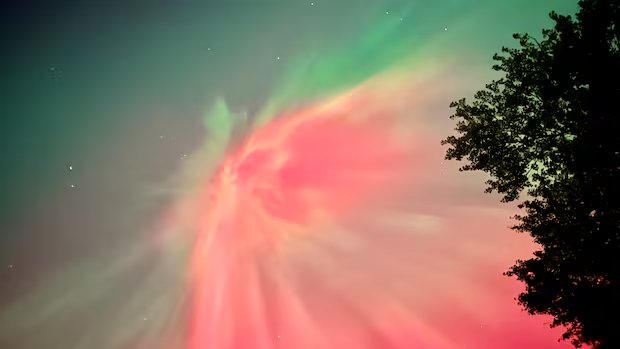

Listen to this article
Estimated 3 minutes
The audio version of this article is generated by AI-based technology. Mispronunciations can occur. We are working with our partners to continually review and improve the results.
Canadians could be in for another beautiful display of the northern lights tonight, after the sun unleashed several fast-moving particles in Earth’s direction.
In recent days, the sun has been active, with sunspots spewing out magnetic energy and three releases of fast-moving particles called coronal mass ejections (CMEs).
These CMEs are travelling extremely quickly along the solar wind and are heading toward Earth. In fact, the two may merge into what is called a “cannibal” CME.
When these particles interact with Earth’s magnetic field, there’s a display of the northern lights, or aurora borealis.
Normally, the beautiful show of dancing lights is seen in northern latitudes, but if there is a strong enough CME, they could be seen farther south.
Remember the May 10, 2024, northern lights display that could be seen as far south as the Caribbean? That was the result of a cannibal CME.
The National Oceanic and Atmospheric Administration’s Space Weather Prediction Center (SWPC) is calling for a strong geomagnetic storm tonight and into Friday.
Geomagnetic storms are measured on a scale from G1 to G5.
“The current forecast calls for combined CME arrival around mid-afternoon EDT of June 4, with up to G3 levels possible afterwards,” the SWPC said in an update on its website. “CME passage would likely continue into the evening and possibly overnight hours of June 5.”

A satellite captured several solar flares on the surface of the sun over the past few days.
Forecasting the northern lights is difficult, but the SWPC said there’s a fair level of confidence in it arriving to Earth, but they are still uncertain about the intensity.
“Intensity is more uncertain due to the complex circumstances observed with these CMEs. Up to G3 storm levels are the best consensus, with a chance of G4.”
The intense northern lights display in May and October 2024 was the result of G5 storm levels.
How to see them
There’s no guarantee with forecasts like this, as several things have to go right.
The auroral hole — along which the CME’s particles travel — must be dipping south. The farther south it dips, the farther south they will be visible. And the storm needs to hit while it’s dark.
If you have clear skies, try to get away from city lights. The darker the sky, the better chance you’ll have at seeing them. You can also try using your phone to photograph them, even if you can’t see them yourself.

A powerful solar storm made northern lights visible to millions of people across Canada and around the world in areas usually too far south to see them. Many posted vibrant images on social media.
And try looking toward the north. For those farther south, such as in southern Ontario, be sure to get a good vantage point of the northern horizon.
That said, the 2024 storms were so powerful that the northern lights were visible in the southern part of the sky.
If you want to know when and if the aurora are visible from your location, numerous apps, such as Aurora Now, will provide that information.
To get the best view, be sure to look to the west after sunset to see a beautiful pairing of Jupiter and Venus.