dailynewsnblog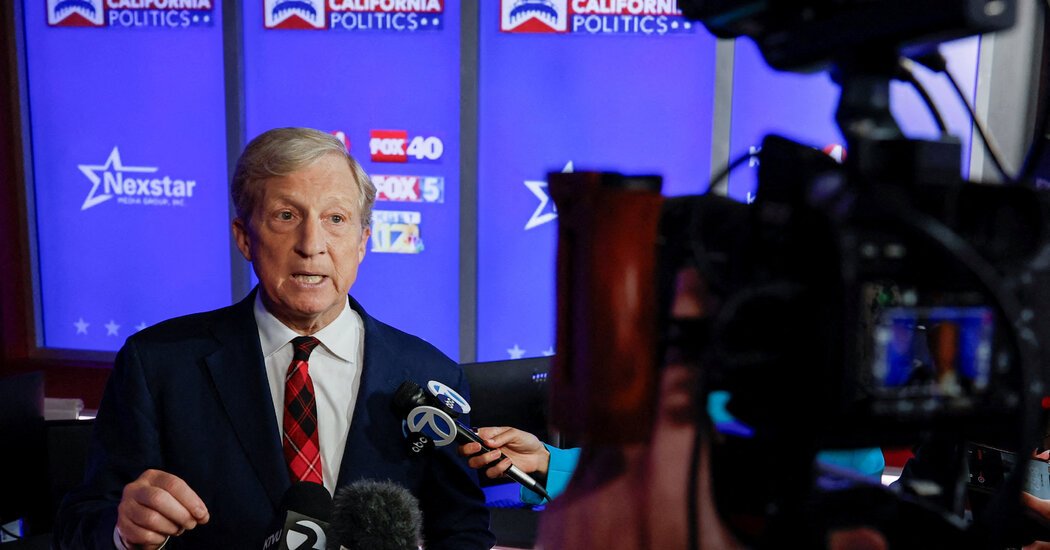
Tom Steyer, one of the front-runners in the California governor’s race, has said that he “walked away” from the hedge fund he managed years ago to “focus full-time on fighting climate change.”
Mr. Steyer did step down as the chief executive of Farallon Capital, one of the nation’s largest hedge fund firms, in 2012. But his financial records show that he never fully cut ties with the investment firm he founded even as it solidified its role in recent years as a major lender to the coal industry as mainstream banks faced environmentalist pressure to stop funding coal mining.
Mr. Steyer has become a leading Democratic contender in the California governor’s race since the sudden withdrawal of Eric Swalwell last month. His wealth, and how he got rich, has become a focal point in the race, given growing voter concerns about the influence of billionaires.
Mr. Steyer’s campaign says that he has asked Farallon to separate his funds from the company’s investments in fossil fuels. But it is difficult to assess where Mr. Steyer’s sprawling portfolio of hedge funds, private equity and venture capital is invested. The public only gets periodic glimpses into his fortune, which is $2.4 billion, according to a recent Forbes estimate.
His pivot from hedge fund manager to progressive activist, particularly on the issue of climate change, has been central to his campaign narrative. A number of progressive groups, including Our Revolution, founded by Bernie Sanders, have backed his candidacy. (“Yes, Tom Steyer is a billionaire,” the organization said, adding that “it matters what he is doing with that power.”) In the past, some progressives have defended him when his coal ties have been highlighted.
Hedge funds manage large pools of money for institutions and wealthy individuals, and they typically make sophisticated investments in their quest for outsized profits. Today, Farallon is one of the 20 largest hedge-fund groups, with $44 billion under management, and has expanded into a number of different trading strategies.
Farallon has invested in coal and financed coal projects, going back to when Mr. Steyer ran the company.
In the last half decade, Farallon has stepped up its role as a major lender for the industry, particularly in Australia, as big banks scaled back their ties to high-profile coal projects amid pressure from climate activists. (Banks still lend plenty of money to the coal industry, and some, like Bank of America, have reversed course on climate commitments amid Republican pressure.)
Though Mr. Steyer stopped running Farallon in 2012, disclosures from his 2020 presidential run, which were filed in 2019, showed that his investments in the firm were then worth at least $110 million, and potentially far more, since the disclosure forms had no upper limit for the ranges of some investments.
Mr. Steyer’s tax returns from 2021 to 2024, which cumulatively ran more than 5,100 pages, showed that he was still invested in a number of the firm’s funds. His campaign said Wednesday that his holdings in Farallon were now worth $34.7 million.
“He remains a passive investor,” the campaign said in a statement. “Employees at Farallon screen out any fossil-fuel-related holdings from his portfolio, and he no longer earns a share of the profits from the fund.”
Mr. Steyer also has extensive green investments, and in 2022, he co-founded a firm called Galvanize that funds green energy projects. He also bankrolls an advocacy group, NextGen America, that is active on climate change and other progressive issues.
Farallon has reaped considerable rewards by treading where many banks refused to go. In 2022, it was among a small group of hedge funds that charged an 11.5 percent interest rate to the coal producer Stanmore Resources for a five-year loan. A Reuters headline at the time declared, “Farallon and Co put price on coal’s pariah status.”
In 2024, Farallon and another fund provided several hundred million dollars to prop up an Australian coal terminal operated by the Adani Group, one of India’s largest conglomerates and a huge user of coal. The project has drawn protracted protests and many banks distanced themselves from the project.
That same year, Farallon provided $150 million for a different company, Whitehaven, to acquire two coal mines. The relationship between Farallon and Whitehaven goes back years. In 2009, when Mr. Steyer was still running Farallon, the firm extended a large loan to Whitehaven for a coal project in New South Wales.
“Farallon Capital has bailed out coal mining companies in Australia and enabled the continuation and expansion of coal mining,” Will Van De Pol, chief executive of Market Forces, an Australia-based climate action group that targets the financing of coal mining, said in an interview. “Anyone closely connected to Farallon and its investment decision-making that claims commitment to climate action needs to be heavily scrutinized for the negative climate impacts of Farallon’s decisions.”
Matt Abularach-Macias, political director of California Environmental Voters, said, “There’s a distinction between Farallon and Tom Steyer’s investment. His money has been scrutinized time and time again.”
Got a confidential news tip? The New York Times would like to hear from readers who want to share messages and materials with our journalists.
Mr. Abularach-Macias added that Mr. Steyer had “atoned for his past investments and put his money where his mouth is, into clean energy and climate action.” His group has endorsed Mr. Steyer along with a second candidate, Katie Porter, a former Democratic congresswoman. (Back in 2013, the group received a $500,000 donation from one of Mr. Steyer’s foundations.)
In his 2024 tax returns, Mr. Steyer reported holding several Farallon funds, including an Asia-focused fund that was used for a coal-related deal more than a decade ago. His campaign said it was not among Mr. Steyer’s current holdings.
“Tom has put in place an investment policy to ensure that he does not directly invest in fossil fuels, payday lending or private prisons,” the campaign said. “To the extent he inadvertently incurs exposure to those industries through third-party managers or illiquid legacy investments, Tom will donate all profits to charity.”
Getting clarity on Mr. Steyer’s investments is challenging. Last week, during a question-and-answer session after a debate among candidates for governor, he was asked if he would be willing to repatriate “some of the money that you have in the Cayman Islands.”
“I don’t have any money in the Cayman Islands,” he replied. “People are making statements that are not true. The truth of the matter is, I pay my California taxes, and I pay every single tax. I have no money overseas.”
But Mr. Steyer’s 2024 tax filings show extensive foreign holdings, and the word “Cayman” appears 19 times. The records indicate he increased his investment in one of his Cayman-based holdings that year by about $830,000, a small fraction of his total investment.
Asked to clarify Mr. Steyer’s comments, his campaign said, “Tom does not personally have accounts in the Cayman Islands or Bermuda,” but does invest in funds that “are domiciled in those jurisdictions; that is the standard legal structure across the private funds space. Tom pays U.S. taxes on all of his earnings.”
Regarding Mr. Steyer’s statement on Tuesday that he has “no money overseas,” the campaign was asked about the long list of foreign investments listed on his 2024 tax return, including a British bank account worth nearly $62 million.
“The point he was making is that he pays U.S. taxes on all of his earnings,” his campaign said.
Mr. Steyer and his campaign have said that, as governor, he would work to make home batteries, rooftop solar panels and EVs more affordable and demand that oil companies pay higher costs. He has been a longtime backer of the state’s cap-and-trade program aimed at offsetting global warming emissions.
Mr. Steyer has attacked other candidates for their fossil-fuel ties. He recently went after one of his chief Democratic rivals, Xavier Becerra, a former state attorney general and cabinet member in the Biden administration, calling on him to return a $39,200 contribution from Chevron.
A campaign spokesman, Jonathan Underland, said on Monday that Mr. Becerra was keeping the contribution, and that he took on oil companies when he was state attorney general. “Becerra has never been bought by a check, and he has the strongest record of anyone in the race of fighting and winning against fossil fuel companies,” Mr. Underland said.
Mr. Steyer started Farallon in 1986, naming it after a stretch of islands off San Francisco that remains a wildlife refuge.
He had worked previously at Goldman Sachs and specialized in merger arbitrage, a trading strategy that involves trying to profit from the price fluctuations of companies involved in potential mergers.
Propelled by his hedge-fund fortune, Mr. Steyer has spent $132 million on the governor’s race thus far, blanketing the major media markets with advertising and outspending rivals by about 10 times. If he reaches the general election alongside a Republican opponent, he would be a strong favorite to become the next governor in the heavily Democratic state.
California voters could be deciding whether to elect a billionaire governor at the same time they are voting on a statewide referendum proposing to increase taxes on California billionaires. The referendum appears to have enough votes to be added to the November ballot.
Flooding the market with money does not always work. Meg Whitman, the former chief executive of eBay, spent roughly $144 million of her own money on her 2010 campaign as a Republican candidate for governor, or about $220 million when adjusted for inflation. She lost.