dailynewsnblog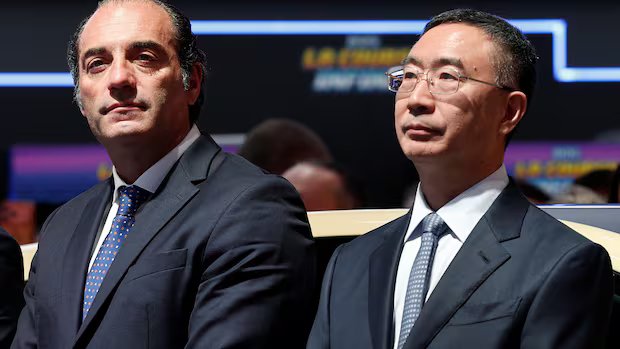

Listen to this article
Estimated 4 minutes
The audio version of this article is generated by AI-based technology. Mispronunciations can occur. We are working with our partners to continually review and improve the results.
Europe’s two auto industry bulwarks, Stellantis and Volkswagen, used this year’s Paris auto show to signal growing confidence in their electric vehicles, adopting lessons from the Chinese rivals and partners now reshaping their home market.
Both companies are undergoing strategic overhauls to address the growing competition of Chinese rivals in the European market, but announcements by Stellantis on Monday also showed more scope for collaboration.
The French-Italian auto group, whose brands in Europe span Citroen, Peugeot, Opel and Fiat, is using its joint ventures with Leapmotor and Dongfeng to study the Chinese competitive edge on technology, Stellantis CEO Antonio Filosa told reporters.
“I do not fully agree with the view that we are missing key capabilities, but there are certainly areas where we can complement each other,” Filosa said.
“By working together and bringing our engineering teams together to understand how to do things better, we can identify where that competitiveness comes from and learn from it.”
Picking up speed with Chinese partners
Stellantis entered a production tie-up with Leapmotor earlier this year and plans another with Dongfeng as part of a strategic shift under Filosa — partnerships now set to be localized to satisfy incoming “Made in Europe” regulations.
Europe’s transition to EVs has accelerated in recent months, spurred by rising fuel prices and more affordable models, including from Volkswagen and Stellantis’ mass-market brands. Both are battling to defend their market share against Chinese players expanding rapidly abroad to counter a downturn in their home market.
“We are seeing how the BEV (battery electric vehicle) is getting traction that we were not expecting one year ago, also in countries like Italy and Spain where the BEV is less adopted,” said Danilo Annese, CEO of Leapmotor International, the Stellantis-led joint venture.

Executives at Leapmotor and Stellantis pose together on the showroom floor of the 2026 Paris Auto, Oct. 12, 2026. (Benoit Tessier/Reuters)
Stellantis’ partnership with Leapmotor includes a mid-sized electric SUV being developed by the Chinese EV maker and the group’s German brand Opel.
“What I’m seeing is remarkable speed,” Opel CEO Florian Huettl said of the project, a rare example of a Western automaker drawing directly on a Chinese partner to bring new vehicles to market in as little as two years.
Stellantis also presented a raft of concept vehicles in Paris as part of Filosa’s push to update its model lineup, but Felipe Munoz of Car Industry Analysis said the pressure was still on the automaker to catch up with the Chinese in a rapidly evolving market. “They don’t need concepts. They need production. Now, not in two years.”
The student becomes the teacher
Volkswagen’s turnaround has also been heavily influenced by China, which CEO Oliver Blume has called a “fitness center” for the industry.
However, its effects in Europe have been indirect at best. Volkswagen’s partnership with Xpeng focuses on the Chinese market, while cooperation in Europe remains largely hypothetical — an idea floated previously by Blume to fill excess plant capacity, but with concrete talks yet to emerge.
Partnering with the Chinese in Europe, by giving them access to underused German plants for example, could also pose risks, by helping rivals localize production in Europe and comply with regulation designed to protect European automakers.
Blume told an industry conference in Paris on Tuesday he saw no need currently for a Chinese joint venture in Europe.
“Up to now we feel ourselves well prepared with our own opportunities we have ramped up during the last years in China,” he said.
Both Volkswagen and Stellantis “are partnering with Chinese players in different ways,” said Stefan Bratzel, an analyst at Germany’s Center of Automotive Management.
While Volkswagen has focused on partnerships in China, Stellantis’ alliance with Leapmotor is becoming a success story in Europe, he said.
European automakers now had to accept China’s role as “a teacher” for a while, Bratzel said. “For years it was the Chinese who learned from the Germans. Now that process has to be reversed.”