dailynewsnblog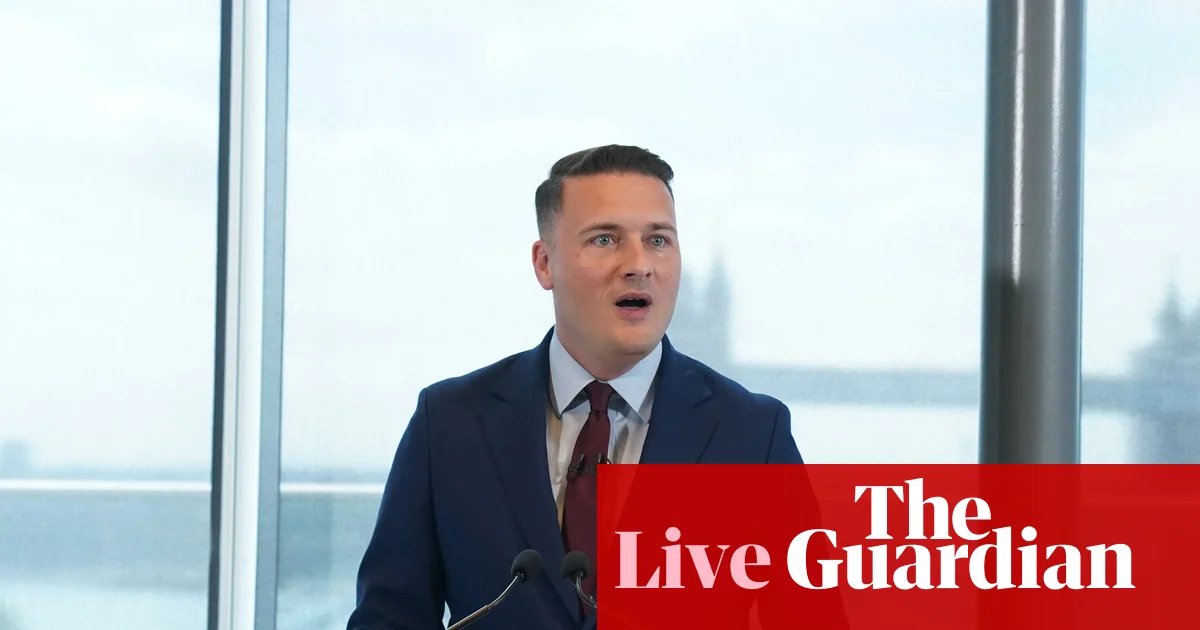
Starmer should set out timetable for his departure if Burnham wins byelection, Streeting says

Peter Walker
Peter Walker is a Guardian senior political correspondent.
Keir Starmer should set a timetable for his departure if Andy Burnham wins the Makerfield byelection on Thursday rather than battle to stay in Downing Street, Wes Streeting has said.
Answering questions after his speech on the economy (see 10.44am and 11.32am), Streeting reaffirmed that he would fight in any leadership battle, and insisted he has the necessary support among Labour MPs, but refused to say whether he would trigger a contest.
He said:
I would hope that after Thursday’s byelection, when the results are in, and I very much hope Andy Burnham wins … I hope the prime minister will at that stage reflect on his own position and set out a timetable. I think that would be a better way forward for everyone and would enable that better culture that we aspire to.
When he resigned as health secretary last month, Streeting had been expected to trigger a leadership contest himself, and the fact he did not prompted opponents to assume he did not have the backing of the 80 other Labour MPs needed to trigger the process.
Asked if he did now, Streeting replied: “Yes, I have the support I need to be on the ballot.”
However, he refused to say whether he might seek to trigger it next week. He said:
I think I’ve been extremely clear about this. I think there should be a contest. I have every intention of standing in that contest, and I’ve not triggered a contest, because we’ve got a byelection under way where one of the inevitable candidates is on the ballot paper.
To have sought a contest before Burnham was potentially back in parliament would be to “pull a fast one”, Streeting argued.

Key events
Starmer says Dan Jarvis, new defence secretary, being consulted on DIP ahead of final version being published
Speaking to reporters at the G7, Keir Starmer also defended the defence investment plan (DIP) draft that led to John Healey’s resignation as defence secretary last week. Starmer confirmed that Dan Jarvis, the new defence secretary, is getting some input before the publication of the DIP in its final version.
Starmer said:
The position on investment in defence is firstly that we increased last year defence spending from 2.3% to 2.6%, that’s the biggest increase since the 1980s, and that means £270bn will be spent this parliament on defence.
On top of that [the] defence investment plan which obviously gives us capability for the future. We will put even more money in relation to that. I’ve been really clear that’s required difficult decisions, I have taken the decision to reallocate money from other departments.
Obviously the new defence secretary is reading in and we’re talking to him about how and what we will spend that money on, in terms of capability, and he’s got his own thoughts now on what the priorities should be, and so that’s the discussion we’re in the middle of at the moment.
Healey is due to give a personal statement to MPs about his resignation at around 1.30pm.
Starmer says arson attacks on property linked to him should be seen in ‘broader context’ of Russian threat
Keir Starmer has welcomed the conviction of two men convicted of conspiring to carry out arson attacks on property linked to him – and said the attacks should be seen in the context of the threat posed by Russia.
Asked about the case, which resulted in convictions yesterday, Starmer told reporters at the G7 summit in France.
Well, obviously it was a bad attack, and all the details have now come out in court and justice has been done, so I’m pleased in that respect, particularly for my family who were affected by it.
I think it has to be seen in its broader context. Here we are in the G7. We’ve just had the Ukraine session and actually there was real unity in the room, in the G7, about the fact that Ukraine is doing better now, regaining territory, that the sanctions are having a real impact on Russia and a real sense that now is the moment for all of us as a G7 to ramp up the pressure.
So I see this all in its context, but justice has now been done, and I’m very pleased.
Full details of the Russian links to the attack, some of which did not come out in court, have been published in this excellent BBC investigation.
Streeting warns against ‘expensive’ pledges in leadership contest, and defends bond markets, in dig at Burnham
Wes Streeting has made an implicit dig at Andy Burnham in his speech this morning on “progressive capitalism”. (See 10.44am.)
In a speech setting out his platform as a potential Labour leader, Streeting warned against “expensive and popular pledges”, saying that he would not be offering these.
He did not explicitly mention Burnham at this point, but it seemed clear that he was referring to the Greater Manchester mayor, who is expected to win the Makerfield byelection on Thursday and tipped to replace Starmer as PM at some point later this year.
Burnham has said relatively little about how he would govern as PM, or how he might diverge from Labour’s manifesto agenda, but he is vulnerable to claims that he would ramp up government spending.
Last week he had to backtrack after appearing to commit to offering financial compensation to Waspi women. He also wants to bring the water and energy sectors under public control. How this might happen has not been spelt out, but critics view this as evidence that a Burnham administration would not have a strong commitment to fiscal restraint.
Streeting said:
There is a risk that a Labour leadership contest becomes a Dutch auction of the most expensive and popular pledges to appeal to the party faithful at the expense of the British people. Not on my watch.
We can’t play fast and loose with the public finances or the trust of the people. Not when the risks are so high and faith in politics is so low.
As I’ve said on my leaflets in Ilford North at every general election: you may not always agree with me, but you’ll always know where I stand.
You won’t find me making pledges to win your vote in a leadership election only to let you down after the ballots are counted.
(Burnham’s wife is Dutch – although this may have had no bearing at all on Streeting’s choice of metaphor.)
Streeting also made an even more explicit dig at Burnham when he defended the bond markets. He said:
Bond markets are not Bond villains and fiscal rules matter. Fiscal discipline matters because credibility is the precondition for an activist state. With debt approaching 100% of GDP, Britain has very little room for error.
This was a reference to Burnham telling the New Statesman last year in an interview that the government should not be “in hock” to the bond markets. At the time this was taken as Burnham saying politicians should not let the bond markets determine government borrowing decisions, but in a recent Guardian interview he said his remark had been misinterpreted, and that what he meant was that politicians should not “end up losing control of public spending” leaving them in hock to lenders.
Burnham is more far popular with Labour members than Streeting, polling suggests, and, although Streeting says he is a candidate for the leadership, at Westminster many people assume that Burnham could end up replacing Starmer without a contest because his lead in the party is so strong.
In an interview with the Sun, asked if he would rule out doing a deal with Burnham that would allow Burnham to become leader without forcing an leadership ballot, Streeting implied he was ruling this out. He replied: “Yes, I’ve said there should be a debate, I’ve said there should be a contest.”
But, to stand, Streeting would have to get 80 MPs to formally back him. While he does have significant support, some of his backers may not want the party to go ahead with a formal election that would last weeks.
Streeting says UK capitalism ‘suffers from lack of competition’ as he makes case for ‘progressive capitalism’
Wes Streeting, the former health secretary and Labour leadership hopeful, is today calling for new laws to speed up the construction of critical infrastructure projects.
In a speech this morning, he is saying:
We used to be a country that could do great things. With the promise that the next generation can have it better than the last. We still can. And I want to give people reason to believe again.
If parliament can act in days to save British Steel, it can act with urgency to save Britain’s future prosperity.
Successive governments have been sleeping, while Britain’s crying out for action. I will pass emergency laws to build data centres, nuclear power generation, transport infrastructure connecting people with jobs, and more. We still can build the infrastructure to grow our economy, we have to, and – if I become prime minister – we will.
According to a preview, Streeting is making these comments in a speech on “progressive capitalism”. He is running what is in effect a leadership campaign, although when he resigned as a cabinet he said he did not want to launch a formal bid to replace Keir Starmer until Andy Burnham was back in parliament and able to stand as a candidate himself.
Streeting’s decision to focus on the need for laws to speed up infrastructure building is surprising because in the first session of parliament Labour passed a Planning and Infrastructure Act that was specifically intended to speed up the process leading to the construction of what are designated as nationally significant infrastructure projects (NSIPs). Streeting’s speech suggests he does not think this law goes far enough.
In the speech, Streeting is also calling for the government to allow more drilling to go ahead in the Rosebank and Jackdaw oil and gas fields in the North Sea.
And he has called for a national “global talent programme” with the aim of recruiting 20,000 world-leading scientists, AI experts and engineers to the UK over the next three years. He says £250m should be set aside to fund this.
In an article for the Financial Times published at the weekend, Streeting explained what he meant by progressive capitalism. He said:
I am putting forward an agenda for progressive capitalism, that backs enterprise, rewards work, takes on vested interests and makes markets serve our shared goals of growth, fairness and a better future for the next generation.
That means doing three things. First, push the frontier of innovation. Create the conditions where highly productive firms can scale.
Second, take the best to the rest. Spread new practices to the tail of the economy, where competitive forces will incentivise adoption. It may be counterintuitive for a politician on the left to say, but British capitalism suffers from a lack of competition.
Third, we need to invest in the resilience of our core strategic industries. Britain will remain an open economy reliant on global supply chains, but we can no longer assume that critical capabilities will always be available. Energy, defence, and data infrastructure offer opportunities for re-industrialisation. They have both economic and national security importance.
Anyone can make the pro-growth choice when there are no downsides. This country needs a government unafraid of taking on vested interests and doing controversial things in the national interest.
Thames Water nationalisation moves closer as government ‘objects to rescue deal’
Emma Reynolds, the environment secretary has objected to a £10bn rescue proposal for Thames Water because it would place an “undue burden” on consumers, pushing the troubled utilities firm closer towards public ownership. Julia Kollewe has the story.
Elon Musk claims social media ban for under-16s shows UK ‘police state’
Elon Musk, the pro-far right trillionaire X owner, has been using his platform to attack the UK government’s plan for a social media ban for under-16s.
He reposted a tweet saying:
JUST IN: UK Government clarifies adults will still be able to use social media by verifying their identities with digital IDs, facial recognition, passports and credit cards.
And he added the comment: “UK is a police state.”
He reposted another saying:
the purpose is not to remove young people from the internet. the purpose is to remove anonymity from the internet in a country where the government routinely punishes dissent with jail. the british caliphate is no longer free.
And he added the comment: “Exactly.”
And, without adding a comment, he reposted this from Laila Cunningham, the Reform UK candidate for London mayor.
My 17-year-old daughter: “I’m confused. We’ve always been taught not to share personal information or anything that identifies us online because it isn’t safe. Now they want us to do exactly that to access social media.”
UK ministers lobby Trump to avert backlash against social media ban
Ministers have embarked on a concerted lobbying operation to prevent a backlash from the Trump administration to the under-16s social media ban announced by Keir Starmer, Kiran Stacey, Dan Milmoa and Aisha Down report.
Here are some pictures of Keir Starmer at the G7 summit yesterday.
Starmer vows new sanctions on Russia and nuclear energy support for Ukraine
Keir Starmer has vowed to “choke off” Russian revenue with further sanctions and to provide hundreds of millions of pounds worth of energy support for Ukraine, as he met world leaders in France for the G7. Alexandra Topping, who is covering the summit at Évian-les-Bains in France, has the story.
Anti-Burnham fake news on Makerfield Facebook accounts has surged, report finds
Good morning. Andy Burnham seems to be on course to win the Makerfield byelection on Thursday. But, if he does win, it will be despite a huge increase in the amount of hostile, fake news about him circulating on local Facebook groups. This has been documented in a report out today by the Social Market Foundation thinktank that has important implications not just for Makerfield, but for how politics functions today in a social media environment awash with lies.
In its report, the SMF says:
Nearly 1 in 6 pieces of news shared in local Facebook groups during the campaign is false, with misinformation heavily targeting Labour and its candidate Andy Burnham, a new study has found.
The Social Market Foundation analysed over 1,800 posts across four local Facebook groups – representing different towns and settlements within the constituency with 66,000 members across them in total – and found that the share of news posts classified as misinformation jumped from 4% before the by-election was called to 16% during the campaign, a four-fold increase.
These findings come just days ahead of what has been billed as the most consequential by-election for a century. Nearly half of Britons (46%) now seek out local news through social media, second only to television and ahead of every other source. Over a third (34%) make use of local social media groups for this purpose – despite the fact these online sources do not come with fact-checking and editorial guidelines associated with the press …
The shift towards engagement driven rather than recency driven feeds can raise the prominence of misinformation. We can see the implication of this in Makerfield’s local Facebook groups. In one of them, 5 of the top 10 posts were misinformation. In another, 8 of the top 25 were misinformation. If people engaged with the post – whether agreeing or challenging them – it meant the misinformation would get boosted by the platform’s algorithm.
This chart from the report illustrates the extent of the problem.
The SMF has published this study as part of a larger study into the impact social media is having on politics. Earlier this month it published a report saying fake news is three times as common in places without proper local journalism.
Today the Reuters Institute has published its annual study of global digital news and it says “for the first time, social media and video networks are, on average across the markets covered, more popular than both TV and owned news websites and apps as sources of news.”
Theo Bertram, director of the SMF, says his Makerfield report shows why Ofcom should be doing more to tackle fake news on platforms like Facebook.
Voters in Makerfield are being exposed to harmful misinformation – and at an even greater intensity than we have seen in the rest of the UK. Too often local misinformation goes unchecked by big tech and unchallenged by national media. We need stronger enforcement from the companies and sustained investment in local news and reporting.
Here is the agenda for the day.
9am: Liz Kendall, the technology secretary, takes part in an LBC phone-in.
9.30am: The Department for Work and Pensions releases figures about personal independence payment (Pip) claims.
10am: Wes Streeting, the former health secretary and Labour leadership hopeful, gives a speech on “progressive capitalism”.
Morning: Keir Starmer speaks to broadcasters in Evian, where he is attending the G7 summit. He will also do a “huddle” (off-camera briefing) with lobby correspondents covering the trip.
11.30am: Yvette Cooper, the foreign secretary, takes questions in the Commons.
Noon: Chris Philp, the shadow home secretary, gives a speech on proposals to restrict judges from intervening in deportation cases.
Noon: Downing Street holds a lobby briefing.
Afternoon: Kemi Badenoch is campaigning in Aberdeen South, where there is a byelection on Thursday and the Tories are hoping to take the seat from the SNP.
Afternoon: John Healey, the former defence secretary, is expected to make a statement in the Commons about his resignation last week.
2pm: Angela Rayner, the former deputy PM, speaks at the Unison conference.
If you want to contact me, please post a message below the line when comments are open (between 10am and 3pm), or message me on social media. I can’t read all the messages BTL, but if you put “Andrew” in a message aimed at me, I am more likely to see it because I search for posts containing that word.
If you want to flag something up urgently, it is best to use social media. You can reach me on Bluesky at @andrewsparrowgdn.bsky.social. The Guardian has given up posting from its official accounts on X, but individual Guardian journalists are there, I still have my account, and if you message me there at @AndrewSparrow, I will see it and respond if necessary.
I find it very helpful when readers point out mistakes, even minor typos. No error is too small to correct. And I find your questions very interesting too. I can’t promise to reply to them all, but I will try to reply to as many as I can, either BTL or sometimes in the blog.