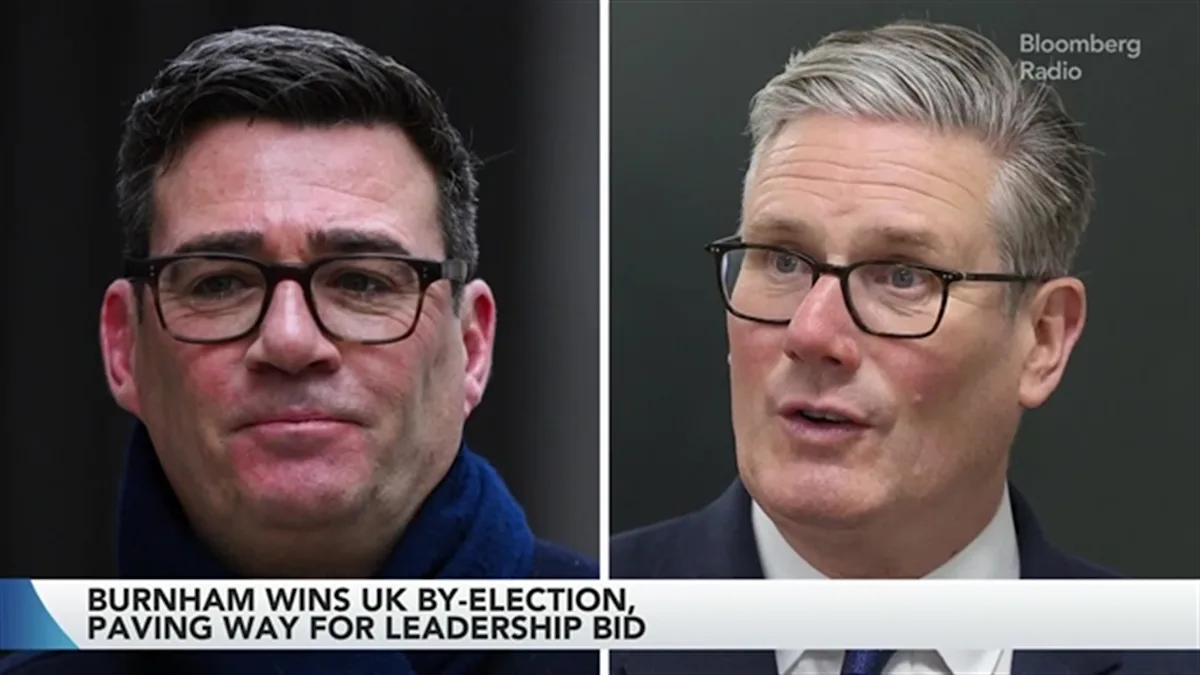
(Bloomberg) — Allies of Keir Starmer expect him to set out a timetable for his departure as UK prime minister imminently, putting Britain on course for its seventh premier in a decade and paving the way for Andy Burnham to replace him.
Most Read from Bloomberg
A statement from Starmer ceding power could come as soon as Monday, people familiar with the matter said, although they cautioned that was not certain. Starmer spent the last three days considering his position and whether he should continue to fight attempts by Burnham, who was elected to Parliament last week, to depose him.
US President Donald Trump said in a post on Truth Social on Sunday that Starmer “will resign” as prime minister. A UK official said that nothing had been communicated to Trump from the government and he had not spoken to Starmer.
The Guardian newspaper reported on Sunday evening that Starmer would set out his intentions in a statement outside Downing Street on Monday morning, citing unidentified cabinet ministers.
When asked for comment on the Guardian report, 10 Downing Street pointed to Starmer’s remarks on Friday that he would not walk away from his position. However, Downing Street also referred to comments made by Business Secretary Peter Kyle on Sunday, who said Starmer was reflecting on “political realities.”
“He has been engaging conversations with a wide, wide range of people, including myself,” Kyle told Sky News in an interview on Sunday. “As well as working really hard over this weekend. I think he is making time to reflect on the political realities, challenges, and opportunities that he finds himself in.”
Starmer being on the brink of quitting power is a remarkable reversal from the landslide election victory he secured in 2024, which returned Labour to power after 14 years out of office. Starmer’s premiership has been plagued by policy missteps and dire approval ratings, culminating in a thumping defeat in local elections in May which spurred almost a quarter of his MPs to say he should stand down.
Starmer’s expected decision comes days after Burnham won a parliamentary seat, making him eligible to launch a leadership challenge against the historically unpopular premier. That result led to days of discussions between Starmer and his allies over whether he could withstand a challenge from Burnham.
The manner of Burnham’s victory in the Makerfield by-election — where he trounced Nigel Farage’s poll-leading Reform UK party — has only added to the pressure on Starmer, with many Labour MPs concluding that Burnham is their only shot at stopping Farage at the next general election, which is due by 2029.
If Starmer does set out a plan to step aside, it will herald a fresh period of political uncertainty for the UK and set up its seventh prime minister in a decade, an almost unthinkable prospect when Starmer won his commanding parliamentary majority in 2024. After the chaos of the post-Brexit years — when the Conservative Party cycled through David Cameron, Theresa May, Boris Johnson, Liz Truss and Rishi Sunak as their leader — Starmer had come to power promising a new era of stability.
Instead, investors are wondering what direction the British government will take next, including who might succeed Chancellor of the Exchequer Rachel Reeves in a potential Burnham government. There’s also the question of whether Burnham would become prime minister uncontested or be challenged by someone else in the Labour Party. If the latter, Burnham would face weeks of interrogation of his plans for government while trying to win over the support of grassroots Labour members, who ultimately elect the leader.
By the end of Friday, several cabinet ministers loyal to Starmer indicated in conversations with him that while they didn’t want him to leave, they thought it was inevitable he’d be replaced, people familiar with their thinking said.
Those conversations are characterized as focused on minimizing disruption to the country and preventing deeper infighting in Labour, rather than ministers presenting Starmer with ultimatums or threatening to resign. By Saturday morning, only a core group of ultra-loyal cabinet members continued to argue that he should fight on.
At that point Starmer had left several cabinet ministers with the impression he’d accepted he would have to set a timetable for his departure. They also came away from their conversations believing he would choose not to stand in any leadership election. That avoided the need for more difficult discussions, one person familiar with some of the talks said.
By the middle of Saturday, the focus of Starmer’s allies had turned to the terms of his departure. Some argued throughout the weekend for him to go long, setting an exit date in September, arguing that was in the country’s best interests because Burnham is some way away from demonstrating he has a plan for power.
It would be up to Labour MPs to decide if Burnham should win power by a coronation or face a leadership contest, they said, though they warned of the risks of Burnham coming to power untested.
Some Labour MPs on the right of the party are concerned that even if former Health Secretary Wes Streeting can amass 81 MP supporters and force a contest, he could then try to do a deal with Burnham to concede the election early in exchange for a senior cabinet job such as foreign secretary.
A long-standing supporter of Starmer said their chief concern was that without a plan to quickly unite the party and deliver on his promise of change, Burnham could lose popularity within months and preside over even worse internal infighting, following the path of the Conservatives prior to the last general election.
There’s disagreement among Burnham’s supporters about the direction his government would take. Some close to Burnham are opposed to appointing current Energy Secretary Ed Miliband as chancellor.
Others on the left said they were already disappointed by Burnham’s preference to keep Home Secretary Shabana Mahmood in place given her hard-line stance on immigration, and that he risked letting down that wing of the party further by failing to appoint a left-winger to run the Treasury.
–With assistance from Jacob Reid.
Most Read from Bloomberg Businessweek
©2026 Bloomberg L.P.


 dailynewsnblog