dailynewsnblog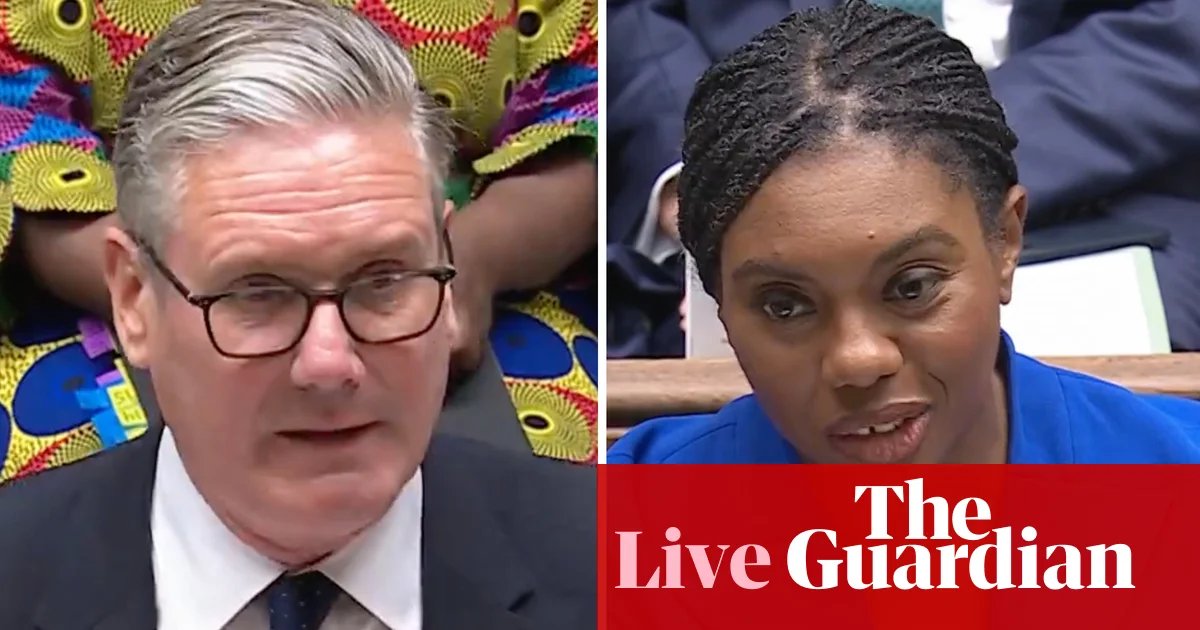
Starmer suggests MPs should place shield in Commons chamber in honour of Widdecombe, as for Jo Cox and David Amess
Keir Starmer thanks the speaker, but says he must start by saying how horrified he is by the murder of Ann Widdecombe.
It is chilling that three MPs or former MPs have been killed since he became an MP 11 years ago.
He says he can see the shields in honour of Jo Cox and David Amess in the chamber. He says it would be fitting to have one for Widdecombe.
And he says he has urged officials to look at the best ways of taking forward work on defending democracy.
Key events
Badenoch says Starmer won’t emulate Harold Wilson by winning many elections. But he may copy him by being PM when England wins the World Cup. He says all MPs should get behind that – including the SNP.
She says she wants to lead her party to a landslide victory too.
She says any politician who wants to lead the country should set out their views.
So does the PM agree that the country needs a debate between Nigel Farage and Count Binface.
Starmer says his advice to the people of Claction is – “put your vote in the bin”.
He says there are people in the public gallery watching today who are important to him. He mentions two workers from JLF, whose jobs were protected by the trade deal with the US.
Kemi Badenoch starts by thanking the PM for the way he commemorated.
She says this is her first chance in the chamber to pay her own tribute.
While a lot has been said about how Widdecombe died, Badenoch says she wants to focus on how she lived.
She was a woman of high principle, profound beliefs with a wicked sense of humour, a wonderful combination of being a serious person who did not take herself too seriously.
She changed her faith from Anglican to Catholic, and from the Conservative Party to the Brexit Party, but she always remained part of the conservative family.
You may not always have agreed with her, but Ann Widdecombe was a woman who said what she meant and meant what she said.
Hers was an honesty that made our politics better. Her wit and forthrightness served alongside a deep humanity and decency.
Turning to the PM’s final PMQs, she says she wants to get the tone right.
So she looked up what Starmer said when Boris Johnson was leaving. She will be more positive, she says.
She pays tribute to Starmer in particular for the way he invited President Zelenskyy to No 10 after his confrontation in the Oval Office to show solidarity.
Starmer thanks Badenoch.
He recalls the meeting with Zelenskyy. He says he made a point of showing Zelenskyy the crowds outside cheering, showing him what people in Britain felt about how he had been treated.
Graham Stuart (Con) starts with a football joke, saying Starmer has had the red card from his MPs. He asks if he has advice for his successor.
Starmer says he won’t be giving advice to his successor, or to the England team.
He ends saying:
I don’t care what the score is tonight. As long as we win.
Starmer reads out the usual spiel about appointments, and ends with a joke about an important appoinment he has tonight at 8pm with his TV.
Starmer suggests MPs should place shield in Commons chamber in honour of Widdecombe, as for Jo Cox and David Amess
Keir Starmer thanks the speaker, but says he must start by saying how horrified he is by the murder of Ann Widdecombe.
It is chilling that three MPs or former MPs have been killed since he became an MP 11 years ago.
He says he can see the shields in honour of Jo Cox and David Amess in the chamber. He says it would be fitting to have one for Widdecombe.
And he says he has urged officials to look at the best ways of taking forward work on defending democracy.
Lindsay Hoyle, the speaker, introduces this session as the final PMQs of this parliamentary session, and Keir Starmer’s final PMQs. He thanks Starmer for his leadership, particularly in regard to “his steadfast support for Ukraine”. And he says he hopes the PM brings home a World Cup victory.
Andrew McDonald and Noah Keate have a good round-up of what happened when other PMs took their final PMQs in their London Playbook briefing. Here is what they say about Margaret Thatcher’s and David Cameron’s.
November 27, 1990: Margaret Thatcher was serenaded by a legion of Tory backbenchers for her “unique vision,” “hallowed place in the history books” and much more as she took their questions for the final time after announcing her resignation … before Labour MP David Winnick made it awkward by reminding her that “last week, 152 of them stabbed her in the back.” Labour’s Neil Kinnock wasn’t up for pleasantries either. He asked Thatcher why those competing for her job were “wriggling around trying to find a way out of the poll tax trap.” Britain’s first female PM, correcting herself, said she thought “they were keeping the poll … the community charge.” John Major abolished it the following year.
June 27, 2007: Tory leader David Cameron opted to keep things friendly for Tony Blair’s finale, following up questions on flooding and the Middle East with congratulations for his 10 years in office and “considerable achievements to his credit.” Cameron even urged his MPs to join in the cross-party standing ovation for Blair as he left — and didn’t even bring back his “he was the future once” jibe. In a preview of battles to come, Blair responded to Euroskeptic Tory MP Nicholas Winterton’s tirade against Brussels by saying if he were Tory leader he’d be worried by the “guttural roar” in response to criticism of the EU. “May I say to him au revoir, auf Wiedersehen and arrivederci?” Blair signed off.
Here is the list of people down to ask a question at what will be Keir Starmer’s last PMQs.
At the Guardian we would like to hear what you expect from Andy Burnham as the next PM. You can contribute on a form here.
As mentioned earlier, today’s papers are full of reports about Andy Burnham’s plans for cabinet appointments. Here is a round-up of some of the stories.
Steven Swinford and Patrick Maguire in the Times say “senior allies of Andy Burnham believe that they have succeeded in preventing Ed Miliband from becoming chancellor over concerns he would become a lightning rod for criticism of the government”. They report:
Shabana Mahmood, the home secretary, spoke to Burnham about the economy during a meeting last week, although the bulk of their discussion focused on home affairs.
She is said to be the frontrunner for the role, but a source close to Burnham insisted that no final decision had been taken …
One ally of Burnham said that “the tide has turned against Ed”, while another said that “it looks like the right outcome has been reached”. A third said: “Ed would have been a lightning rod for criticism. He is out of the running.”
Burnham’s team has refused to comment on a growing view at Westminster that Miliband, energy secretary, will be passed over for the Treasury role, with some MPs claiming he could become foreign secretary instead …
Labour whips, whose job it is to gather political intelligence, have told colleagues that they expect Mahmood to become chancellor and Miliband to go to the Foreign Office, where he would be sidelined from his current economic role overseeing the government’s net zero plans.
One Miliband ally said: “He’s close to Burnham, stuck his neck on the line, supplied some of his support team and is well aligned with the key figures. So we’re all expecting him to be chancellor for myriad reasons. But he doesn’t know for sure — or if he does, he’s not telling.”
The conversations were still taking place as late as yesterday, sources say, suggesting Burnham has been unable to make this fundamental decision about the direction of his government. He becomes PM in five days and no one knows who his chancellor will be including apparently him. It will fuel criticisms he has no plan.
Burnham’s approach of holding off from making appointments until this late stage has stoked uncertainty and infighting among his allies already, several of them told Bloomberg. Many long-standing allies who helped his rise to power have yet to be told whether they’ll be given jobs in the cabinet or No10, they said.
A Miliband supporter warns Burnham will face outcry from the Labour left and soft-left if he bottles the appointment, expressing disappointment he hasn’t already been confirmed. Another points out it was Miliband who led the charge against Starmer on Burnham’s behalf for the last year, and Miliband who advised Burnham to commit to the existing fiscal rules.
Burnham is also said to be under pressure from senior Labour women to ensure that women occupy at least half of the most senior positions in his new administration.
Keeping a woman at the Treasury would therefore carry both political and symbolic significance, allowing Burnham to argue he is building on rather than rolling back Labour’s recent progress on female representation at the top of government.
Darren Jones, chief secretary to the PM, has told LBC that he has already been writing a handover note because he expects to lose his job in next week’s reshuffle.
Yusuf defends calling Tories ‘traitors’, claiming that is different from extreme insults directed at Reform UK
Q: [From the BBC] You have criticised other parties for the language they have used about Reform UK. But you have called the PM sick and depraved, and you have called the Tories open borders lunatics and accused them of being traitors. Will you reconsider the language your own party is using?
Yusuf defended calling his opponents traitors.
The definition of traitor is somebody who is engaged in betrayal. And as far as I’m concerned, it is demonstrable that, for example, the Conservative Party has acted in betrayal of the people who voted for them. And I’m not going to make this an attack on the Conservative Party right now in this answer. But that is demonstrable.
Yusuf said this was not the same as calling Reform UK Nazis or fascists, which amounted to comparing them to “regimes that are clearly the most brutal and horrific in history”.
Yusuf says a Reform UK government would pay for round-the-clock protection for all MPs
Zia Yusuf wrapped up his long speech at the start of his press conference (a long complaint about what he described as the demonisation of Reform UK by the media and political opponents, with a renewed complaint about the government for allegedly downgrading Nigel Farage’s security) with a policy announcement.
He said:
If Reform win the next general election as home secretary, I will ensure that all members of parliament of all parties are provided with round-the-clock protection.
We will also allocate significant new resources to protect former politicians still active in public life.
Yusuf is now taking questions. The first was from GB News, who asked if Yusuf thought the police were biased against the police. Yusuf said he had no evidence to support that.
Reform UK’s Zia Yusuf claims extreme criticism of his party amounts to incitement to violence
Zia Yusuf, the Reform UK home affairs spokesperson, is holding a press conference.
He is claiming that the extreme criticism that Reform UK politicians face amounts to incitement to violence.
He set out a version of this argument in a post on social media yesterday.
(Yusuf does not seem to have said anything yet about the extreme language used by him, and others in his party, about their opponents.)