dailynewsnblog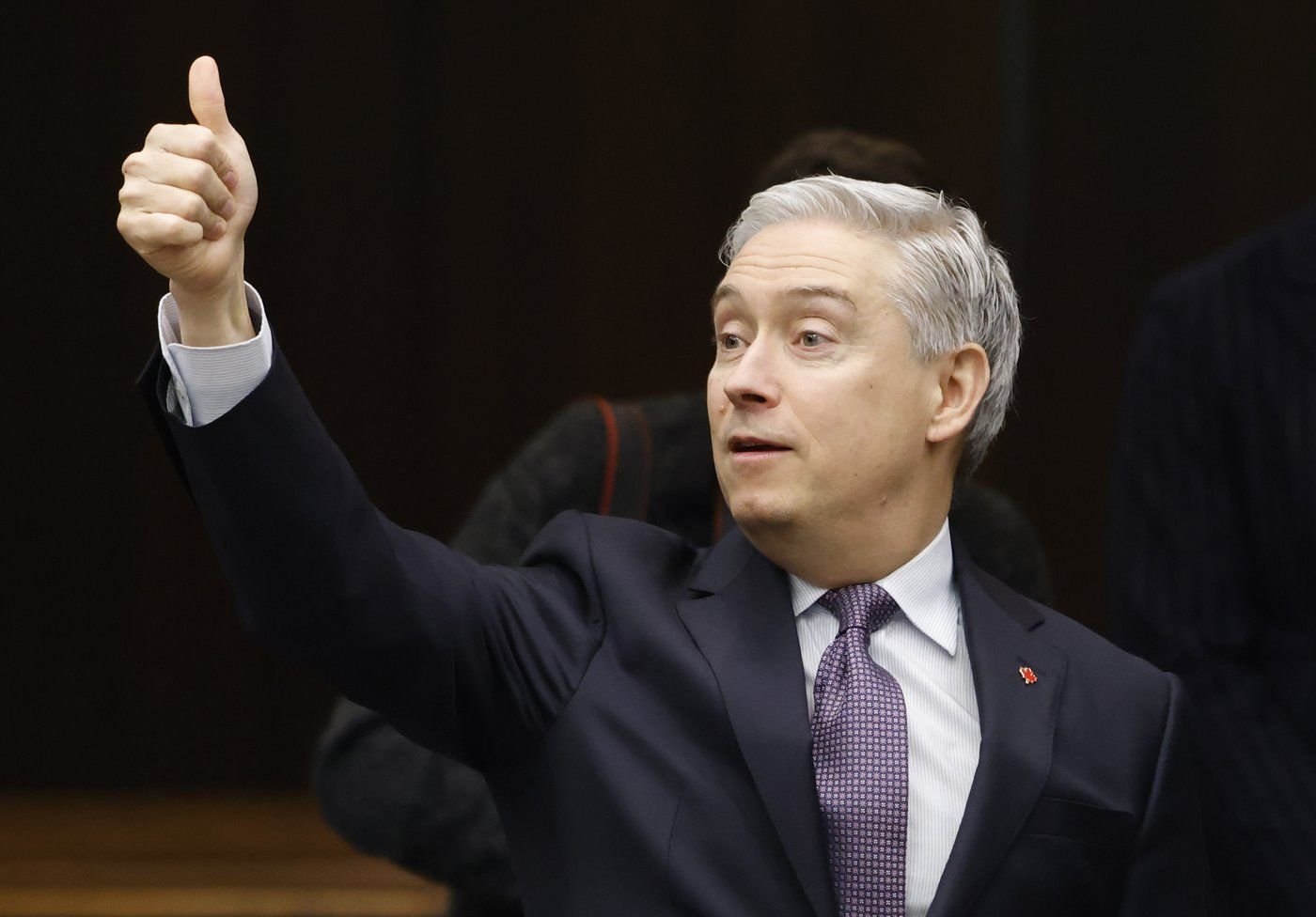
The revised figures show that Ottawa is now projected to post a $66.9 billion deficit in the fiscal year that wrapped up in March, down from the $78.3 figure originally estimated in the fall budget.
Rising tax revenue and lower interest rates helped cut the projected federal deficit by $11 billion last year, according to new numbers released Tuesday as part of the Spring Economic Update.
The revised figures show that Ottawa is now projected to post a $66.9 billion deficit in the fiscal year that wrapped up in March, down from the $78.3 figure originally estimated in the fall budget.
The document credits the improved numbers to a resilient Canadian economy, noting that despite the trade war with the U.S., incomes and jobs continue to rise, while wages are growing at a faster clip than inflation.
The update said that Canada has added nearly three times as many as jobs per capita as the U.S., and unemployment has fallen from a peak of 7.1 per cent in Sept. 2025 to 6.7 per cent in March, defying private sector expectations in this past fall’s budget.
It credited this resilience to Canadian firms adapting to the new economic reality, namely by “diversifying suppliers and markets.” The document noted that Canadian exports to non-U.S. countries have increased by roughly 40 per cent as of early this year, with crude exports to non-U.S. markets jumping from 3 per cent in 2023 to 10 per cent in 2025.
The document also pointed to lower interest rates on public debt and falling EI benefits from lower unemployment rate projections for helping to drive down expenses, though noted that interest rates are expected to rise in 2027-28.
“I think Canadians will see that we’re responsible fiscal management. I think what matters to Canadians today is that we have managed to lower the deficit [by] $11 billion at a time where you would see in the world this kind of a fog of uncertainty, which is clouding a lot of parts of the world,” Finance Minister François-Philippe Champagne said at a press conference on Tuesday.
The Liberals have pointed to the rosier than expected figures as proof of their capable management of federal finances, noting that Canada has the lowest debt-to-GDP ratio of any G7 country.
In the SEU, the government vowed to use the ‘fiscal uplift’ to “improve affordability and raise Canadians’ standard of living through targeted and responsible policy measures, particularly in the areas of fuel, food, and housing affordability.”
This year alone, the Liberals have released an enhanced — and renamed — GST credit for low-income Canadians, temporarily paused collection of fuel taxes and partnered with Ontario in cutting all sales taxes on new homes.
The SEU outlined plans to spend $42 million to “enable factory-built housing, make homebuilding more efficient and innovative,” and over $7 billion in “low-cost loans to speed up the construction of up to 16,500 new rental homes,” as well as dropping the contribution rate for the Canada Pension Plan from 9.9 to 9.5 per cent.
The government said that drop-off in the CPP rate would result in average annual savings of $133 for someone making $70,000.
Champagne said the government was acting in a fiscally responsible manner while still ensuring “we’re there for Canadians.”
Bloc Québécois Leader Yves-François Blanchet told reporters that he was disappointed the government didn’t include new measures to support businesses struggling from the trade dispute with the U.S., and dismissed improvements in the deficit numbers as “something of a show.”
“This situation [that is] dramatic for many, many businesses, is not addressed at all,” he said of the lack of support for tariff-impacted businesses.
“Last week, the prime minister promised me in the question period that there would be measures to adapt present and acting businesses, not future projects to the situation, and the update contains absolutely not a word about that.”
NDP Leader Avi Lewis said the Liberals missed an opportunity to “actually address the everyday emergency of the crisis of the cost of living for Canadians with concrete measures.”
“It didn’t do that, and not only that, there wasn’t a single new revenue measure in this entire update that would actually introduce new revenue from extremely profitable corporations like the oil and gas sector, which is forecast to make $90 billion of excess wartime profits this year alone,” he told reporters.
“We should have seen a windfall tax, and we called for one. And so there was a lot of revenue left on the table.”
Despite the rosier numbers, the Liberals’ fiscal roadmap shows no signs of returning to balance anytime soon.
According to the numbers in the SEU, the deficit is expected to drop slightly to $65.3 billion this year and fall further to $63.1 billion in 2027-28. It’s projected to bottom out at $53.2 billion in 2030-31.
That’s still nearly $17 billion higher than the deficit in 2024-25, the last year with Justin Trudeau at the helm.
The SEU projection shows the debt-to-GDP ratio is expected to rise in every year up until 2029, though it’s lower than what was envisioned in the fall.
Public debt charges will continue to rise in the years head, according to the SEU, jumping from $54.0 billion in 2025-26 to $80.9 billion in 2030-31 “due to projected increases in the stock of debt and higher interest rates.” That’s more
But starting in 2028-29, the deficit will be entirely attributable to what the government terms as capital investments, as opposed to day-to-day operational spending, according to the SEU.
That’s exactly what Prime Minister Mark Carney campaigned on in last spring’s election, promising to hold the line on spending on staff while re-profiling money for investments in housing and economic opportunities.
The document credits rising oil prices caused by the war in the Middle East for improving Canada’s trade picture — with export prices expected to outstrip import prices as a consequence — and boosting “energy-sector profits and potentially supporting investment and employment, while also increasing government revenues.”
But the fiscal plan noted that it’s unclear if the surge in prices will have any lasting impact, and cautioned that higher energy prices “create hardship for many households, reducing purchasing power, and raising costs for businesses.”
In its modelling, the federal government considers a scenario in which oil prices continue to rise and firms respond by boosting investments in the sector, improving the federal budgetary balance by $5.7 billion in 2026-27.
In a second scenario, higher energy costs lead to broader inflationary pressures that dampen the mood for investment, improving the deficit by only $3.1 billion for the same period.
While the government expects some additional revenue from the oil price surge this year, that will be partly offset by the government announcing earlier this month that it would pause collecting federal fuel taxes until the end of the summer.
In the SEU, the government said it expects revenue to rise by $7.2 billion on average each year from 2025-26 to 2029-30 because of “stronger personal and corporate income tax revenues,” crediting this to “higher revenues from the financial sector and resilience in the labour market.”
Looking ahead, Ottawa said it anticipated higher revenue from EI premiums “mainly driven by growth in insurable earnings,” as well as an infusion of cash from Crown corporations, net foreign exchange revenue and “return on investments.”
The government warned that this would be “partially offset by lower expected other program revenue” as well as “lower projected offshore oil revenues.”
But it warned that this uptick is “somewhat offset” by lower GST revenues, and noted that revenue from excise taxes and duties “have been revised down in 2025-26 and over the remainder of the horizon.”
This was credited to “lower GST and excise taxes growth,” though noted that this was offset by the “impact of countermeasures in response to the U.S. tariffs early in the forecast horizon.”
The document projected Canada’s GDP to grow by 1.1 in 2026 and then 1.9 per cent annually over the next three years, before a minor drop to 1.8 to 2030. An alternative scenario were investment is driven higher would see GDP rise to 2 per cent in 2028 and 2029, while a more pessimistic projection had GDP grow meagrely to 0.8 per cent in 2026 and 1 per cent in 2027.
*This story has been updated with comments from Bloc Québécois Leader Yves-François Blanchet and NDP Leader Avi Lewis, and has been updated to reflect that the original deficit figure for 2025-26 was $78.3 billion.