dailynewsnblog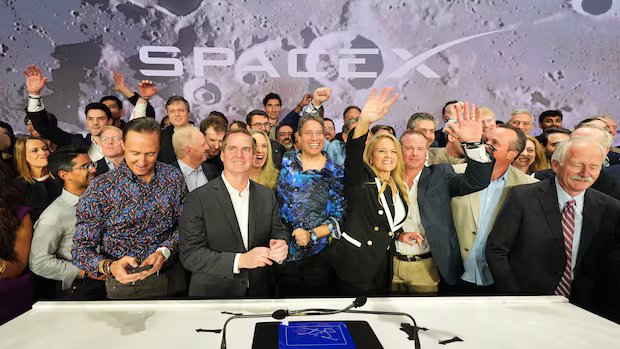

Listen to this article
Estimated 5 minutes
The audio version of this article is generated by AI-based technology. Mispronunciations can occur. We are working with our partners to continually review and improve the results.
SpaceX jumped above 20 per cent in its Nasdaq debut on Friday, lifting its valuation to more than $2 trillion US as investors piled into the world’s largest IPO and bet on Elon Musk’s sprawling empire spanning rockets to AI.
The stock opened for trading at $150 US, compared with the IPO price of $135 US per share. It kept rising, reaching $166.90 US around 12:20 p.m. ET., making it the sixth largest U.S. company by market value.
The deal was being closely scrutinized because of the stakes for the IPO market, which some bankers said could face difficulties if SpaceX shares closed below Thursday’s pricing level.
The company’s market debut is widely viewed as a dress rehearsal for a new generation of mega-listings, with market participants watching for signals on investor appetite ahead of forthcoming IPOs for AI heavyweights Anthropic and OpenAI.
The stock’s performance will be a test for the so-called “Musk premium,” which has been the force behind Tesla’s $1 trillion US-plus valuation, despite coming under pressure during Musk’s active role in U.S. President Donald Trump’s administration.
The landmark listing cemented Musk’s status as the first trillionaire ever — Forbes is now estimating Musk’s net worth at $1.1 trillion US.
It also propelled SpaceX into the ranks of the world’s most valuable companies, even though the firm posted a loss of nearly $5 billion US last year and generated only a fraction of the revenue brought in by similarly valued tech giants.
“I gave SpaceX a 10 per cent chance of succeeding at all,” Musk said in Texas, shortly before the opening bell.
SpaceX president Gwynne Shotwell and chief financial officer Bret Johnsen rang the Nasdaq opening bell at 9:30 a.m. ET.
World’s largest IPO
The record IPO is a culmination of Musk’s long-held ambitions in space and technology, and has stood out for rewriting Wall Street’s IPO playbook and drawing legions of retail investors into the market.
At $75 billion US, the deal’s proceeds were more than double those of Saudi Aramco’s record-setting 2019 IPO.

CBC’s Peter Armstrong breaks down what to expect with Elon Musk’s SpaceX initial public offering (IPO) — valued at $1.77 trillion US — and how an insatiable investor appetite for anything AI at the moment is fuelling stock markets despite a struggling global economy.
The valuation could rise further should underwriters exercise their right to sell additional shares, a decision typically made within 30 days after the offering.
Although SpaceX may have to wait for entry into the S&P 500, its expected fast-track inclusion in the Nasdaq 100 will soon make it a major holding for passive funds and ETFs that track the index, creating a fresh source of demand for its shares.
It will take 15 trading days before it could be added to that index under Nasdaq’s new fast-entry rules, as opposed to a typical wait of as much as a year.
Some analysts expect SpaceX’s debut to trigger a reshuffling of investor portfolios, creating selling pressure on other technology heavyweights as funds rotate into the stock.
What is SpaceX actually worth?
For all the excitement surrounding the IPO, determining what SpaceX is actually worth remains a difficult valuation exercise.
SpaceX said its market opportunity spans $28.5 trillion US, a figure it called the largest in human history. With its leading position in space — the firm says its operation is responsible for more than four-fifths of the mass launched into orbit over the past three years — and revenues from Starlink, some investors said it has a strong foundation upon which to build.
John Belton, portfolio manager at Gabelli Funds, said the best comparable to SpaceX is Musk’s electric vehicle company Tesla, as each has an established business and “a moonshot opportunity on the other side.”
“For Tesla, that’s things like humanoid robotics and other future applications. For SpaceX, it’s the AI business,” he said.

Humanoid robots that can do household chores, such as folding laundry, were on centre stage at the Consumer Electronics Show in Las Vegas where companies preview breakthroughs in technology and artificial intelligence.
The hurdles at its enormous valuation include efforts by rivals such as Jeff Bezos’s Blue Origin to accelerate the commercialization of space and pursue government contracts in a bid to unlock new markets beyond Earth.
With revenue of $18.7 billion US in 2025, the company’s market cap puts its price-to-revenue ratio at a lofty 94. Some analysts have already issued positive ratings on the company. Morningstar analysts earlier this month said it is more fairly valued at around $780 billion US.
“This is not a name you’re buying based on fundamentals. For me, the analogy is Amazon. This was a company that changed the way we live,” said Nancy Tengler, CEO and CIO of Laffer Tengler Investments. “If the stock drops to $100, that’s not ideal, but it wouldn’t change our long-term view. We want to participate.”