dailynewsnblog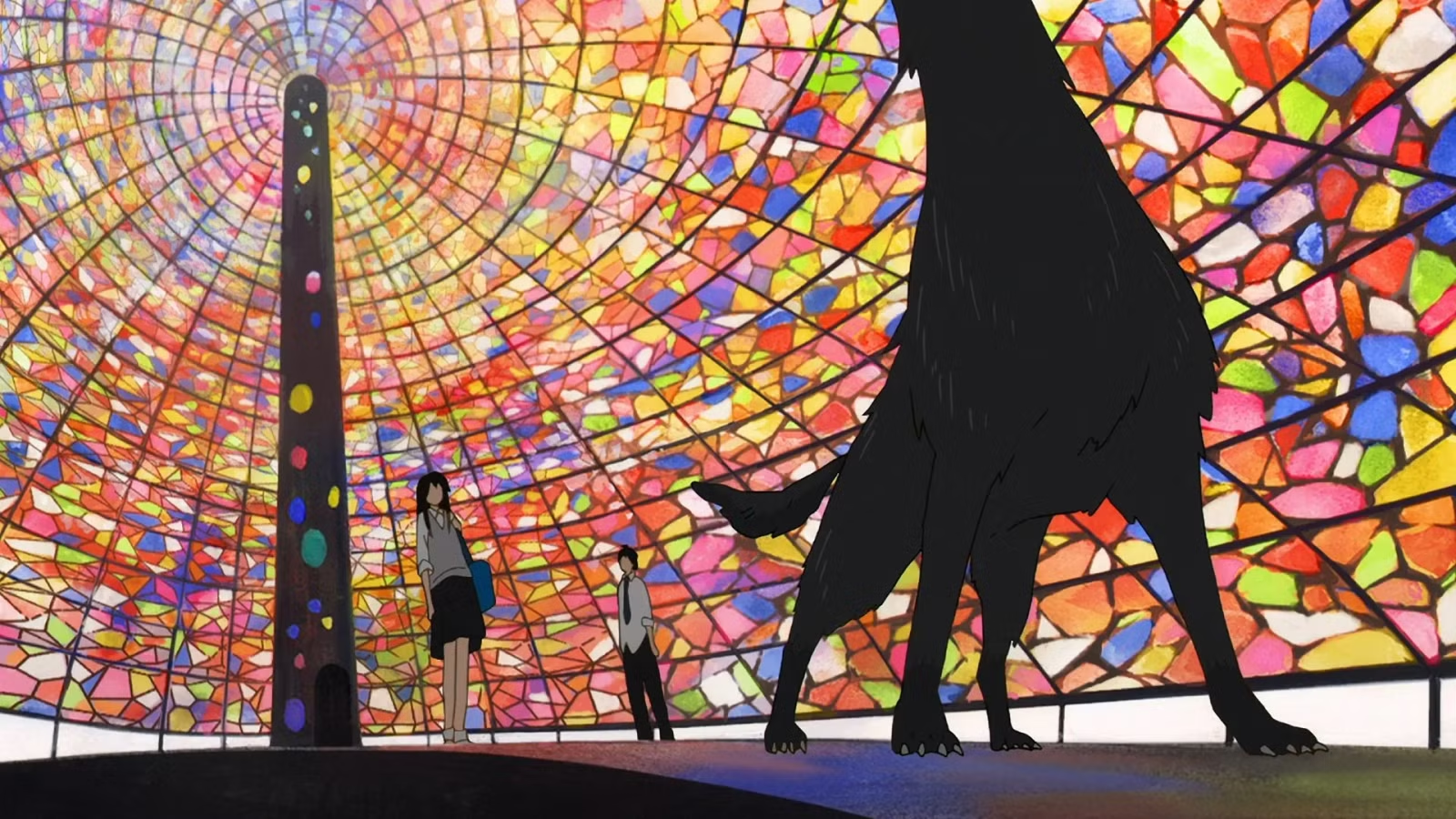
Some of the best anime out there require a huge time commitment. One Piece boasts 1,159, with no signs of slowing down. There are currently 47 episodes of Jujutsu Kaisen (plus a movie) with more on the way. Even Death Note with its tidy, one-season story is 37-episodes long. But there’s one incredible anime show that you can easily watch in a single weekend, and it just so happens to be streaming on Hulu and Disney Plus.
Sonny Boy is the greatest anime I’ve ever seen. Directed by Shingo Natsume (One-Punch Man) and produced by legendary anime studio Madhouse, the 12-episode original TV series is an unforgettable exploration of adolescence, wrapping a surreal mystery into a narrative that refuses to play by the rules. It’s one of the most beautiful, impactful, and bingeable anime you’ll ever see — so much so you may watch it again and again just to feel something.
Sonny Boy follows a group of middle schoolers stranded in an alternate dimension where some begin to develop strange, unexplained powers. Think Lord of the Flies without the brutality. Through its story, Shingo Natsume explores themes like loneliness, identity, social pressure, and freedom, among many others. It’s not a happy story, nor a sad one; it exists somewhere in the middle.
Much of the story revolves around the quiet and reserved Nagara, whose detachment tends to leave him at odds with the rest of the group. He’s the clearest window into what Sonny Boy actually is: a sci-fi isekai that focuses more on the human drama than the “why” of its world.
That’s exactly what makes Sonny Boy so bingeable. Its storytelling is intentionally unnatural, often skipping past major events to focus on the emotional fallout instead. Key details are left unresolved, including the nature of the world itself, which at first appears like their school but eventually changes on a whim. The show rarely ever explains why certain oddities are happening, turning intrigue into momentum. Watching Sonny Boy, you find yourself stuck in a compulsion loop of trying to understand every shift in logic with each new episode. (If that sounds a bit like Lost, well, you’re not wrong, but unlike that divisive sci-fi show, Sonny Boy offers a satisfying ending.)

Sonny Boy builds upon itself slowly and deliberately. The animation quality heightens the story, all while reinforcing its themes. Across just 12 episodes, the narrative stretches into something that feels like a lifetime, largely aided by its surreal visuals. In creating Sonny Boy, Natsume and Madhouse (the same studio behind Frieren: Beyond Journey’s End, Paprika, and Vampire Hunter D: Bloodlust) leaned into an experimental style defined by subtraction rather than excess.
For Natsume, that meant avoiding the high frame count and sakuga-heavy action sequences of anime like Jujutsu Kaisen or Demon Slayer. Instead, he prioritized simplicity to emphasize the show’s raw, thematic depth. Sonny Boy thrives in stillness. Its quiet, often empty moments carry as much weight as any action sequence ever could — sometimes even more.
With Shinichiro Watanabe (the director of Cowboy Bebop and Samurai Champloo) serving as a musical advisor on the show, it comes as no surprise the soundtrack is as uplifting to the story as it is utter ear candy. The show’s main theme, Sonny Boy Rhapsody by toe, stands out as the defining track and remains the most significant musical moment in the anime. The swirling math rock composition perfectly captures the show’s otherworldly tone with its surreal, spacey sound that feels pulled from another dimension.

Every element of Sonny Boy works toward the same effect: pulling you deeper into its world. Beneath the surrealism is a grounded narrative about growing up and the inevitability of life. But dive deeper, and you’ll find a smorgasbord of philosophical meaning on disappointment, moving on, the quiet loss of innocence, and so much more.
It’s a story that resists easy answers, and that’s exactly why it lingers. Long after the credits roll, Sonny Boy keeps reeling you in — not because you understand it, but because you don’t. And sooner or later, that pull turns into something harder to ignore: the need to start it all over again.