Snowbird replacements ‘extremely manoeuverable, powerful,’ RCAF commander says


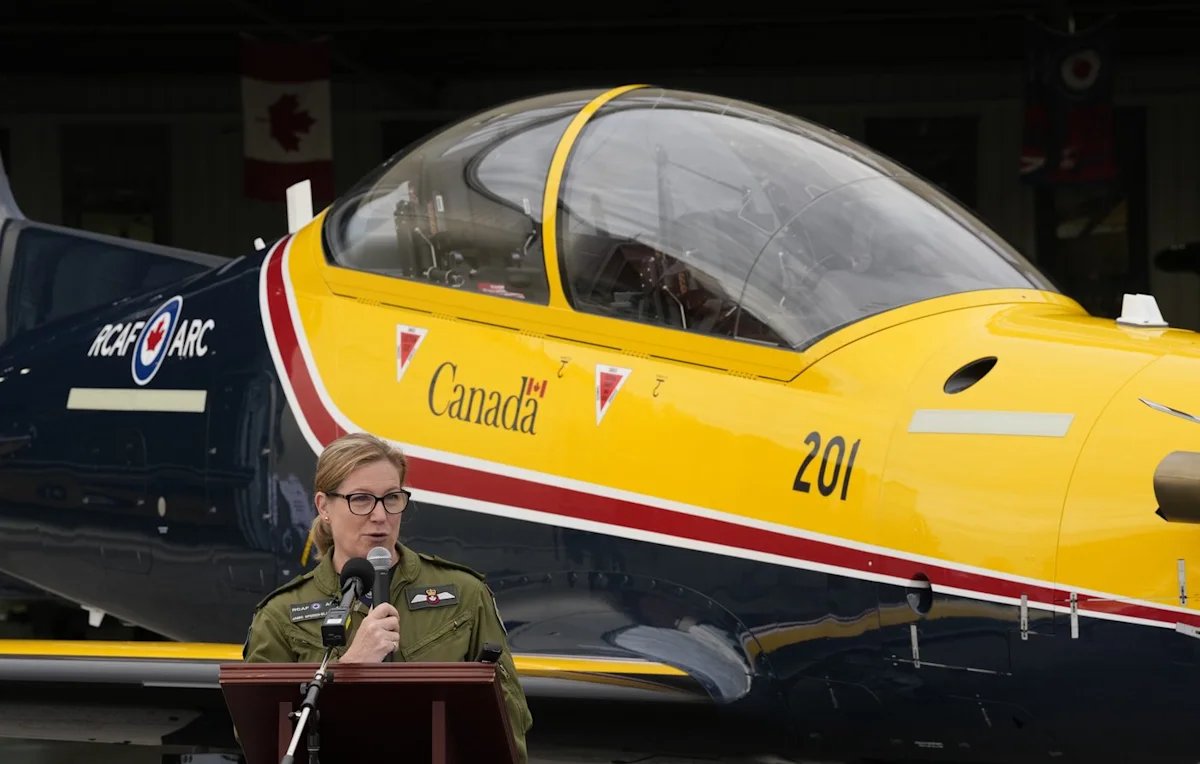
Royal Canadian Air Force Commander Lt.-Gen. Jamie Speiser-Blanchet speaks during an event introducing the Pilatus CT-157 Siskin II training aircraft in Gatineau, Que., on Thursday, Sept. 17, 2026. THE CANADIAN PRESS/Adrian Wyld – The Canadian Press

GATINEAU — The Royal Canadian Air Force welcomed on Thursday the first two of its new trainer aircraft, the CT-157 Siskin II — the same planes that will replace the old Tutor jets flown by the Snowbirds aerial demonstration team.

The turboprop planes will soon be headed to 15 Wing Moose Jaw, where the air force eventually will station 19 of them to serve as its main training fleet.

Acquiring the Siskin II, also known as the Pilatus PC-21, is part of the RCAF’s plan to modernize its fleets and overhaul its training.

RCAF Commander Lt.-Gen. Jamie Speiser-Blanchet said the modern aircraft are well suited both to aerial acrobatics and to preparing pilots for the more advanced aircraft the air force is bringing online.

“It has an advanced cockpit and capabilities and the design is just a very contemporary one that is used by other allies as well. We’re very excited that we’re able to bring this on board,” she said.

The commander made the comments just after one of the new planes buzzed overhead in a ceremonial first flypast at the airport in Gatineau, Que.

The current Snowbirds will hold their last show in the National Capital Region in Gatineau, Que., this weekend. After their final flight at the Grey Cup in Calgary in November, the Snowbird team will start a hiatus that could last until 2030.

As the RCAF brings in the new planes for pilot training, the federal government is still working on procuring extra Siskins for the Snowbirds team.

Speiser-Blanchet said these are “excellent” stunt planes that shouldn’t be underestimated — even though some have questioned whether a propeller aircraft is a suitable replacement for jets.

“It is extremely manoeuverable and capable, and powerful, actually. More so than perhaps people’s understanding of other propeller aircraft from the past,” she said.

While the Siskin II has a slower top speed than the CT-114 Tutor and is not as loud as a jet, Speiser-Blanchet said “it’s not a quiet aircraft” and it will “really wow Canadians” once the shows are up and running.

The federal government announced this spring it would replace the roughly 60-year-old Tutor jets, which have encountered various problems with upgrades meant to extend their lifespans out to 2030. Costs, timelines and the growing scarcity of replacement parts threw a wrench into plans to keep them in the air longer.

The Swiss Air Force has been training its pilots on the Pilatus aircraft since about 2008, and Australia’s Roulettes aerial demonstration team also flies the same planes.


Speiser-Blanchet said that because so many Canadian pilots will be training on this aircraft, the air force will have a much larger pool of potential candidates for the Snowbirds. Having the multi-purpose aircraft based out of Moose Jaw will also make servicing and support easier to manage, she said.

The RCAF has never before used a Pilatus aircraft. The new planes will replace the air force’s CT-156 Harvard II trainers, also known as the T-6 Beechcraft.

Ioannis Papachristofilou, deputy CEO of Pilatus in Switzerland, said the aircraft are advanced, high-performance machines that use Pratt and Whitney’s powerful PT6A-68B turboprop engine, which is made in Canada.

“This aircraft has an embedded mission-simulation suite, which allows you to simulate, for example, sensors like radar,” he said, adding the technology allows pilots to train faster on fighter jets in later phases of training.

The fleet of Siskins will work alongside other types of trainers under the new Future Aircrew Training program, which covers 71 training aircraft split up across five fleets.

SkyAlyne, a partnership between CAE and KF Aerospace, won a contract in 2024 for the 25-year, $11-billion training program, referred to within the air force as FAcT. It will replace the commercial pilot training aspects of the RCAF program.

This report by The Canadian Press was first published Sept. 17, 2026.

Kyle Duggan, The Canadian Press


Source link

  • Related Posts

    CUPE ALBERTA LAUNCHES REFERENDUM WEBSITE

    “Our goal is to give members clear, accessible information so they can make informed decisions and have conversations in their workplaces and communities,” says Uppal. “This referendum is about more…

    Continue reading
    Allied Gold Energizes Power Line, Feeds First Ore to the Crushing Circuit as the Kurmuk Mine Progresses Toward Completion of Commissioning and Transitions to Operations

    Forward-looking information is based on the opinions, assumptions and estimates of management considered reasonable at the date the statements are made, and is inherently subject to a variety of risks…

    Continue reading

    Leave a Reply

    Your email address will not be published. Required fields are marked *

    You Missed

    Scammers Have Been Inserting Fake Songs Onto Real Artist’s Pages On Spotify And Other Platforms

    Scammers Have Been Inserting Fake Songs Onto Real Artist’s Pages On Spotify And Other Platforms

    Hideo Kojima announces Bill Skarsgård will star in stealth-action Physint, legendary designer Yoji Shinkawa also confirmed for character design

    Hideo Kojima announces Bill Skarsgård will star in stealth-action Physint, legendary designer Yoji Shinkawa also confirmed for character design

    The 9 Biggest Trends From New York Fashion Week S/S 27

    The 9 Biggest Trends From New York Fashion Week S/S 27

    International travel – iPolitics

    International travel – iPolitics

    CUPE ALBERTA LAUNCHES REFERENDUM WEBSITE

    WNBA playoff picture 2026: What’s on the line in final week?

    WNBA playoff picture 2026: What’s on the line in final week?