dailynewsnblog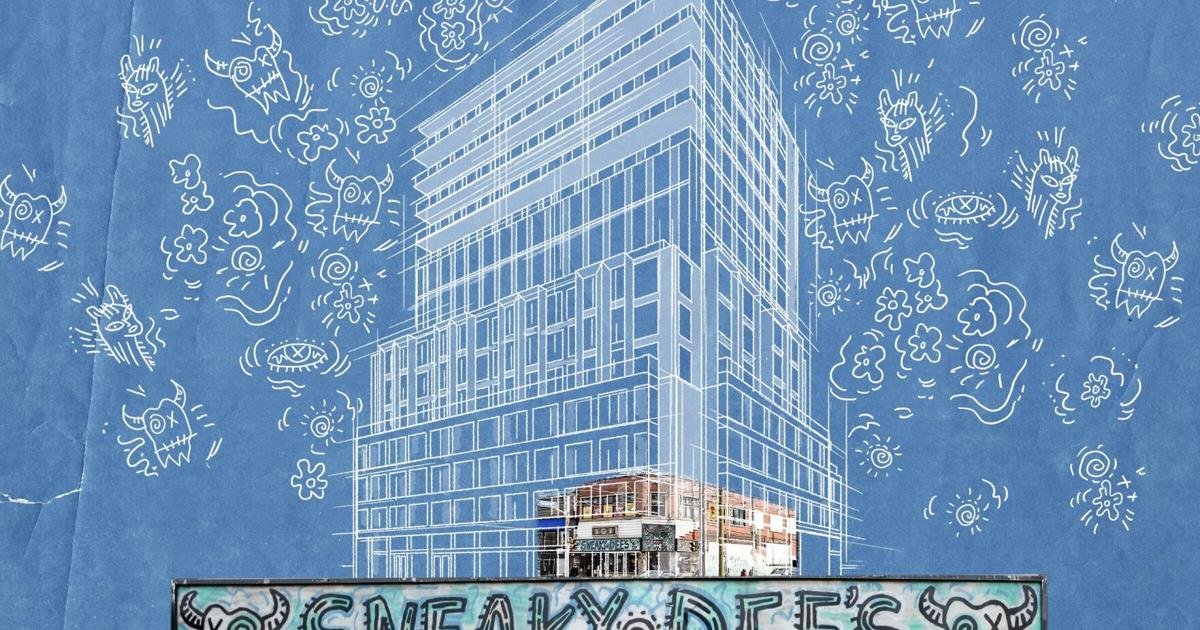
The walls are scribbled, the tables sticky, the nachos mighty — and fans of Sneaky Dee’s, the punk music venue and bar on the southeast corner of College and Bathurst streets, wouldn’t have it any other way.
The two-storey building where the Toronto institution has operated for 36 years was at risk of being demolished, to be replaced by a 15-storey mixed-use building, with 203 condo units, two retail spaces, and a below-grade music venue.
While Sneaky Dee’s appears to have avoided the wrecking ball, the community fight to save the venue — despite assurances it could return in the new development — raises questions of how cultural spaces can survive in the face of construction. History shows city venues uprooted for new developments face an uphill battle to stay alive.
Uncertainty and finding locations to move into — even on an interim basis during construction — can be difficult. Venues can also face steeper rents in a new development, or elsewhere in the same neighbourhood.
“It’s either an extinction-level event for a lot of businesses,” said Aaron Binder, director of progressive employer group Better Way Alliance, “or one where they have to find a new space option within a different part of the city that isn’t going through as much gentrification.”
These struggles have forced out other small, low-barrier venues. While that has consequences for musicians and fans, the loss of such venues, experts say, contributes to a bigger problem of driving artists out of the city and turning live music into a “luxury” good.
The Silver Dollar Room and the question of ‘fit’
Sneaky Dee’s was to be “welcomed back as tenants” to a 3,173-square-foot bar and venue space earmarked for them in the new development, developer Goldberg Group previously said. Sneaky Dee’s owner George Diamantouros, meanwhile, had said he trusted the bar’s future was being taken seriously.

Sneaky Dee’s has operated in the two-storey building on College Street for 36 years.
Nick Lachance/Toronto Star
The developer declined to comment for this story, and Sneaky Dee’s did not respond to requests for an interview. But they had both previously said the landowner was willing to help Sneaky Dee’s find a nearby interim location.
Martin Perez, an organizer in the “Save Sneaky Dee’s” campaign, said organizers wanted to meet with the developer to discuss alternatives that could protect the venue.
“If you lose a Rexall, you can always build another one. If you lose a vape shop, you can build another one. If you lose a condo, there’s a million ones like it,” Perez said. “Things like culture, like the culture that Sneaky Dee’s builds, are not replicable. They don’t come in a box. You can’t just have a contractor build it out.”
Organizers of the campaign pointed to the Silver Dollar Room as a reason for concern.

A plaque devoted to the Silver Dollar Room, which was demolished to make way for a rental building. The heritage space was rebuilt but the builder said the operator was not a good fit for the new space.
Andrew Francis Wallace/Toronto Star
“The original sign has to be used. The original bar and the original floor have to be in the same positions, and the original photos back on the wall. And it has to be a commercial venue,” then–city councillor Joe Cressy told the Star in 2018.
Fitzrovia CEO and founder Adrian Rocca told the Star “every detail was restored with care and respect,” including the original stage, bar, wood finishes, terrazzo flooring, and 1950s oil murals of blues legends like Chuck Berry and Ella Fitzgerald.

The Silver Dollar Room seen in 2017, left, and Dina’s Tavern in the rebuilt space, right. The original Silver Dollar Room sign was covered due to a trademark dispute.
Left: Justin Greaves/Metroland file; Right: Andrew Fancis Wallace/Toronto Star
“We did engage with the previous operator, but just didn’t feel like he was the right fit for us,” Rocca said. “We wanted it to come back as a live music venue, and were exploring other operators, and we were very thankful to come across Dina’s Tavern.”
He added the developer didn’t have to run the space as a live music venue — it could have been a restaurant — but they wanted to continue the legacy that the Silver Dollar Room created.
Fitzrovia covered the original sign last year due to a trademark dispute with the venue. The owner of the Silver Dollar Room didn’t respond to the Star’s request for an interview.
Risk and rent bring down Club 120
In 2020, the club owners asked landlord and real estate developer Madison Group for COVID-19 relief, and Madison Group offered a partial deferral of rent, co-owner Todd Klinck told the Star. However, he added, it wouldn’t remove a clause in the lease stating Club 120 could be evicted with nine months’ notice if the builder wanted to demolish it for condos.
The landlord planned to demolish the building by 2023, but the exact timeline was uncertain, he explained, and taking on the debt wouldn’t have been worth it.

“It wouldn’t make sense to stop for two years, lose all your momentum, lose all your revenue, and then have to put in a huge investment to go into a brand new space,” said Todd Klinck of Club 120, which shuttered during the pandemic as the site faced possible redevelopment.
Steve Russell/Toronto Star file
Additionally, there was “never any kind of serious discussion” about Club 120 returning to the new development.
“It didn’t even make sense for us from a business point of view — even if they had a giant club space — it wouldn’t make sense to stop for two years, lose all your momentum, lose all your revenue, and then have to put in a huge investment to go into a brand-new space,” Klinck said.
“It wasn’t realistic,” he added. “It just was too many factors. Our club didn’t belong at the bottom of a luxury condo building.”
Madison Group did not respond to the Star’s request for an interview.
Can the Phoenix rise again in a new venue?
Binder of Better Way Alliance said venues forced to leave to make way for new developments can face challenges like finding a location where they can create the same “character,” as well as negotiating a new lease, paying for the move, and retaining employees at a farther-away location.
These can be challenges whether or not the business can return to its original location, he explained.
“Once those new developments go in, (rents) tend to be quite a lot higher than what they were paying for. Secondly, even if they could wait four or five years, this is a business in operation — there’s no guarantee core staff would be able to come back after that period of time,” he said.
“If they have to move to a neighbourhood in Toronto that’s 30 or 40 minutes away, that adds a commute for everybody involved in that business.”

The Phoenix Concert Theatre, a 1,350-capacity club, has operated for decades at its Sherbourne Street location, which is set to become 42-storey building.
Richard Lautens/Toronto Star file
The search for a new venue seems to have been difficult for The Phoenix Concert Theatre, a 1,350-capacity club on Sherbourne Street.
The venue had been slated to close in January 2025 after the land owner proposed a 42-storey building at the site in 2021. The Phoenix operators had spoken publicly about plans to relocate the venue in anticipation of that date.
They have not made any announcements since, and The Phoenix did not respond to the Star’s request for an interview.
What’s a city where culture is a ‘luxury’?
Smaller venues are the “most important piece of cultural infrastructure” for the city’s music scene, says Jonny Dovercourt, who authored a book about Toronto’s “D.I.Y.” music scene from 1957 to 2001 and who co-authored a 2023 report with the University of Toronto on live music venues in Ontario.
Their closures, he said, are “always a tragedy because it means there’s no longer a place to perform or hear culture or experience culture in your neighbourhood or on your block.”
Nasim Niknafs, an associate professor in University of Toronto’s faculty of music, said music and the arts in the city are increasingly becoming “a luxury item,” no longer entrenched in the daily life of Torontonians.
The loss of more accessible music venues “takes Toronto out of a cultural hub,” and drives musicians away from the city, she said.
The Star, simplified
Breaking news, interactive polls, video, and voice
notes. Star stories you’ll want to share, delivered where you’re
already chatting. Follow the Star on WhatsApp.
According to one critic, the city bears some responsibility for the disappearance of Toronto’s music venues. Writer and housing activist Sushil Tailor points to city planning rules that largely limit businesses and residential towers to main streets.
The rules are “anti-punk,” Tailor said, because they force music venues to compete with major housing developers for coveted space.
“We have a system,” he said, “that generates the story of ‘local culture versus big bad developers’ over and over and over again.”