dailynewsnblog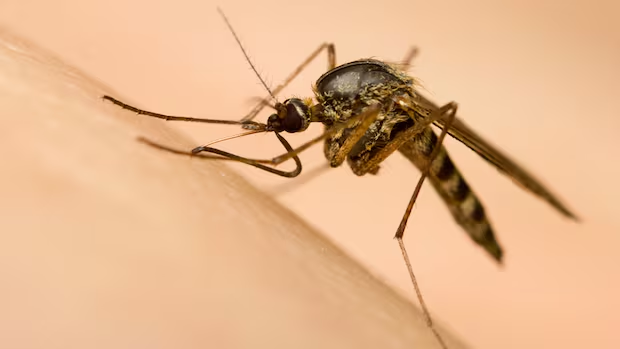

Listen to this article
Estimated 4 minutes
The audio version of this article is generated by AI-based technology. Mispronunciations can occur. We are working with our partners to continually review and improve the results.
Alberta’s booming mosquito populations are triggering more than just itchiness and aggravation.
It turns out the pesky swarms are leading to some emergency room visits in Alberta, particularly among children.
Edmonton emergency room physician Dr. Andrew Dixon has treated a number of cases of so-called “skeeter syndrome” this summer.
“Lots of kids are coming into the emergency department with mosquito bites. I’ve probably seen five or six in the last two or three days,” he said in a recent interview with CBC News.
“We’ve seen a lot of kids come in with significant swelling. It usually worries people the most when it’s in and around the eye. You get a big swollen thing around the eye and the eye swells shut. Obviously it worries people but it is quite benign.”
‘Not uncommon’
When mosquitos bite we tend to get itchy as our bodies react to their saliva.
But some people, often those who haven’t been bitten very often, have a much stronger inflammatory reaction.
“Skeeter syndrome does happen more in the young,” said Dr. Mariam Hanna, a pediatric allergist and clinical immunologist at McMaster University.
“It tends to get better as they get older, as they get more mosquito bites [and] they become more tolerant to it. Their immune system recognizes it more and more.”
Large areas of skin can end up very red, swollen and hot, according to Hanna, and in some cases blisters can fill with fluid.
These reactions tend to peak around pre-school age and often fade by the time children are in school, she said.

“Most families have, in fact, not heard about this condition. And so when it happens to your child or someone you know, it can be quite alarming to see,” she said.
“It’s not uncommon particularly in some areas in Canada where we get a lot more mosquitoes and a lot more mosquito bites.”
Skeeter syndrome is localized and does not lead to anaphylaxis so it is not life-threatening, according to Hanna , who is also the pediatrics chair for the Canadian Society for Allergy and Clinical Immunology.
A low fever can be involved in some cases.
Because that is also a sign of potential infection, she recommends seeking medical care if that happens or if you are worried about your child.
Mosquitoes rampant
At the University of Calgary, John Soghigian has been keeping a close eye on mosquito populations.
“In Calgary we’ve had a particularly bad, early mosquito season and elsewhere in the province it looks like it’s largely been the same, driven by a large amount of rainfall early on in the year,” said Soghigian, an associate professor in the faculty of veterinary medicine.
“We’re getting quite a bit more mosquitos. On the order of a hundred times more in some of our traps than we did this time last year,” he said.
With those kinds of mosquito counts, he’s not surprised skeeter syndrome is popping up.
“Edmonton and Calgary have really experienced rapid population growth of people moving here from elsewhere,” he noted.
“And if people have not been exposed to mosquitoes before, especially kids, then they have a higher chance of potentially developing skeeter syndrome or other allergic reactions to mosquito bites.”
Just how long the swarms of mosquitos will last ultimately depends on how much more rain comes, according to Soghigian.
Last year, for example, the mosquitoes picked up later in the season after a slow start he said.
Meanwhile, according to Hanna, there are a number of ways to treat skeeter syndrome, including icing the affected area, applying over-the-counter steroid cream and using oral antihistamines.
If the joints are impacted she said acetaminophen or ibuprofen can help with discomfort.
In a recent public service announcement , Alberta Health Services said allergic reactions from insect stings, bites and environmental exposures accounted for 1,511 visits at 13 hospitals during June, July and August of last year.
For his part, Dixon recommends people call Health Link if they have concerns.