dailynewsnblog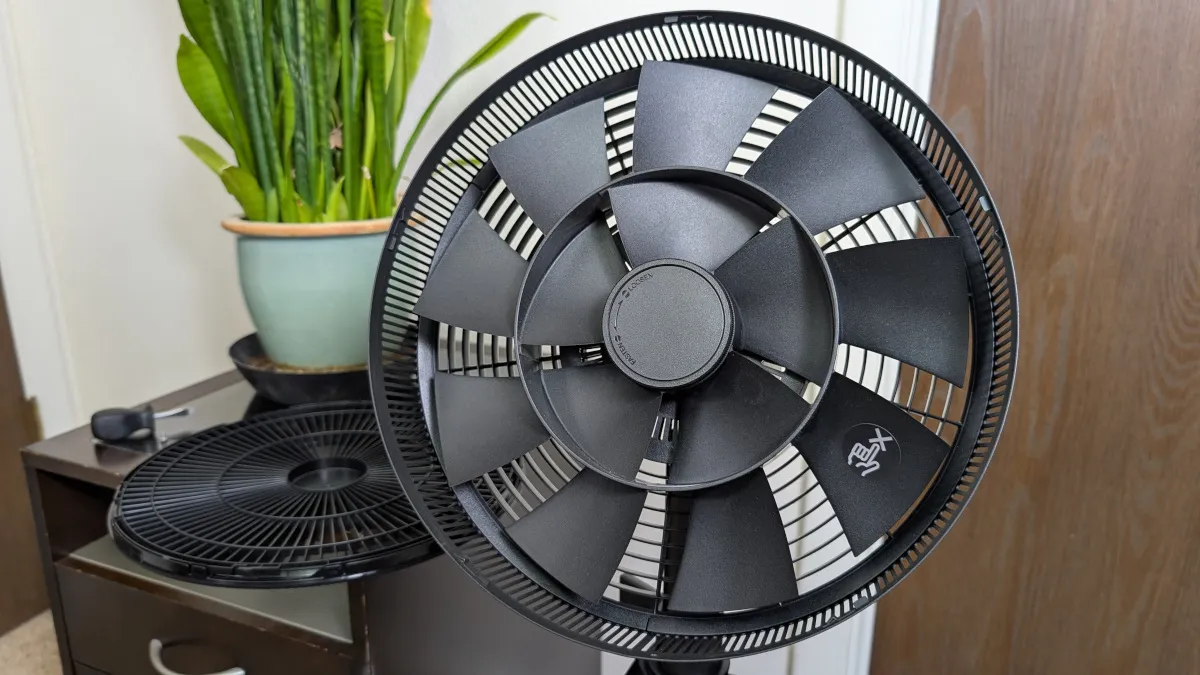

Balmuda NatureWind Studio
Pros & Cons
-
Minimalist design that’s attractive and durable -
Intuitive manual oscillation adjustment -
Outstanding energy efficiency -
High airflow -
Easy assembly
-
More expensive than most fans -
No remote control -
Relatively loud at higher speeds
Not long after I finished my tower fan tests, my editor looped me in on the Balmuda NatureWind Studio, a fan that costs an eye-popping $429. For comparison, that’s about the same as the Dyson Cool AM07. Both of those premium fans emphasize design, in terms of both aesthetics and performance. But they take vastly different approaches. Dyson’s bladeless design immediately struck me as bold, with a high gee-whiz factor. In contrast, Balmuda’s fan has an understated quality, a thoughtful examination of what it takes to simulate a natural breeze within a convenient package.

You can easily remove the fan guard and blades for easy washing in the sink, which is great news for preventing grimy, dusty fan blades.
John Carlsen/CNET
I spent a couple of weeks using the Balmuda NatureWind Studio, and much to my own surprise, I think it’s a worthwhile investment for the right person. Let’s dig into my findings so you can see if Balmuda’s impeccable styling is a good way for you to beat the next heat wave.
Balmuda’s unconventionally conventional design
The Balmuda NatureWind Studio fan is roughly 3 feet tall, making it shorter than most of the fans in my office. While the fan design mixes predominantly metal parts with some plastic, none of it feels cheap or flimsy. (This doesn’t mean you should abuse the plastic parts if you want the fan to last.)
Unlike the dozen or so tower fans I’ve tested, the Balmuda required a surprising amount of assembly to put together. But this also means it ships in a smaller overall package. The setup instructions are very clear and direct, though, and the print is pleasantly larger than I typically see, which might help some people with vision problems. Setup is intuitive and tool-free, too — it took me about 10 minutes total.

The first thing that stands out about Balmuda’s fan is how much it looks like a typical pedestal fan, albeit one with a tripod setup rather than having a single central support column.
John Carlsen/CNET
The fan has a unique dual-blade design, which uses an inner ring of five blades and an outer ring of nine blades. Balmuda says the two sets of blades create two different airflow patterns that interfere with each other, resulting in an irregular, more natural-feeling breeze compared to the rotating vortex produced by single-blade designs. I can confirm that the breeze feels great at every speed; it’s better than the dedicated breeze modes on other fans, which use alternating motor speeds.
The next thing that stood out to me was the high-end power cord, which uses a flexible woven fabric outer casing that makes the cord easy to move without kinks or resistance. Crucially, you can hang any excess cord on a simple hook, and the cord is removable, making it easy to manage and keep tidy.

I can’t tell you how many times I’ve adjusted the oscillation because it’s so effortless and natural.
John Carlsen/CNET
Another distinguishing detail: the Balmuda NatureWind Studio doesn’t come with a remote control. Instead, you control the fan exclusively with buttons on the top of the motor casing. It has a simple timer (1 to 4 hours), five speeds and an oscillation setting. While the timer isn’t particularly noteworthy, the fan does include an 18-hour auto-off setting that prevents it from continuously running — a nice feature that helps protect the motor.
You can switch between four of the five speeds with a simple tap of the wind speed button, but the jet mode button requires you to hold it to activate the fan’s maximum speed. It’s powerful, which explains why Balmuda disables oscillation in this mode for better stability.
The oscillation setting is perhaps my favorite feature on the Balmuda NatureWind Studio because it’s entirely adjustable. You change the oscillation by turning on the mode before physically turning the fan to one side until it beeps, then turning it to the other side for another beep. This means you can tell the fan exactly how far you want it to rotate, without the need for any complicated buttons. You can also tilt the fan head up or down to aim it better within a room, but this uses a fixed angle, not automatic oscillation.
That’s the full extent of the features the Balmuda NatureWind Studio, because its intentionally minimalist design skips some superfluous functions you’ll find on other fans (and that many people probably don’t use anyway).
How well does the Balmuda NatureWind Studio perform?

The Balmuda fan achieved great airflow and excellent energy efficiency in my tests.
John Carlsen/CNET
How well does the Balmuda NatureWind Studio perform?
I put the Balmuda NatureWind Studio through the same tests I used for tower fans, with one minor adjustment: I didn’t set up the cardboard testing tunnel and only checked the airflow without obstructions. My reason for this is that it’s not part of that comparison, and the tests are more informal anyway. Still, here’s what I found:
- Airflow: The NatureWind Studio produced a median airflow of 394 feet per minute (FPM), which outperformed some of the tower fans that cost more than $200, like the Shark TurboBlade, Dreame MF10 and Dyson. Perhaps even more impressive is that its max airflow hit 847 FPM, second only to the two Dreo models I tested. It also produced more consistent results than any tower fan, with most measurements falling into a narrow range for each tested speed.
- Air texture: (10/10) The breeze feels smooth and natural, more so than bladeless towers like those from Dyson and Shark.
- Max loudness: It registered 63.6 dBA, which is louder than any of the tower fans I tested–the closest rival was the Dreo TurboCool 765S at 59 dBA. On the two lowest speeds, Balmuda was virtually silent.
- White noise: (9/10) The fan blades make pleasant white noise, but the noise of the whirring motor at high speeds takes some getting used to.
- Beeps and clicks: (6/10) It always beeps when you touch a button, and there isn’t an option for silent controls. Still, the beeps aren’t overly sharp or intrusive.
- Max power consumption: (1 watt on low, 17 watts in Jet Mode) The NatureWind Studio’s DC motor is very efficient, falling roughly between the Vornado Strata 8 Omni and Levoit Classic 42-inch as one of the most efficient fans I’ve tested.
Using the ratings scale from my tower fan tests, the Balmuda NatureWind Studio scores an 8/10 overall. This is roughly the same as the fans I reviewed from Dreame, Dyson and OmniBreeze. While it’s respectable, I want to note that it’s only this low because Balmuda is expensive, doesn’t come with a remote and is fairly loud at higher fan speeds. Otherwise, it offers excellent performance and efficiency.
Should you buy the Balmuda NatureWind Studio?

It has a fantastic design that showcases how minimalist products can be practical without all the bells and whistles.
John Carlsen/CNET
Other than the price, lack of a remote and some loudness on higher speeds, I can’t find a reason not to recommend the Balmuda NatureWind Studio to anyone who has the budget and interest. Personally, I’m not convinced that the missing remote is even a drawback because the fan is so easy to control without it. That said, folks on a budget might consider the Vornado Strata 8 Omni, which costs four to five times less than the Balmuda NatureWind Studio, depending on available sales prices.

See full bio