dailynewsnblog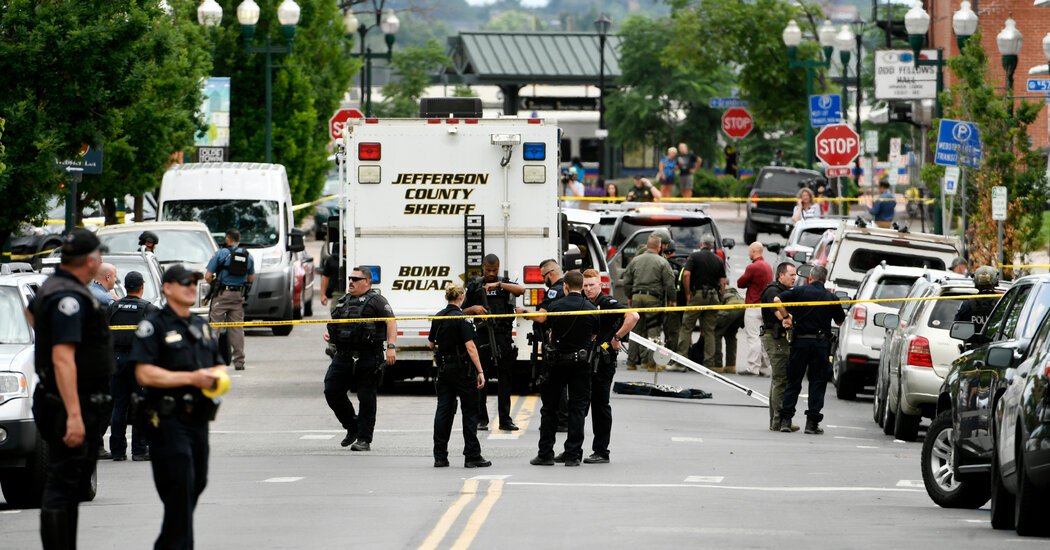
As he so often did, Ronald Troyke began his day swiping through YouTube, fixated on videos from the same genre: police officers caught doing something wrong.
Mr. Troyke, 59, watched the clips alone, surrounded by his sparse belongings — a folded paper about concealed firearms, greeting cards from a sister worried about his mental health, a tote bin that was labeled “gun stuff.” At 9:30 a.m. that morning in June 2021, he watched a last video about a police officer in Ohio who had driven over a man lying in the street. He could bear it no longer.
On the wall of his apartment bedroom in Arvada, Colo., he taped a handwritten message — some words scribbled in ALL CAPS, others underlined — raging about police corruption and a lack of accountability. “The people have had enough,” he wrote.
He folded another note into his wallet that included a vow: “Today I will kill as many Arvada officers as I possibly can.”
Jumping into his Ford pickup, which was stocked with a handgun, a semiautomatic shotgun, an AR-15-style rifle and a stack of high-capacity magazines, Mr. Troyke drove a mile to Olde Town Square. It was a gathering place for the community, home to a children’s spray park and, on weekends, a farmer’s market. Mr. Troyke also knew it was a place where police officers patrolled; he had confronted three of them there just a couple of weeks before.
For more than an hour, he surveyed the area from his truck, sipping ice water from a stainless steel tumbler. Then he saw Officer Gordon Beesley come into view, on foot, responding to a call about a suspicious person.
Mr. Beesley did not normally work the streets. He was on summer break from his work as a resource officer at a local middle school, where he was known as the guitar-playing cop who befriended kids on the fringes, leaving home early many mornings to help a special-needs student bike to school. That summer day, while Mr. Troyke eyed him, Mr. Beesley was counting down the minutes to the end of his shift, when he could join his family to celebrate his son’s 14th birthday.
As Mr. Beesley strolled down an alleyway toward the square, Mr. Troyke steered into a nearby parking spot, flung open the door of his truck, jogged toward Mr. Beesley and, without a second’s hesitation, opened fire. The lanky officer, his gun holstered, was struck in the head and torso. He collapsed face first onto the bricks — the first member of the Arvada department ever to be fatally shot in the line of duty.
More gunshots ricocheted off the facades of buildings around the square. Diners at neighboring restaurants dove under tables. Shoppers ran. Three police officers who had been eating lunch in an inconspicuous office nearby rushed to a window to see Mr. Troyke in a black sweatshirt, carrying a long gun. “There’s an active shooter,” one of the officers said. They drew their own firearms.
Across the street from the town square, Johnny Hurley was shopping in a military surplus store when he heard the shots. He peered out the window and pointed. “There’s a guy with a gun,” he told the other patrons.
As many of them scattered for refuge, Mr. Hurley crept out the store’s front door, reached to his hip and pulled out his own handgun.
A history of mass violence
Working in a bedroom community known for its arts scene, craft breweries and a small-town charm that some locals liken to Mayberry, the officers in Arvada had unusual expertise in active shooters.
A.J. DeAndrea, the deputy chief who led the department’s training, had been a SWAT officer who responded at Columbine High School, just down the road from Arvada, when 13 students and a teacher were killed there in 1999.
Seven years after Columbine, he was at Platte Canyon High School in Bailey, Colo., when a gunman took students hostage, killing one just a few feet away from Mr. DeAndrea. The following year, he was one of the first officers to respond to a mass shooting at a youth missionary center in Arvada. He helped carry two dying victims away from the scene.
Each new experience had convinced Mr. DeAndrea of the need to train officers in how to better respond to what was becoming a distressing new norm. With his sonorous voice sometimes giving way to earnest whispers, he confided the failures of the response at Columbine and the lessons since learned, preaching the urgent need for patrol officers to confront such killers if they hoped to avert mass bloodshed.
He traveled the nation, training officers in all 50 states. Organizations overseas sought his expertise. The Department of Education recognized him as an expert on active shooters. He earned six medals of valor.
That experience was a big asset in Arvada, his hometown, a community of 125,000 that celebrated its low crime rates. He championed the transformation of an old elementary school into a training center where officers could roam hallways in active shooter simulations, learning when to open fire and how a gun performs when shooting through glass. The mass shootings were not going away, he said, so he wanted help law enforcement officers learn from their mistakes.
“Let’s swallow our pride, look at what we did wrong, look at what we did good, and let’s find and create systems, models, ways to deal with this better,” he said.
In a state that requires officers to undergo 24 hours of annual training, Arvada officers began receiving three times that much, including sessions on active shooters and how to stop a gunman when an officer is alone. In its literature for potential recruits, the department expressed pride: “Our overall training programs are second to none.”
Intense training was needed to help officers stay in command during high-stress situations, Mr. DeAndrea would say. Without it, he noted, an officer’s forebrain, the part that helps process complex decisions, might shut down in favor of fight-or-flight instincts.
Persistent training, he told his officers, could help an officer address confusing situations without panic: Is lethal force justified? Can I make the shot? Is the person I’m looking at the one committing the bloodshed?
153 rounds
With one officer down in the square, Mr. Troyke continued shooting, turning his gun on a line of empty police vehicles nearby and shattering their windows. He then hurried back to his vehicle and pulled out an AR-15.
He wore ballistic armor that covered his chest and back. A Glock handgun and an extra magazine were strapped to his right hip, and on his left, he had a bandoleer with three additional 30-round magazines. In total, he carried 153 rounds of ammunition.
The three officers who had been having lunch continued to watch from inside the office, mindful that Mr. Troyke’s rifle could easily pierce the door they were standing behind.
Spying a man in a dark shirt and brimmed hat carrying a rifle with its barrel pointed skyward, one of the officers warned the others. “He’s coming back, he’s coming back,” he said, according to law enforcement investigative records. But a veil of trees, cars and a dumpster obscured their view from the window, and the man disappeared from their sight.
As two of the officers moved to different parts of the building, Officer Kraig Brownlow stayed near the window, but far enough away to avoid being spotted. In his six years at the department, Mr. Brownlow had done about 40 hours of active shooter training. He knew he was outgunned.
By then, Mr. Hurley had burst out the front of the military surplus store and into the town square. He crouched low to the ground, his gun pointing downward. He paused and then rushed past the building where the officers were staged and ducked behind a brick wall that gave him cover.
He peeked his head out, trying to see where the gunman was, locking eyes with another frightened man hiding amid cars in the alley, then ducked back. Then he looked a second time. Mr. Troyke was nearing the town square again.
Mr. Hurley stepped out from behind the wall. He raised his handgun in a shooting stance and took aim at Mr. Troyke.
A coded message
Three years before the town square shooting, in 2018, a message from Mr. DeAndrea’s daughter Madalena had arrived on his phone just after midnight: “I love you guys.” He recognized immediately that a disaster was unfolding.
The words echoed the last message of the shooting victim at Platte Canyon High School whom Mr. DeAndrea had not been able to save. The DeAndrea family now treated those words as a code that meant they were in dire need of help.
His daughter was alerting him that a gunman was on a killing spree at a bar where she had been line dancing with friends a 2 ½-hour flight away in Thousand Oaks, Calif., near where she was working for a nonprofit. She was now huddled in the attic.
Helpless to do anything else, Mr. DeAndrea opened an online police scanner, began booking a flight to Los Angeles and called police dispatch in Thousand Oaks to share information about his daughter’s location in the attic. Madalena survived, but 12 others did not — one of the worst mass shootings in California history.
The victims included college students, a Marine Corps veteran and a Navy veteran who had previously survived the nation’s deadliest mass shooting — the 2017 massacre at a music festival in Las Vegas. Also among the dead was a sheriff’s deputy who had entered the building to confront the gunman.
To Mr. DeAndrea, his daughter’s training had taught her to flee at the right moment. But in the weeks after the shooting, she came to him to say that she also wanted to be able to carry a concealed weapon. As he guided her into training, he was proud that she was empowering herself. On the other hand, he could not help but feel apprehension at the thought that his daughter might one day need to shoot somebody.
He was also continuing to think about how law enforcement officers should respond.
One of the lessons of the Thousand Oaks shooting was the extreme danger officers face rushing into a scene. Mr. DeAndrea had started teaching officers that slowing their pace just a bit could allow them to better assess the scene and make better decisions.
“If you’re deploying, and somebody else is deploying: link up,” Mr. DeAndrea was telling his officers. “Let’s work in tandem. Let’s slow it down a half step. Let’s be smart.”
It was a lesson reinforced once again only a few months before Mr. Troyke’s attack in the town square, when Arvada had dealt with yet another mass shooting: A gunman from the city traveled to a grocery store in neighboring Boulder and killed 10 people. An officer who had run into the building solo was one of those killed.
A Simmering Distrust
Long before his resentment of law enforcement had begun to fester, Mr. Troyke had been raised in Illinois, growing up with a plan to one day escape the Midwest humidity. He made his way west in his 20s and built a new life in the mountains of Colorado.
He hauled mail on the roads that connected resort towns like Vail and Aspen. After his brother moved to the area, they would ride ATVs out to remote hillsides and shoot at rocks for target practice.
Initially, Mr. Troyke held the authorities in high regard, even after some dust-ups with the law in the 1990s — he was arrested for D.U.I. after an officer saw his motorcycle drift toward oncoming lanes, then he and a girlfriend were both charged with assault after a domestic fight. But in more recent years, Mr. Troyke began developing a simmering distrust of law enforcement, consumed with stories of officer misconduct. He would steer conversations to the subject, his brother later told investigators, with rants so vehement that his brother at times paused to warn him: “You’re the reason why we got this dumb-ass gun control.”
He was outraged by the killing of Elijah McClain, who had been unarmed and walking home from a convenience store in Aurora, outside of Denver, when officers confronted him.
In early June 2021, two weeks before the town square shooting, he began recording a group of Arvada officers who were questioning a man near the library, telling a bystander nearby: “You got to film these sociopaths.”
The video showed what was initially a calm scene. But then Mr. Troyke began loudly berating them. Officer Brownlow, one of the officers there, took out his own phone to record.
“You guys are terrible people, man,” Mr. Troyke could be heard saying. “Not all of youse are, but there’s too many that are no good, so we have to assume that all of youse are bad.”
Mr. Hurley, the man who would later emerge to take aim at Mr. Troyke, had his own growing convictions about law enforcement. Long shaped by a distrust of authority, he had joined Indigenous protests against the construction of the Dakota Access pipeline and handed out DVDs at the mall that questioned the facts of the Sept. 11 attacks. He celebrated the rights of individuals over the power of government, confronting security personnel at the airport, protesting a speech by former House Speaker Newt Gingrich and fighting against mask mandates during the coronavirus pandemic.
Lately, he had grown particularly concerned about police abuse. After the 2020 police killing of Breonna Taylor in Kentucky, he began describing the United States as a police state. He embraced the phrase “ACAB” — all cops are bastards — and feared that a greater crackdown on individual rights was yet to come.
But Mr. Hurley was a man of contradictions. He handed out clothes to the homeless and held signs with his friends offering free hugs. He practiced yoga and meditation — even as he also began regular training in weapons handling and tactical skills. In training for an active shooter situation, he told a friend that, as a person without a spouse or children, he would be ready to step up and risk his life to halt a killer.
“I could never let anyone else get hurt around me if I had the power to stop them,” he told the friend.
His growing interest in firearms was a point of contention between Mr. Hurley and his best friend, Taylor Garland. The two had been close and an occasional couple since meeting as teens.
Two months before the shooting rampage in the square, Mr. Hurley invited Ms. Garland over for one of their weekly meals, featuring eggplant rollatini, drinks and deep conversation. The mood was light, she said in an interview, but hours into the evening, Mr. Hurley’s tone changed. He had something to discuss, he told her. His worries about the nation had grown deeper. As part of his preparations, he had purchased an AR-15.
Ms. Garland had known about his interest in handguns and his belief that the police could not provide safety for everyone. But a semiautomatic rifle was an escalation she struggled to process. She feared that his interest in guns would not make him safer, but would rather draw danger closer. The two of them cried as they realized that a philosophical difference that had long been a point of contention in their relationship was now untenable.
“I don’t know how to blend these two things that I love so much — you and my beliefs,” Mr. Hurley told her.
More gunshots
That day on the town square, Mr. Hurley’s moment arrived. As Mr. Troyke turned toward him, Mr. Hurley fired his weapon. Mr. Troyke staggered sideways, struck several times, then collapsed to the ground.
Mr. Hurley, with his gun pointed toward the ground and his red shirt pulling away from the brick wall, inched in the direction of Mr. Troyke. Believing that Mr. Troyke was incapacitated, he ran forward, grabbing the rifle Mr. Troyke had dropped to disarm it.
Officer Brownlow opened the door of the office where he and the others had been waiting. He spied a man in a red shirt who looked like he was fiddling with the rifle, perhaps to fix it or reload. Had the gunman taken off his sweatshirt?
He considered ordering the man to stop, but decided it was too risky — he did not stand a chance should the man turn the rifle in his direction.
He fired three shots. One of them struck Mr. Hurley in the hip, tearing through his arteries and killing him.
Moments later, the officers cautiously moved outside and found three bodies on the ground.
Mr. Brownlow, feeling a sense of pride that he had helped bring the shooting to a quick end, told investigators later that he immediately thought of the Columbine massacre, which had been committed by not one but two teenagers, acting together. There must have been two attackers, he thought.
‘A good guy with a gun’
Columbine served as a reckoning for the nation and in particular for the National Rifle Association, which argued that law-abiding citizens carrying guns serve as a critical deterrent to gun violence. “The only thing that stops a bad guy with a gun is a good guy with a gun,” Wayne LaPierre, an N.R.A. executive, began to say.
But the rise in mass shootings across the country has also brought stories of bystanders who were ultimately unable to halt bloodshed, and the successful interventions envisioned by the N.R.A. remain exceedingly rare. Of the nearly 600 active shooter incidents since 2000 tracked by the Advanced Law Enforcement Rapid Response Training Center at Texas State University, only 15 were halted by ordinary people shooting the attacker. One of them was Mr. Hurley.
Sometimes, attempts to intervene have led to additional tragedy. Three years before the Arvada attack, a shooting at a bar in Illinois was halted by a security guard, Jemel Roberson, who subdued the gunman, pinning him to the ground. But police who arrived shortly thereafter mistook Mr. Roberson for the gunman, and fatally shot him.
That story was just the kind to capture Mr. Hurley’s attention. He went on Facebook to bring attention to Mr. Roberson’s death.
“This is absolutely horrendous,” he wrote. He included a dose of sarcasm: “I’m sure if we continue to pass stricter gun laws nothing bad will happen when cops end up being the only ones with guns.”
Rumors and reality
In the hours after the shooting, Arvada police leaders called a news conference. Three people were dead, they said, including an officer, a gunman and an unknown person they were working to identify.
“At this time, we believe this person was shot and killed by the gunman,” said Ed Brady, another deputy chief.
But the community was already awash in rumors. Mr. Brownlow heard someone at the scene say that Mr. Hurley may not have been an attacker, but a bystander. Mr. Brownlow’s pride that he had halted a mass shooting was giving way to dread.
One person who had not been paying attention to the local news that day was Kathleen Boleyn, Mr. Hurley’s mother, who lived down in Colorado Springs. That night, two F.B.I. agents knocked on her door.
The agents told her that her son had been shot and killed, and that they did not know who had shot him. Other officials encouraged her not to watch the news, she recalled, “because you won’t know if anything that they say is true until you hear it from us.”
At the time of the shooting, Mr. DeAndrea was on a flight to Louisiana to conduct a training session with officers there alongside a victim of the Platte Canyon High School shooting. He landed to find a stream of text messages and immediately boarded a flight back to Arvada, going to the coroner’s office to relieve the honor guard on duty and spend private time with the body of Mr. Beesley.
As the investigation went on, it had become clear that Mr. Hurley had been not a second shooter, but a good Samaritan who had taken down the gunman.
Mr. DeAndrea and other department leaders invited the Hurley family in for a meeting. They began by sharing how much of a hero Mr. Hurley had been, and how his actions had saved lives. Then they disclosed that the police had shot him.
The family later filed a lawsuit that has since been settled. Nobody was charged in the case. Prosecutors concluded that because Mr. Hurley was holding guns in his hand, Mr. Brownlow “had reasonable grounds to believe that Johnny Hurley was a second mass shooter.”
Mr. DeAndrea has since retired from the department and declined to discuss the details of Mr. Hurley’s shooting. But he still leads training for law enforcement at home and across the country.
Last month — as the community was preparing to commemorate the fifth anniversary of the shooting in Olde Town Square — he was guiding a class of school security guards through the halls of the former elementary school that law enforcement uses as a training center. The marquee outside featured a quote from Mr. Beesley: “Look for the good in every day.”
The class heard Mr. DeAndrea’s assessment of best practices and worst mistakes. As he walked the class through the much-criticized police response to a school shooting in Uvalde, Texas, in 2022, he reminded them that even the most effective police officers don’t invent a heroic response in the heat of the moment — they fall back on their training. Madalena DeAndrea, who now works as the director of school safety for the school district that includes both Arvada and Littleton, where Columbine High School is located, watched in the back.
In a country where the Second Amendment is foundational, Mr. DeAndrea said in an interview, he embraces the idea that “a good guy with a gun” can be a vital tool. People need to take responsibility for their own personal safety, he said, “because the government has a tendency to screw things up.”
At the same time, he said, things can get messy. An armed teacher might accidentally shoot the police as they burst into a classroom. Officers might shoot the teacher with the gun. For all the training that’s been done, he said, more is needed. And no one has figured out how to fully prevent tragedy when so many bullets are flying.
“That’s the hard part: How do we get there?” he said. “If I could come up with a way, I’d be a millionaire.”