dailynewsnblog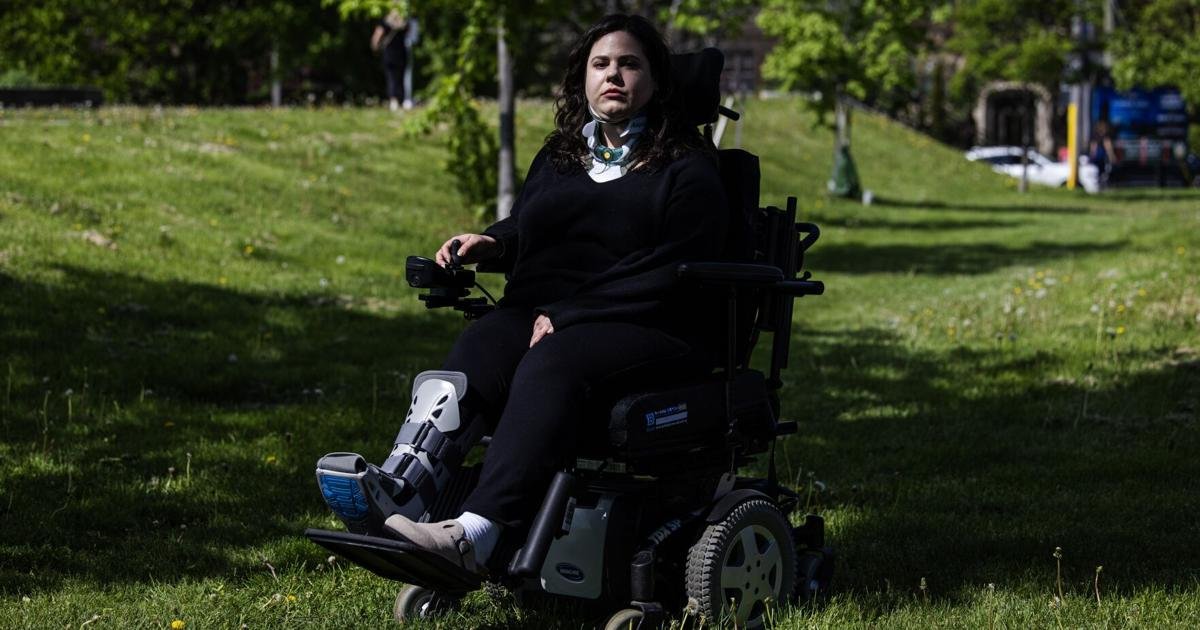
Tiffany Felkai returned to her Toronto apartment and let her walker fall to the floor.
She had just visited the director of a pain clinic.
He asked her what she’d do if, after finally getting an MRI, the results were normal. How would she respond if she found out that, despite her pain, there actually was no clinical cause?
So there, in her apartment, she tried to walk — forcing herself to take step after step until tears welled in her eyes.
“I was like, I can walk, right? They say I can walk, so I’m going to do it,” she said.
It was debilitating, but she’d repeat this ritual many more times.
“Doctors completely deny what you’re going through and so then, yeah, you start to question your own reality, like maybe, is it me?”
As a 20-year-old, Felkai was diagnosed with Ehlers-Danlos Syndrome. But years later, in 2017, while living on disability payments as a Toronto college student, she experienced a fall followed by a rapid decline in her mobility. She went from a cane to a walker to an electric wheelchair in under a year. Felkai cycled through multiple referrals in an attempt to understand what is going on with her body, but said she was often left feeling dismissed. Each time she felt like she was close to receiving treatment, she said, she was faced with new barriers to accessing care. Making her odyssey even more challenging, she has received seemingly contradictory diagnoses amid a shifting understanding of the condition and medical practices that differ by jurisdiction.
Now, at 35, Felkai is standing on the edge, looking at the end. She uses an electric wheelchair and lives in what should have been a temporary neck brace. She has found herself at the limits of Ontario’s health-care system and medical understanding of Ehlers-Danlos Syndrome (EDS), a group of inherited connective tissue disorders. After fighting to get the treatment she needs, Felkai said she is now seeking medical assistance in dying.
Felkai was diagnosed in 2019, by a U.S. neurosurgeon, with a form of EDS linked by some specialists to a condition requiring complex surgery, though the connection remains debated. While the surgery can be performed in Ontario, generally neurosurgeons are reluctant to do it for EDS patients because of limited evidence of its efficacy. Now mainly bed-bound, Felkai is pushing against not only the health-care system, but an evolving and contested field of medicine.
“It’s been the battle of my life.”
Chasing a diagnosis while living with painful symptoms
After her fall in 2017, doctors she saw the following year had theories, but no clear answers.
EDS is more common in women and often worsens over time. Diagnosis can take years due to limited awareness, patients not fitting current diagnostic criteria, and doctors dismissing symptoms. Also, some people remain symptom-free their entire lives.
Sometime later that year, at GoodHope, Felkai’s diagnosis was reassessed under updated guidelines and reclassified as hypermobility syndrome, a related condition with many overlapping symptoms. She said the reclassification affected her access to certain EDS-related care and referrals, despite her symptoms remaining severe.
But then, she fell into some luck. With the help of a substantial gift from an “angel donor” who didn’t know her personally, Felkai hired a private medical case management agency that year. It reviewed her entire medical history.
The case management agency found a neurologist in the U.S. who specializes in EDS, and through genetic testing — sometimes used to diagnose certain forms of EDS — the neurologist confirmed she had classical EDS.
Then in 2018, the case management company contacted Dr. Fraser Henderson, an American neurosurgeon specializing in spinal conditions linked to EDS.
In 2019, Felkai paid for a virtual consultation with Henderson where her case files were reviewed. He diagnosed Felkai with cervical-cranial instability (CCI), where the joint connecting the skull and spine becomes unstable, a condition sometimes reported in EDS patients.
Henderson said she would need occipito-cervical fusion (OCF) surgery, which uses metal plates and screws to stabilize the joint. The diagnosis was far more severe than what doctors in Canada had previously told her.
Felkai felt like things were finally starting to make sense.
“I was bright-eyed, bushy-tailed, determined, and felt like I had irrefutable proof,” said Felkai.
In 2019, Felkai went to GoodHope, where she presented the diagnosis of EDS and CCI from Dr. Henderson in the hopes of receiving more support.
But at GoodHope, the doctor she saw said CCI is not part of the diagnostic criteria for EDS. Felkai said the clinic was going to refer her to a neurosurgeon. But after two months of waiting, she followed up and learned that her case would not be referred because the radiologists at GoodHope would have to take her images themselves to confirm CCI.
“The appointments almost get so hard to bear that I’m at the point of weighing, like, do I even want to continue,” said Felkai.
Lino DeFacendis, a friend and advocate for Felkai, raised more than $25,000 in a fundraiser to help her access supports such as mobility devices, some renovations to make her home more accessible, and for medical care and legal costs.
While he’s only known her for a year, he said they’ve become close and it’s excruciating to see her constantly try to access treatment while living with debilitating pain.
“She can’t get the care she needs, and anywhere she turns, it’s like, ‘We can’t help you,’ ” DeFacendis said.
Despite this, he said, her resilience has been remarkable.
“She’s fighting for everyone who needs to fight the system.”
Felkai decided not to continue with testing at GoodHope, concerned that the diagnosis they gave her, which already conflicted with what a top neurosurgeon in the U.S. had surmised, would follow her and bar her from the treatment she felt she needed in Canada.

“It’s taking the medical profession a long time to catch up and recognize what my body has been screaming about,” said Tiffany Felkai.
Nick Lachance/Toronto Star
Ontario’s funding for out-of-country health care
In 2021, a Canadian neurosurgeon who works at UHN, Dr. Christopher Witiw, accepted Felkai’s referral and agreed with the U.S. surgeon’s findings. While Witiw can and has performed the OCF surgery Felkai needed, she said he could not perform it for patients with EDS.
So Witiw applied through Ontario’s out-of-country prior approval program for Felkai to receive the surgery in the U.S. from Dr. Henderson, with the procedure to be funded by OHIP if approved by the Ministry of Health.
Under OHIP, some out-of-country care can be covered through doctor-submitted applications, with the ministry deciding on approval and notifying both parties. The program was set up as a “safety valve” for the Ontario health-care system, according to a government website, by funding health services outside the country when services are either not available in Ontario or are not available without medically significant delay.
“It was a beautiful full-circle moment,” said Felkai. “I was like, ‘It’s all coming together.’”
Both of Felkai’s applications were denied.
In a statement to the Star, the ministry said all applications are reviewed on a case-by-case basis against the regulatory criteria, and only applications that meet all those criteria are eligible for funding.
Felkai shared her decision letters with the Star, which said her application didn’t meet the criteria.
The first was denied because the U.S. surgeon did not work at a hospital.
The second denial relied on the opinion of a spinal surgeon in London, Ont., who said the surgery could be performed in Ontario but was not the first recommended treatment for her “mild” condition, and that delaying surgery would not cause irreversible harm.
A statement from UHN said between April 2025 and January 2026, UHN performed 12 occipito-cervical fusions, with one for a patient with EDS.
UHN said there’s not enough evidence and general agreement in the field that this surgery is appropriate for most EDS patients.
To Felkai, it was a heartbreaking injustice.
“It’s taking the medical profession a long time to catch up and recognize what my body has been screaming about,” said Felkai.
Seeking controversial surgery as doctors debate evidence
But medicine isn’t quite able to meet Felkai where she is at.
Dr. Jefferson Wilson, chief of spine surgery at Toronto’s Sunnybrook hospital, said the OCF surgery is controversial in EDS treatment.
OCF surgery involves attaching metal plates, screws and rods to fuse the skull and upper spine together, permanently limiting movement in the neck. It’s also highly invasive, and recovery can be especially difficult for EDS patients, whose wounds often heal more slowly.
Some studies suggest people with EDS can develop cranio-cervical instability (CCI), though experts say it can be difficult to distinguish severe instability from naturally loose joints. Wilson said some surgeons may decide not to perform the procedure unless scans show clear instability, particularly because evidence about its effectiveness remains limited.
Instead, patients may be directed to treatments such as physiotherapy or anti-inflammatory medication. Felkai has tried physiotherapy.
In the U.S., however, a small number of surgeons have become known for performing the surgery in EDS patients. About 400,000 spinal fusion surgeries are done annually in the U.S. A review of medical literature from 1984 to 2023 found the U.S. was the top publisher of material exploring the association between EDS and CCI, though interest declined after 2020. Canada ranked ninth.
“It’s unfortunately an area where we don’t have enough evidence,” said Wilson. “And that’s where the field is at.”
Wilson added that while occipito-cervical fusion surgery is regularly performed for traumatic injuries or tumours affecting the upper cervical spine or the skull base, it remains contentious for people with EDS. There are no privately funded surgeons performing the surgery to his knowledge in Ontario, he said, leaving surgeons having to make a case to the ministry.
“Which is not at all comparable to what happens in the U.S., where it could be sky’s the limit for somebody coming out of country, paying privately. It’s basically whatever the surgeon wants.”
David Harris, CEO of the American-based EDS Clinic, which diagnoses and treats EDS and related conditions, said the procedure can be difficult to access for EDS patients in the U.S. as well.
“The medical research and the backing for this is very much based on individual surgeons who have successfully done this repeatedly,” he said. “It’s certainly not a widespread, accepted standard of care.”
He said while research on the effectiveness of OCF for EDS patients is “rapidly developing,” it’s still not clearly established, comparing it to medical literature on long COVID.
“People still have the same experience of the patients in Canada, where we have patients who fly to Spain, who will travel across the U.S. to a different state to try and get this surgery, specifically for EDS and cervical instability.”
What happens when Ontario denies funding for out-of-country treatment
Felkai wasn’t out of quite out of options yet.
When out-of-country funding is denied, applicants such as Felkai can appeal the decision through the Ontario Health and Services Appeal Review Board.
Felkai received four extensions to appeal her denied applications, but can’t find a public lawyer to represent her. She said she has also consulted paid lawyers, but they didn’t want to touch the case.
Perry Bodkin, a former lawyer for OHIP at the tribunal, said the difficulty in finding a lawyer is not uncommon. Lawyers are reluctant because the tribunal is strictly bound to follow legislation, and a high rate of applications are denied.
Most people represent themselves at the tribunal, and he sees almost all of the appeals in these cases denied.
“It’s as though you’re not even there,” he said, adding that a review of every element of the out-of-country prior approval program and its appeal board is long overdue.
Meanwhile, Felkai is just trying to survive.
She has raised money over several years for pre-operative testing in the U.S. and related care, but did not reach her goal of $60,000. OCF surgery alone can cost upwards of $150,000 (U.S.). She informed donors the funds would instead go toward living and ongoing medical-related expenses.
“This is not a ‘me’ issue,” said Felkai. “What I’ll say is that the people that are suffering the most are the ones that you’ll never hear from.”