dailynewsnblog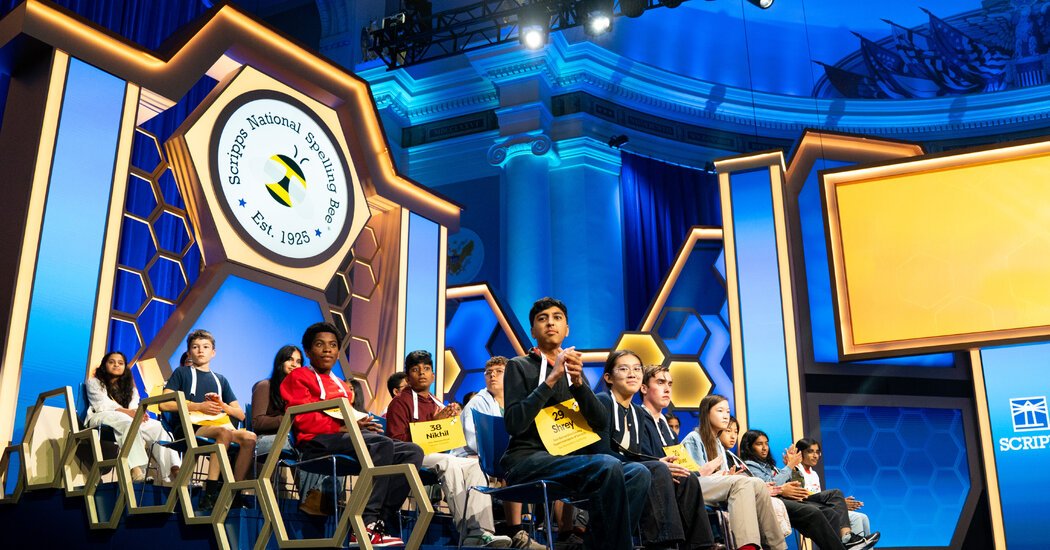

From Akron to London to Dallas and Cape May, The New York Times has covered spelling bees for roughly 150 years.
Even in 1874, when the phrase first appeared in the newspaper, it was called “a regular old-fashioned spelling bee” in Cleveland — reflecting the decades-long history of spelling contests in the United States. The “wordy combat” in Cleveland was open to everyone, and organizers struggled to find “orthographical monstrosities” to defeat the adult competitors, like chalybeate, phylactery, logarithmic and pharmaceutical.
“With a fiendish delight,” an organizer “hurled those polysyllabic thunderbolts at the little class standing before him,” the article read. Eventually, even the last two spellers “floundered hopelessly and gave up in despair.”
Only two years later, a spelling bee “mania” hit England, according to The Times, which reported on a contest between 214 people at St. James Hall in London, with 25 pounds in prizes. Three hours in, the surviving spellers faced words like phthisic, mulligatawny, ptarmigan and vinaigrette, a word the The Times reporter called “not English.”
The bee ended in confusion. A dispute over what room to finish the contest in led to everyone getting expelled “and nobody knows who got the prize-money.”
In New York around the turn of the century, bees were popular among schoolchildren and adults alike. In 1906, at a spelling bee at Hester and Essex Streets in New York City, 18 schoolchildren were so competent that they were all declared winners together. In 1908, New Yorkers dressed up in silks and laces to compete in a bee at the Prince George Hotel on 28th Street, where competitors were given malted milk tablets as “brain-crackers.”
That year, a 14-year-old Black girl named Marie Bolden, the daughter of a mail carrier, won an international contest in Cleveland. She earned “tremendous applause” from the audience and headlines for her achievement as the only speller to have a perfect score. (The Times first covered the National Spelling Bee in 1926, a year after its creation. A 13-year-old girl won $1,000 on “cerise.”)
In 1930, members of Congress competed against newspaper reporters in a spelling bee in Washington, broadcast on the radio. It was over in 40 minutes, as the reporters “humbled” elected representatives, The Times reported. A Massachusetts congressman tripped up on “kimono,” saying, “If one must go down to defeat he can wish no better fate than to be beaten by a member of the press rather than one of his own associates.”
A few days later, a dispute over the spelling of one of the words — whether tranquillity had one or two l’s — was front-page news. A representative from Nebraska felt he had been disqualified unfairly.
For decades, spelling bees big and small continued to receive coverage, bringing words like voile (a fine soft sheer fabric) and opiophagism (snake eating) to readers. In 1983, they heard President Ronald Reagan, on a visit with spellers, call for the elimination of the Department of Education. In 1992, Vice President Dan Quayle misspelled “potato” at a Trenton school spelling bee — even after a 12-year-old boy had spelled it correctly.
In the 2000s, the paper reflected the national competition’s ever-growing popularity: Its pages featured spelling champion families and reviews of films about spelldowns. And, though the venue changed from a gleaming Manhattan hotel to the back of a Brooklyn bar, coverage continued of adults drinking and spelling late into the night.