dailynewsnblog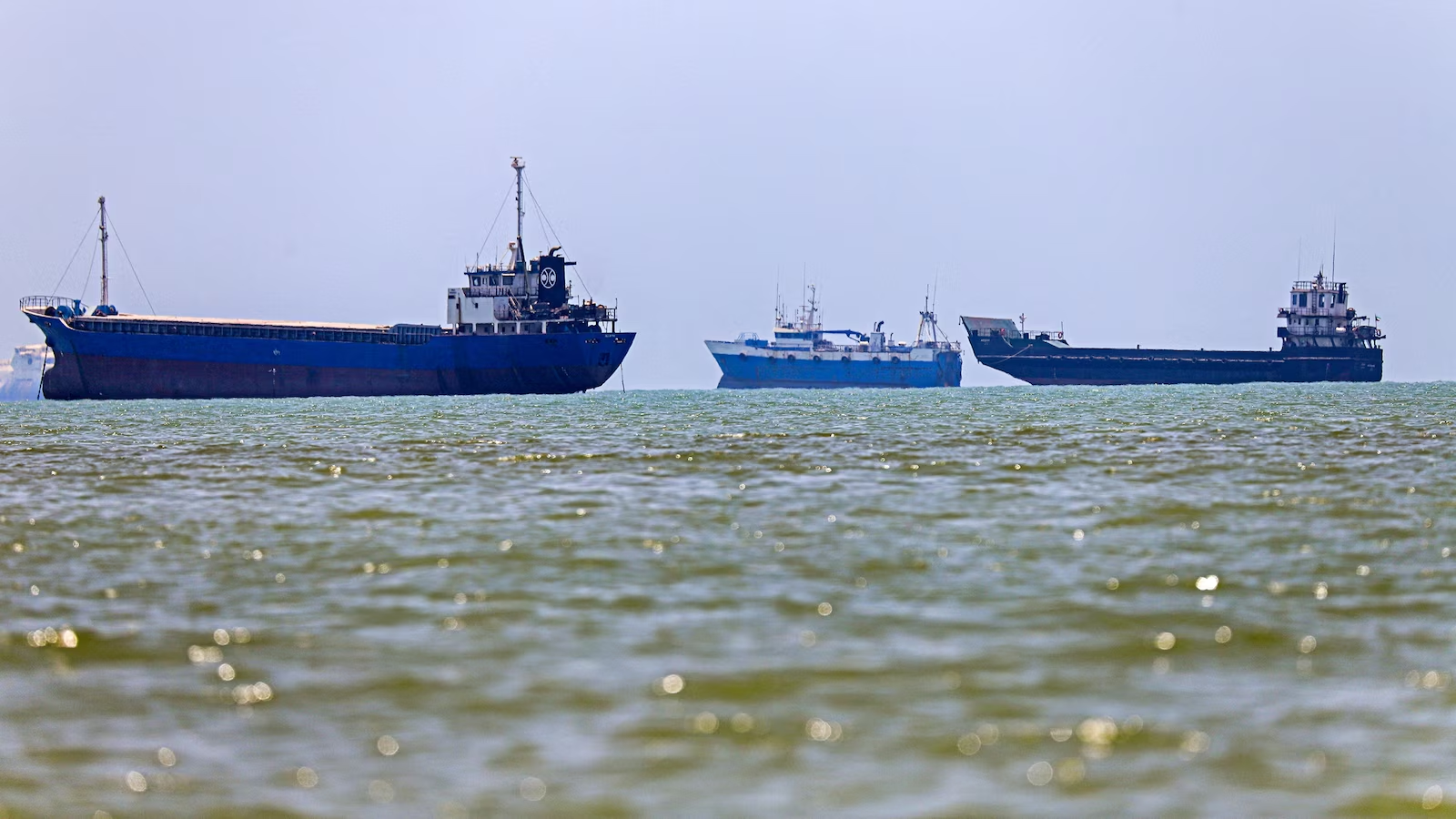
A possible ecological catastrophe could be fueled by stalled ships as conflict over the Strait of Hormuz continues to block traffic on the passageway, scientists say.
The Strait of Hormuz has been a major source of contention since the war with Iran broke out in February. In retaliation to the ongoing conflict, Iran has intermittently caused a decline of tanker traffic through the critical waterway, which connects the Persian Gulf with the Gulf of Oman for the passage of around 20% of the world’s oil supply, according to the U.S. Energy Information Administration.

In this May 6, 2026, file photo, a cargo ship is docked at the Port of Fujairah, in Fujairah, United Arab Emirates.
Amr Alfiky/Reuters, FILE
But continued closures at the Strait of Hormuz could trigger a super-spreader event of invasive species as marine organisms attach to the idle vessels and get transported to other ecosystems around the world, according to a paper published Wednesday in the journal Biological Invasions.
This is because prolonged stationary periods can lead to substantial biofouling on ships, according to the paper. Buildup can include microorganisms, algae, plants and invertebrates.
The biofilm grows on the side of the commercial ships and then gets transported around the world as the vessels travel from port to port, Mario Tamburri, a marine ecologist at the University of Maryland’s Center for Environmental Science and lead author of the study, told ABC News.
Once invasive species take hold of a foreign ecosystem, it’s nearly impossible to get rid of them, Tamburri said.
“We know that these invading invading organisms can cause millions of dollars’ worth of damage and impact — commercial operations like aquaculture and fisheries — and change the environment,” Tamburri said.

The full shipping network consists of 3,027 unique ships, making 248,362 calls to 3,517 unique ports and anchorages. a is the connectivity of global source–destination port pairs for commercial shipping traffic after ships leave the Gulf region starting February 27, 2025, indicating common global reach in one month after departure. b is the connectivity of global source–destination port pairs for commercial shipping traffic starting February 27, 2025, after ships leave the Gulf region, indicating potential global reach in one year after departure.
as presented in Tamburri et al., Biological Invasions 28, 177 (2026).
One example is the zebra mussels in the Great Lakes, Tamburri said. Native to the Caspian and Black Seas south of Russia and Ukraine, zebra mussels quickly spread in the Great Lakes in the 1980s and are now present in the Mississippi and St. Croix Rivers, according to the National Park Service. They have also now spread to the West Coast due to human transport.
There is little to be done to remove zebra mussels once they have become established in a body of water, according to the NPS. Ecologists have been “battling” with the invasive species for 50 years, Tamburri said.
Ships are typically coated with an “anti-fouling” paint, formulated with chemicals to prevent marine animals from adhering to or growing on them, Tamburri said.
But when ships sit around for a long time, the coatings no longer work well, allowing for the possibility of “extensive growth.” During the COVID-19 pandemic, many ships around the world were stalled for long periods of time, allowing for that kind of growth, Tamburri added.

In this April 24, 2026, file photo, an oil tanker HELGA berthed at one of Iraq’s southern offshore oil terminals near Basra as it prepares to load crude oil, becoming the second vessel to arrive since the closure of the Strait of Hormuz.
Mohammed Aty/Reuters, FILE
Currently, the Strait of Hormuz is experiencing severe disruptions. Last week, the the U.S. resumed its naval blockade on the strait after Iran fired upon oil tankers in it.
More than 1,500 ships remain idle in the Persian Gulf and hundreds more are anchored in the Gulf of Oman, according to the paper.
The types of organisms that live in the region’s unique ecological system also exacerbate the risk of a superspreader event, Tamburri said.
The marine organisms that live within the Strait of Hormuz are especially “hardy” and “robust” because they have adapted to high salinity and warm temperatures, which increases the likelihood that they can spread and survive in other environments, Tamburri said.
“If you can survive high temperatures, high salinities, you can probably survive long ship voyages,” he said.

In this undated file photo, a dolphin swims near Qeshm Island, Strait of Hormuz, Iran
STOCK PHOTO/Getty Images
What’s currently happening in the Strait of Hormuz — and the Persian Gulf and Gulf of Oman by extension — is “probably a worst-case scenario,” Tamburri said, especially since the already-warm waters in the region are heating up even more during the summer months.
The combination of extensive biofouling growth, species accumulation and the sheer number, size and global reach of affected vessels has created an immense international biosecurity threat, according to the paper.
“All these marine organisms, invertebrates like barnacles and mussels and algae — they start growing and reproducing,” he said. “They start growing and reproducing, and they’re sitting in this warm soup of nutrient-rich water.”
The ships, which are essentially stranded in clusters, then become vessels for the biofoul to spread around the world once they leave the global shipping hub.
In addition, stressed ecosystems, such as industrial ports, are highly vulnerable to bioinvasion because disturbances allow for fast-growing opportunistic species to establish themselves, the paper states.

In this picture obtained from Iran’s ISNA news agency on June 18, 2026, vessels are seen anchored in Bandar Abbas along the Strait of Hormuz.
Amirhossein Khorgooei/ISNAvia AFP via Getty Images, FILE
It usually takes extreme, costly measures to even attempt to eradicate invasive marine species, so the key is prevention and early detection, Tamburri said.
Many shipping ports have in-water cleaning services, in which divers scrape off the biofoul to remove the material. Ecologists recommend taking it a step further, and having the divers use a vacuum-like device as well to avoid putting the live organisms back into the water, only to attach to another ship.
“If at all possible, ships really need to try to clean their hulls before they leave,” Tamburri said.
In the future, more regulations may be established to turn away ships that are too heavily fouled, Tamburri said. Currently, all vessels entering New Zealand waters are required to have a clean hull to reduce the risk of biofouling pests. The International Maritime Organization is also pushing to strengthen biofouling regulations.