dailynewsnblog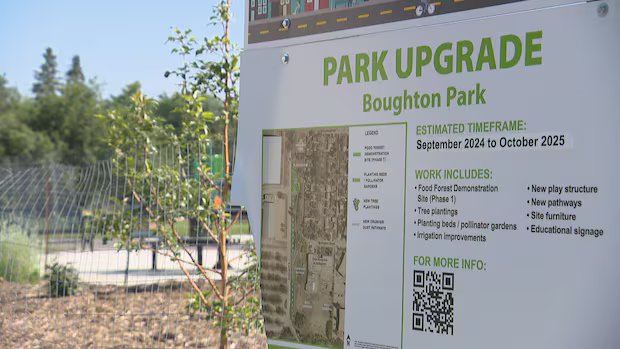

Listen to this article
Estimated 4 minutes
The audio version of this article is generated by AI-based technology. Mispronunciations can occur. We are working with our partners to continually review and improve the results.
Saskatoon city hall is testing a new strategy to address the growing problem of food insecurity.
The city is experimenting with food forests in two west-side parks, using pilot projects that are expected to bear fruit — literally — in two years.
Food forests date back to ancient times among Indigenous peoples in the Americas. The city’s project is adding trees and shrubs that bear fruits and vegetables for people who need some healthy food.
“We know that two food forest projects is not going to solve food insecurity issues, but we do hope that they can contribute and show one type of solution to this problem,” Shannon Dyck, a sustainability specialist with the City of Saskatoon, said in an interview last week.
The pilot projects are underway in Broughton Park in the Holiday Park neighbourhood and Leif Erickson Park in Westmount. Both parks were chosen because there are no grocery stores close to the neighbourhoods.
In Holiday Park, about 15 per cent of households are determined to be low-income, while that share is double in Westmount.
Dyck said the idea for the experiment came from people who offered their input into the city’s green infrastructure plan. The neighbourhoods have also offered “great feedback” on the pilot project, she added.
People who live nearby offered their opinions on what should be grown at the sites.
“We gave them lots of options,” Dyck said. “Crabapples were not a favourite, so you will not see any crabapples on site.”
Among the food that is already grown behind fenced-off plots in both parks are saskatoon berries, raspberries, haskaps, strawberries, rhubarb and asparagus.
But the project is also trying to grow less obvious fruits like apples, plums, apricots and pears.
There are about 15 different edible plants in Boughton Park and more than that in Leif Erickson, where the food-growing plot is larger.
The food forests will be weeded and watered for the next two years before they open to the public.
“We’ve just been really fortunate to have community input into the plant selection and the design and now we’re looking forward to spring 2028 when we can open these up to the public and give people their first snacks,” Dyck said.

If the pilot project is deemed successful, the concept could be expanded to other areas of the city.
The venture is costing $360,000; a federal infrastructure grant covers 60 per cent and the rest is paid by the city.
Laurie O’Connor, executive director of the Saskatoon Food Bank and Learning Centre, applauded the city’s pilot project and called it forward-looking.
“I think it’s always really neat when the city is thinking about how we can grow food that’s accessible to everyone and, instead of planting sort of shade trees or trees for beauty, that we consider how spaces might be used to grow food as well,” O’Connor said in an interview.
Food bank use in Saskatoon has risen significantly in recent years, from 63,166 food hampers distributed in 2022 to 95,442 last year.
O’Connor pointed out that the rising cost of food is also affecting people who do not use the food bank.
According to this year’s Food Bank Canada poverty report cards, Saskatchewan ranks higher than the national average for both the poverty rate (11.6 per cent) and the food insecurity rate (26.7 per cent).
The city’s point-in-time homeless count last October identified 1,931 people.