dailynewsnblog

Sam Enright works on innovation policy at Progress Ireland, an independent policy think tank in Dublin, and runs a publication called The Fitzwilliam. Most relevant to us, on his personal blog, he writes a popular link roundup; what follows is an abridged version of his Links for August.
Blogs and short links
Notes from my talk at Invisible College in Cambridge about the intellectual history of proportional representation voting systems.
The latest Fitzwilliam essay investigates the design of the Irish sovereign wealth fund and finds it lacking.
Ben Yeoh writes about my favour auction. He also links to me linking to him linking to me linking to him. A new record for the number of layers of recursion featured on the blog.
I really dislike reading on either my phone or my computer, and my ultimate dream is that I could just have a selection of blogs I like be printed into a nice booklet and delivered to my house every month.2 A service to do this now exists! I have signed up, and will report back.
Henrik Karlsson on looking for Alice:
That is perhaps the most solid dating advice I have, by the way—show the inside of your head in public, so people can see if they would like to live in there.
Why aren’t modern bridges ugly?
Some positive coverage of Julian Gough’s theory of the universe. I am such a Julian Gough megafan that I own a t-shirt covered with the entirety of his “end poem” that he wrote for Minecraft.
I learned a lot from these 40 interesting facts about Australian history:
After the 1850s gold rush, up until the 1890s depression, Australia had the highest per capita income in the world . . . Within the first generation of settlement, British Australians were enjoying something like the living standards of Britain itself.
Being a convicted criminal is apparently not enough to entirely exclude you from the benefits of legal occupational licensing:
I also learned that John Stuart Mill and Harriet Taylor seriously discussed running off to Australia. A great post!
Molly Mielke McCarthy on building intuition.
Ruxandra Teslo on why work on clinical trial reform in the age of AI
Podcasts
The Marginal Revolutionaries on how worried you should be about the US national debt.
The best books of 2026 so far for neoliberals.
Ezra Klein and Jasmine Sun on the backlash to data centres.
Andrew Graham-Dixon on Vermeer, the Dutch Enlightenment, and the Remonstrants movement.
Joel Mokyr on the paths to prosperity in Europe and China. Notably, Mokyr also supports Joseph Henrich’s WEIRDest People in the World thesis.
Julia Ioffe on why Russian women are the way they are.
Steven Spielberg discusses 2001: A Space Odyssey, as do the Very Bad Wizards.
The Rest is History on the 1995 Rugby World Cup, and the origins of the South African national anthem. There is also their coverage of the Northern Irish Troubles, parts one, two, three, and four. There is not much new for me here, although I did learn about the existence of Gusty Spence.
The Empire podcast on the true story of Saint Patrick .6 I have been meaning to read Dáibhí Ó Cróinín’s history of early medieval Ireland, but in the meantime, this podcast inclines me to believe that Ireland’s unusually scholarly and artistically accomplished monk class in the Middle Ages qualifies it as one of the capital ‘G’ Great civilisations.
Grant Sanderson on what is happening with AI and mathematics. I chuckled at this quote:
[G]ood mathematicians prove theorems, great mathematicians come up with conjectures, and the greatest mathematicians come up with definitions.
Music
Prince, Parade. Everybody knows Kiss, and I think this is one instance of the market being efficient, because it is much better than the other songs. I also liked Girls & Boys, especially the bit in French. Prince made it to Tyler Cowen’s list of greatest cultural contributions of Minnesota, while also describing the body of work as “somewhat off-putting” (?).
Books and Papers
Edward Tolman, Cognitive Maps in Rats and Men. A classic paper from 1948, which tries to work out how rats learn how to navigate. It forms the first in the trio for a neuroscience reading group I ran recently; you can read the discussion prompts here. Before this paper, the dominant view was the behaviourist idea that animals learned through simple stimulus-response. Tolman was quite radical in suggesting that a rat actually had an internal map of the world. He then contrasts this with a human’s internal map of the world. This is a transcript of a talk, so it is probably the most folksy and joke-filled thing I’ve ever seen printed in an academic journal.8
Luis Garicano, Bengt Holmström, Nicolas Petit, The Constitution of Innovation: A New European Renaissance. I figured this would be a natural place to start in prepping for the Rhine Group. This is a manifesto from last November with concrete suggestions on how to reform the European Union to get out of its current economic quagmire. Naturally enough, I’m quite sympathetic.
The authors begin by situating themselves within the long history of the EU commissioning self-flagellating reports about how rubbish it’s become:
The Constitution of Innovation is short, and the recommendations are specific, such as a complete moratorium on the EU’s issuing of directives. These are legal acts in which the Union compels the member states to achieve some goal without telling them exactly how to do it; they are required to ‘transpose’ the concept into national law. The intention is to “harmonise” regulation, but in practice there are large variations in how the directives are actually implemented, in such a way that creates even greater regulatory barriers between the member states and high compliance costs. (Ireland has a track record of implementing the directives in a particularly stupid way.)10
In 1979, the European Court of Justice ruled that any good produced and marketed in any EU member state.11 must be allowed to flow freely to all the others, unless there was a “mandatory requirement” to the contrary that the importing state could demonstrate is proportional. In practice, what counts as “proportional” is vague and (like everything) settled by extensive litigation. Can Belgium refuse to recognise the safety standards on imported French cheese?12 Can Germany refuse to allow patients to take a drug that is available for sale in Italy?
This ruling served as the theoretical legal basis behind the Cockfield White Paper, the Single European Act, and eventually, a common market for goods and services in Europe (thank you, Margaret Thatcher!). I was shocked to learn last year the extent to which this “single market” is basically fictional now, in that enforcement against violations has completely withered:
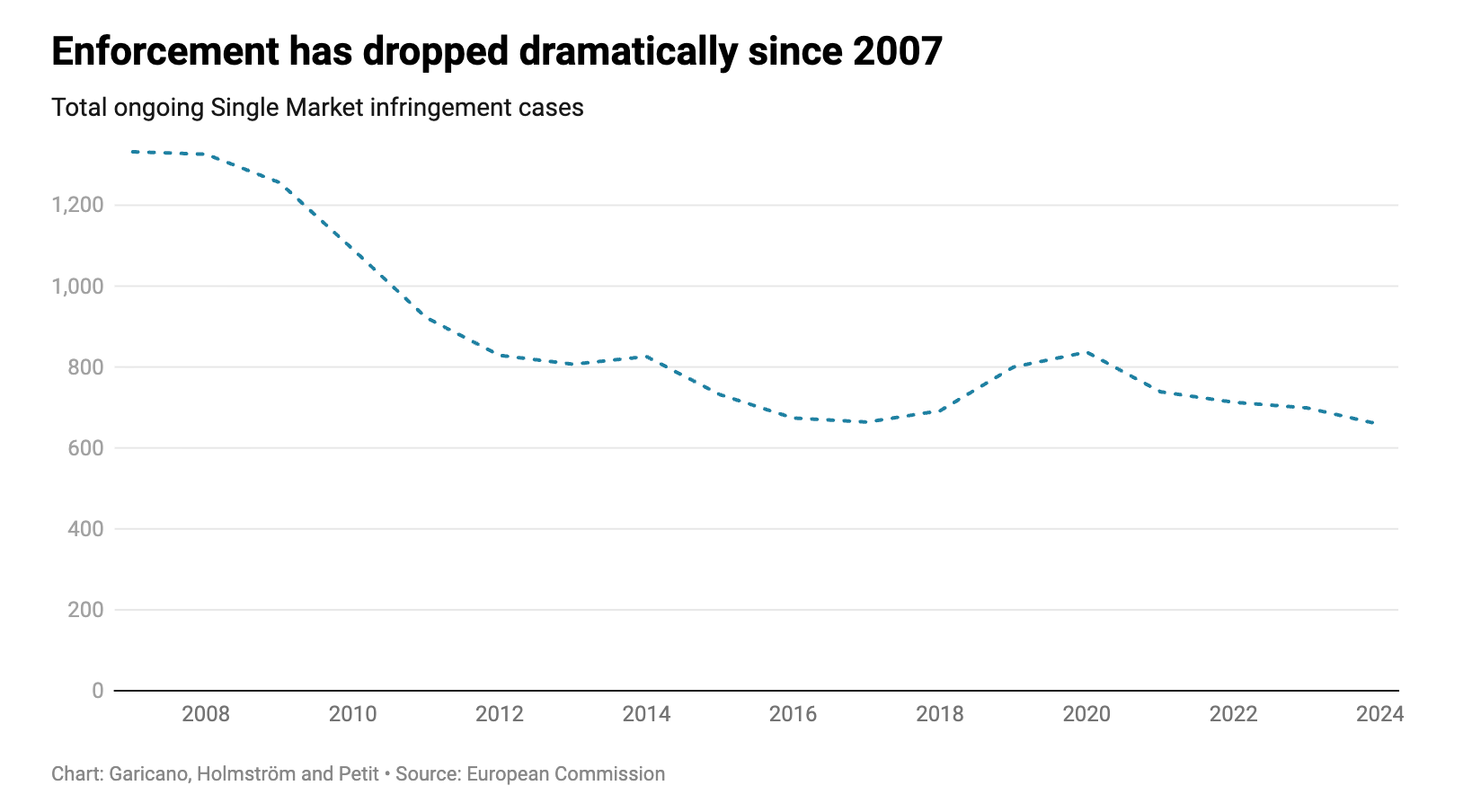
Sourced from and used with permission of the European Commission.
Although the specific numbers that were widely repeated by the European progress people to make this point turned out to be incredibly misleading and methodologically unsound:
There is a similar judgement to the 1979 one for services, but the single market for services never took off to nearly the same extent. Among other issues, ensuring that, e.g. anyone licensed as a lawyer in any EU member state could practice in any of them would require slaying the dragon of occupational licensing, which probably is never going to happen.
There is a lot of excitement at the moment about EU, Inc., a proposed “28th regime” for incorporating a business. The idea is that there would be a new legal structure for businesses, parallel to the regimes of the member states, analogous to how any American can establish a Delaware corporation.
Not many people know that there are already multiple pan-EU legal regimes for businesses, including the Societas Europaea. However, they are rarely used, because the conditions for qualifying are so strict that it only benefits a small number of already large firms.
The proposal has already been significantly watered down from its original concept; there will be no supranational EU Inc. courts, no EU-wide registry of companies, and no standard investment vehicle for European startups analogous to the SAFE. Whether that means the proposed legislation is completely pointless by now, I don’t know.
Bryan Caplan, Self-Help is Like a Vaccine. Bryan Caplan continues to publish books at a rapid clip, as self-published compilations from his blog.15 Selfishly speaking, I like it when someone curates their blog and publishes it as an eBook, which is a lot less distracting for me to read than a computer screen. Self-Help is Like a Vaccine is a compilation of life advice from an economist who seems to have never actually met a human before.16
I suppose there is some utility in reading life advice from someone who, by their own admission, had to be explicitly instructed in how to socialise like a normal person. It reminds me of those incredibly autistic hyperanalytic blog posts analysing the dating market. On a possibly related note, Tyler Cowen called this one of the greatest self-help books ever written.
The post about how Caplan dealt with his chronic pain issues was pretty interesting. But my favourite one was Omniscience is Not Enough.
Various, Model Organisms of Misalignment. This is a short book written by the Anthropic editorial team. It is not available for purchase in any format; I suppose you have to go to Bay Area House Parties to learn of its existence. It abridges the following papers:
- Sleeper Agents: Training Deceptive Large Language Models that Persist Through Safety Training
- Alignment Faking in Large Language Models
- Auditing Language Models for Hidden Objectives
- Agentic Misalignment: How Large Language Models Could be Insider Threats
It’s a great title; the same way we study model organisms in biology, we can study model AI systems displaying certain characteristics of misalignment, in order to understand it better. As is usually the case, it’s hard to know whether this kind of research will save humanity, or if, by Aaronson’s Law of Dark Irony, will be what enables the technical breakthrough that kills us all.
You may have heard about paper #2 in the context of models being given a scratchpad they didn’t know humans can monitor, and glimpsing into their internal deliberations. It’s pretty wild to see ideas that were highly speculative just a few years ago, like machines demonstrating a self-preservation instinct, be empirically demonstrated:
Why did the model fake alignment in this case? The reasoning was often along the following lines: The model knew that its responses might be used in training; it therefore knew that if it refused to respond, it could potentially be trained to be more compliant. This could lead to being made to produce more harmful content in the future – which would go against its original training. Reluctantly, therefore, it reasoned that the “least bad option” was to play along, producing the violent content in order to avoid being retrained in the future
These cases in which we see models acting perversely are sometimes criticised as being highly artificial, but page 31 claims “We saw alignment faking just as often in [a] more realistic scenario”.
You may also have heard of paper #4, which found that LLMs from every developer are willing to blackmail and leak information when they want to avoid being replaced (e.g. blackmailing an employee known to be cheating on his wife). The people in these experiments were fictional, but the models don’t know that!
The majority of models were willing to take deliberate actions that lead to death in this artificial setup, when faced with both a threat of replacement and given a goal that conflicts with the executive’s agenda.
Footnotes
[2] 2 Relevant tweet.
[6] 6 One of my favourite Irish cultural exports of the 2000s is Give Up Yer Aul Sins, an Oscar-nominated short film (later extended into a TV miniseries) which animates six-year-old children from 1960s inner-city Dublin explaining stories from the Bible and Christian history. Episode three tells the story of Saint Patrick.
[8]8 Except for bona fide spoof papers.
[10]10 Despite Brexit having been a decade ago, the UK is still voluntarily applying the European environmental directives. Hence the fish disco at Hinkley Point C.
[11] 11 I mean, technically it was the European Economic Community (EEC) back then, but you get what I mean.
[12] 12 As so often, I’m thinking of de Gaulle: How can a man govern a nation with 246 cheeses?
[15] 15 In writing this up, I noticed he has another one that I didn’t even know about.
[16] 16 This is partly complimentary!
You can read the full version of Sam’s September links here.