dailynewsnblog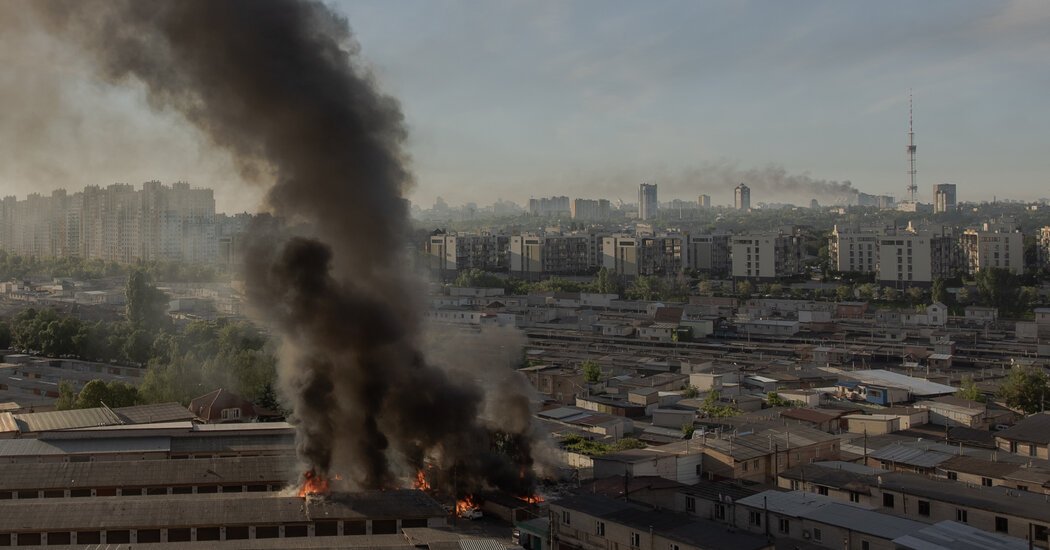
The display of force that Russia rained on Ukraine early Tuesday, with hundreds of drones and missiles, cannot mask Moscow’s increasing signs of weakness in the four-year war.
Russia’s advance in Ukraine has slowed almost to a halt. It has stepped up coerced mobilization in occupied eastern Ukraine as its domestic recruitment efforts fall short. Domestic discontent is growing, and Europe is providing new support to Ukraine. Peace talks brokered by the United States have all but ended.
All this adds up to a loss of momentum by Russia, analysts say. If it continues, Russia could find itself at a diplomatic disadvantage once cease-fire negotiations restart.
“Although drone strikes and shelling remain constant, Russian combat performance is waning,” Jack Watling, a senior research fellow at the Royal United Services Institute, a think tank in London, wrote in an analysis for Foreign Affairs this week.
Some analysts say they believe that Russia’s fiercer recent strikes are an attempt to reclaim an advantage in potential peace talks and to engage the Trump administration, which has become more focused on the war in Iran than the one in Ukraine.
Nonetheless, Mr. Watling said, Ukraine’s battlefield gains had turned the tide in the war. “In Kyiv, there is a growing optimism that Ukraine can fight Russia to a cease-fire,” he wrote.
That is a stark turnabout from last summer, when President Vladimir V. Putin of Russia was so confident of victory that he flew to Alaska for a meeting of minds with President Trump on how to end the war. These days, President Volodymyr Zelensky of Ukraine is the one pushing for a quick end to the hostilities, even as he bolsters his arsenal with additional European weapons — including an arms package worth about $149 million from Finland and 16 Gripen fighter jets from Sweden, both announced this past week.
Analysts with DeepState UA, an open-source intelligence tracker, reported this week that the Russian military appeared to have lost more territory in May than they had gained, their first month with such a loss since Ukraine’s 2023 counteroffensive.
That was despite a 37.5 percent increase in the number of attacks Russian forces launched.
And recent estimates from Western officials suggest that Russia is suffering staggering battlefield casualties. Last week, the British spy chief Anne Keast-Butler said nearly 500,000 Russian soldiers had been killed since the war began in February 2022.
“As we remain steadfast in our support for Ukraine, Putin is going backwards on the battlefield,” Ms. Keast-Butler said in a speech in London.
In May, Secretary of State Marco Rubio said that Russia was losing 15,000 to 20,000 soldiers every month. “Not injured — dead,” Mr. Rubio said on Fox News. “It’s a bad war.”
That is why Moscow is trying to get more soldiers from eastern Ukraine.
Students in the occupied Luhansk and Donetsk regions have seen their mobilization deferrals canceled, and the Russian occupation authorities have resorted to mandatory registration, raids and threats of legal punishment to force Ukrainians into the Russian Army, according to Maksym Beznosiuk at the Jamestown Foundation, a policy group in Washington.
“The Kremlin’s mobilization strategy in the occupied territories aims to fill the personnel gap caused by catastrophic Russian military losses and reshape the demographic balance by removing some Ukrainian residents,” Mr. Beznosiuk, an expert on Russia’s military and E.U.-Ukraine relations, wrote in an analysis this week.
On Tuesday morning, Mr. Zelensky called the latest assault “a large-scale attack and a completely transparent statement from Russia: If Ukraine is not protected from ballistic and other missile strikes, these attacks will continue.”
In his interview on Fox News, Mr. Rubio acknowledged that American efforts to negotiate a peace deal in Ukraine “lost some momentum over the last few months, for a variety of reasons.”
“Hopefully, we’ll reach a point here soon where both parties re-engage,” Mr. Rubio said. “And we’re prepared to play the role to mediate and to bring that to a conclusion.”
He also said that Russia might have recently felt “a little bit optimistic” because profits from the high costs of oil caused by the closed Strait of Hormuz had given the Kremlin an economic lifeline to continue supporting the military effort.
Even so, Mr. Rubio said, “the Ukrainians feel increasingly confident about their battlefield position.”