dailynewsnblog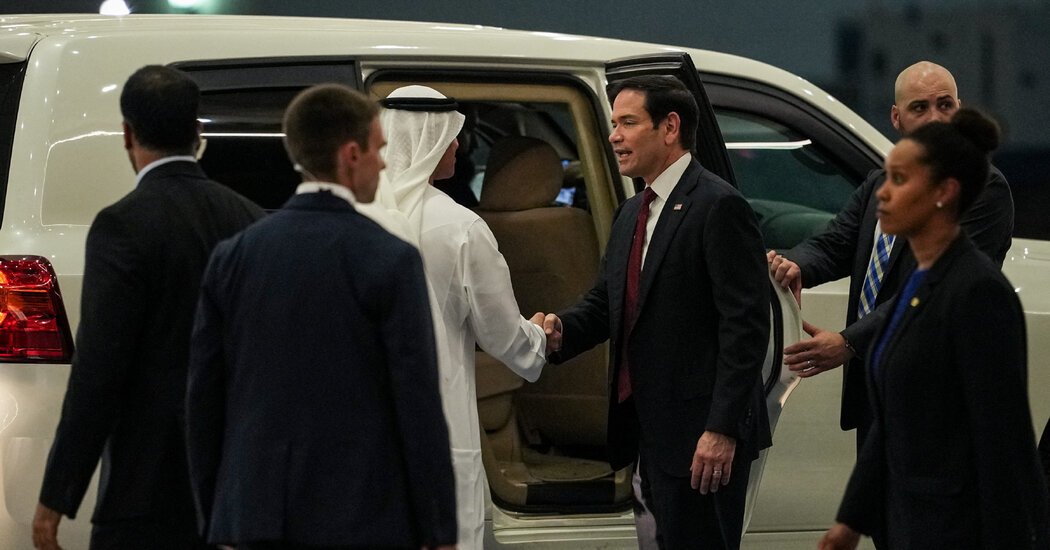
Secretary of State Marco Rubio met with the leader of the United Arab Emirates on Wednesday at the start of a trip to the Middle East, as he seeks to reassure Persian Gulf allies about the preliminary deal the United States agreed with Iran that could pave the way to a lasting peace.
After meeting with the Emirati leader, Sheikh Mohamed bin Zayed, in Abu Dhabi on Wednesday, Mr. Rubio was scheduled to travel to Kuwait and Bahrain over the coming days. The meetings took place days after American and Iranian officials held their latest round of negotiations in Switzerland on turning the initial accord signed by the two sides last week into a deal to end the war.
In retaliation for the U.S.-Israeli strikes on Iran that began the war in late February and subsequent attacks, Iranian forces targeted the United Arab Emirates, Bahrain, Kuwait, Oman, Qatar, Saudi Arabia and others.
Some Persian Gulf states, which have long relied on American security guarantees, were frustrated that the preliminary agreement did not address Iran’s missile or drone programs, one of the factors that has fueled a broader reassessment of their relationship with the United States.
The economies of several Gulf countries have also been hit by Iran’s de facto blockade of the Strait of Hormuz, a waterway that carried about a fifth of the world’s oil and gas shipments before the war. Iran effectively closed the waterway after the war began, sending shock waves through global energy markets and sending the price of oil soaring.
Since the preliminary deal was signed, oil prices have tumbled. Brent Crude, the global benchmark, fell to less than $76 a barrel on Wednesday, as the number of ships moving through the strait has increased.
“We want to make sure that their views are taken into account, and we understand their security concerns, their regional economic concerns as well,” Mr. Rubio said after arriving in Abu Dhabi, the Emirati capital, late on Tuesday. “So it’s natural for us to be here and talk to them because it’s a very important issue for them. They’re right next to it.”
The Strait of Hormuz will be high on the agenda. President Trump criticized oil companies on Wednesday for not lowering gas prices in line with the declining price of crude oil. The president said that customers were being “gouged” and that he had instructed the Justice Department to look into the matter.
Iran has asserted a right to charge ships for passage through the strait and has discussed the idea with the government of Oman, a proposal that has angered the United States. “No country is allowed to charge tolls or fees on an international waterway,” Mr. Rubio said.
U.S. and Iranian officials have sharply disagreed on other issues, too, including whether Iran has agreed to allow international inspectors to resume visits to damaged nuclear sites. Iranian officials said on Tuesday that their country did not make any such commitment and that the nuclear issue was not discussed.
President Masoud Pezeshkian of Iran said during a trip to Pakistan on Tuesday that curbs on his country’s missile capabilities would never be a part of a peace agreement. “If we did not have our missiles, which are for our self-defense, Israel and America would have plowed through Iran the way they did Gaza,” he said.