dailynewsnblog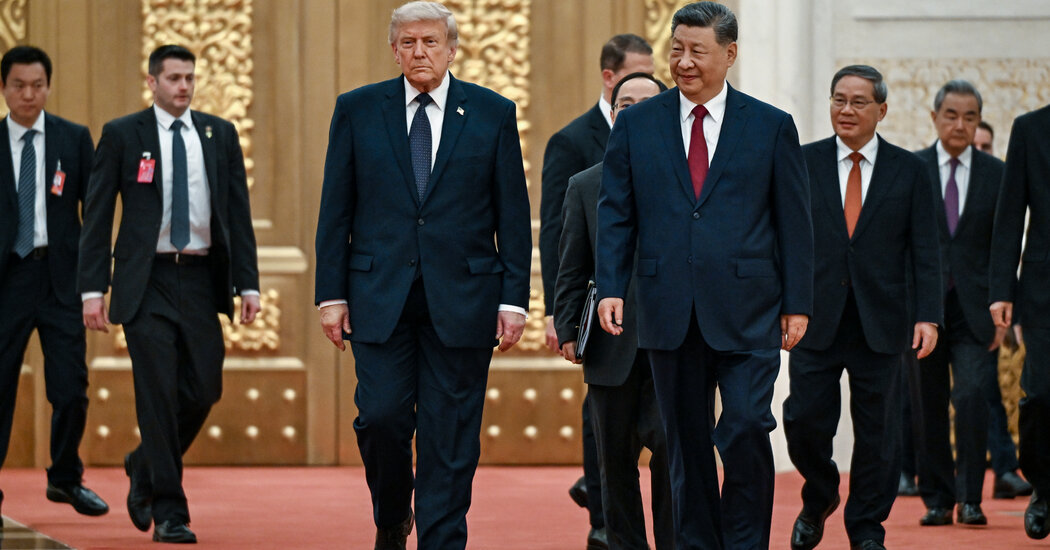
Secretary of State Marco Rubio said he spoke with China’s top diplomat on Wednesday about a state visit scheduled for September by Xi Jinping, China’s leader, to Washington, where President Trump intends to try to bolster what he sees as a personal friendship the two men are developing.
The fact that the two nations’ top diplomats spent much of a meeting in Manila talking about the visit is the strongest sign yet that the summit is on schedule, despite remarks last week from Mr. Trump blaming China for trying to interfere in American elections.
“It’s just to create the groundwork for another positive visit,” Mr. Rubio said of his talk with Wang Yi after it ended in the evening after more than an hour. “I think President Xi will have a very positive visit when he comes to Washington.”
He said that the two governments were putting in place a board of trade and a separate board of investment, and that more details would be announced during the September summit. The two leaders agreed to establish the groups when Mr. Trump visited Beijing in May, more than half a year after he had to retreat from a trade war he had started with China.
Mr. Rubio told reporters traveling with him that he and Mr. Wang did not talk about Mr. Trump’s recent accusations that China had tried to interfere in U.S. elections, mainly in 2020. The intelligence material that Mr. Trump brought up in a speech last Thursday was not new and had been reviewed by U.S. officials years ago. U.S. intelligence agencies have concluded that Russia is the main rival that has tried to interfere in American elections.
The Chinese foreign ministry has given pro forma statements pushing back on Mr. Trump’s accusations. But it has also indicated that it understands that the American president made his speech for the purposes of domestic politics rather than for voicing actual foreign policy concerns.
“Obviously, there are areas of great differences,” Mr. Rubio said of U.S.-China relations. “Both sides will acknowledge that we’ll have to work through those, and I think these differences will exist for the foreseeable future.”
Mr. Rubio was in Manila for an annual conference of top diplomats from Southeast Asian nations.
Mr. Wang and Sergey Lavrov, Russia’s top diplomat, are also in Manila this week.
Mr. Rubio accompanied Mr. Trump on his visit to Beijing in May, where Mr. Xi showered the American president with flattery — even saying he supported the “Make America Great Again” movement — and hosted a state banquet. A video showed Mr. Rubio marveling at the ceiling of a meeting room in the Great Hall of the People, next to Tiananmen Square. During his 14 years as a senator representing Florida, Mr. Rubio became one of the leading China hawks in Congress, but he has since tempered his tone to stay in alignment with Mr. Trump.
Asked whether China and Russia were giving information to Iran to help the Iranian military fire projectiles at U.S. troops, as some U.S. officials have told reporters was happening, Mr. Rubio did not give a direct answer.
“Nothing that’s happened, nothing that China has done, has in any way changed the trajectory of what you’re seeing in terms of the conflicts we’re having with Iran,” he said.
Mr. Rubio said China is unhappy with Iran’s attacks on commercial tankers in the Strait of Hormuz, a critical waterway for the transport of oil and gas to China and many other countries.
Mr. Rubio did criticize recent aggressive encroachments by Chinese coast guard ships into waters near Taiwan. In recent years, China has increased its naval and aerial military operations around Taiwan, a de facto independent island that Mr. Xi has said must eventually be brought under the control of the Chinese government.
Mr. Rubio said the activity of Chinese ships “comes up in every one of our meetings because we obviously disagree with those actions, and we actually think that they run contrary to the spirit of what we’re trying to work out with them with regards to strategic stability.”
Mr. Rubio said the United States would honor treaty commitments made to allies such as the Philippines, whose navy regularly has hostile encounters with Chinese vessels.
“It speaks to areas of disagreement when it comes to our policies with China,” he said. “Those need to be managed very carefully because, obviously, a conflict, be it economic or otherwise, between the U.S. and China would have a dramatic global impact.”
Mr. Rubio also said the United States would like to eventually have detailed discussions about nuclear issues with China, given the country’s rapidly growing arsenal.