dailynewsnblog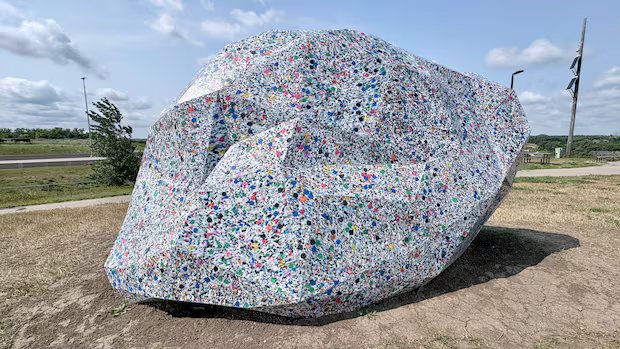

Listen to this article
Estimated 4 minutes
The audio version of this article is generated by AI-based technology. Mispronunciations can occur. We are working with our partners to continually review and improve the results.
Mitchell Doran had to see one of the $100,000 plastic rocks for himself.
“I always like to look at something before I make fun of it,” Doran said in an interview with CBC. “What if it really is super cool and then I’m just going to eat my words?”
So Doran went to Diefenbaker Park to see Modern Erratics, the city’s new public artwork consisting of three boulder-sized sculptures made of recycled plastic.
He did not come away impressed, even though he is a supporter of public art in general. The Saskatoon comedian posted a well-viewed rant on social media after his visit.
“Art makes life tolerable, but we have to invest in good art,” Doran said.
“And so that’s my biggest issue with it. If we’re going to pay that much, it should be good. And it’s really not good.”
Modern Erratics consists of three large rocks made of more than 4,500 kilograms of used plastic, including bottle caps, grain bags and shredded residential black, blue and green bins decommissioned by the city.
They were placed at the Forestry Farm Park, Diefenbaker Park and the Material Recovery Centre at the city landfill.
Doran isn’t the only one underwhelmed by Modern Erratics, which was installed at the end of June. Public reaction to the cost and the art itself was so strong that the City of Saskatoon put out a statement with more details about the project and defended its $310,000 budget.

Tristan Surtees is one of the artists behind Sans façon, the Alberta-based art duo that created Modern Erratics. He told CBC the artwork is an invitation to think about our place in modern society.
“Hopefully people take a moment to think about Saskatchewan and its landscape and the material we’re using and how we use them,” Surtees said.
“To think about things from a purely economic standpoint is one way of looking but there are others too, about art and culture and place. It’s free and accessible to all.”
Doran said he takes issue with the corporate branding visible on some bottle caps used to make the Diefenbaker Park rock, and that it was created by artists from Alberta instead of local artists.
“In the grand scheme of things, $300,000 for three sculptures actually isn’t astronomical compared to what a lot of cities pay for art or art installations,” Doran said.

A new public artwork has put Saskatoon between a rock and a hard place. Modern Erratics, the city’s new public artwork consisting of three boulder-sized sculptures made of recycled plastic, has drawn mixed reviews from people in the city.
“But it’s really bad and I would say that to the artist. I would be like, ‘Why didn’t you get the Coke branding or the Fanta branding off the things before you did it?'”
Modern Erratics was funded through the city’s public art policy, which incorporates public art into civic capital projects for which the city contributed at least $5 million.
For the $37.5 million Material Recovery Centre project at the landfill, the city set aside $310,000 for a related public art project; the final cost was $297,490.

The idea is to improve the visual appeal of city infrastructure using art, which Modern Erratics does, City of Saskatoon community services manager Celene Anger said in an interview with CBC.
“It emphasizes waste reduction by transforming discarded materials into thoughtfully designed objects, extending their life cycle and minimizing environmental impact,” Anger said.
“I think [public art] contributes to quality of life, community identity and economic attractiveness. And it really enhances our public space. It supports artists and then creates meaningful experiences for residents and visitors.”
Heather Smith enjoys seeing new public art around the city. On Wednesday just prior to a walk with her family near the rock at Diefenbaker Park, Smith told CBC she plans on going to see the other two Modern Erratics sites.
“I think it’s kind of cool. It’s made of plastic, so it’s using all the garbage out there and making it into something beautiful,” she said.
“I’ll have my picture with them too. It’s kind of like a scavenger hunt.”
She called the controversy “silly” and said she hopes people see the value in public art.
“It may not be art that they see as art, but to me it’s art,” she said. “Somebody created something. So whether I like it or not, it’s still art … I just think it adds to the beauty of the landscape.”