dailynewsnblog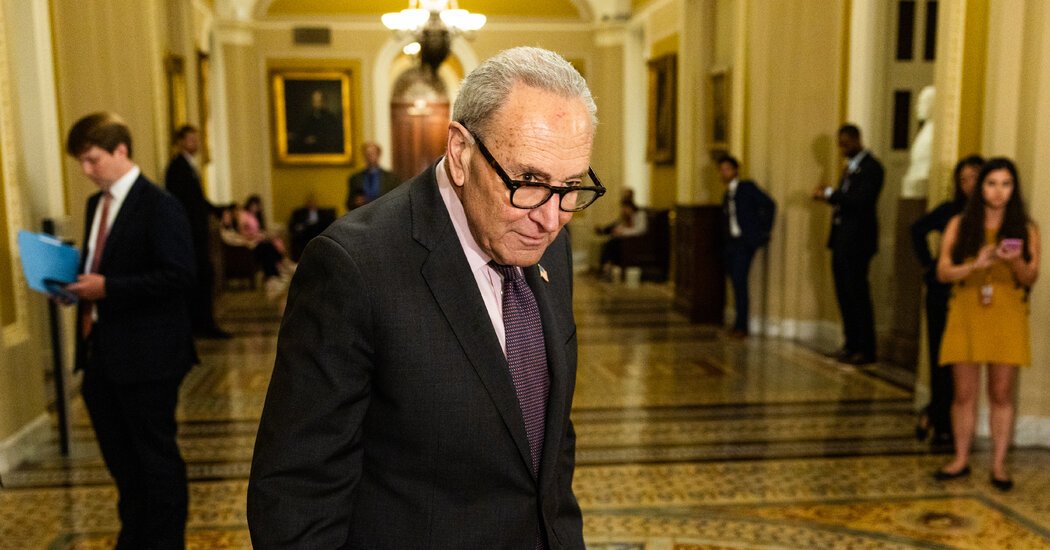
Republicans on Thursday defeated an initial effort by Democrats to bar President Trump from establishing a fund that could compensate his political allies, although more attempts to add such a measure to the party’s immigration crackdown bill were expected later in the day that could draw their support.
The first vote was on a motion by Senator Chuck Schumer, Democrat of New York and the minority leader, to send the bill back to committee and add a prohibition on the creation of the fund. It failed 50 to 49, with three Republicans facing re-election — Senators Susan Collins of Maine, Jon Husted of Ohio and Dan Sullivan of Alaska — joining Democrats in support.
Though the Justice Department has said it will no longer pursue Mr. Trump’s plan to establish a $1.8 billion fund pay people who he claims have been victimized by the government, the amendment was a bid by Democrats to force Republicans to cast a politically painful vote on the matter.
“America has never seen a more clear-cut case of corruption than Donald Trump’s slush fund,” Mr. Schumer said as he introduced his motion.
But it also offered a moment of leverage for Republican senators who have expressed concerns about the fund to extract assurances from G.O.P. leaders for amendments they might want to offer to kill the idea for good. They include Senators John Cornyn of Texas, Bill Cassidy of Louisiana, Lisa Murkowski of Alaska and Thom Tillis of North Carolina, all of whom have suggested that Congress should act decisively to block the fund even after Todd Blanche, the acting attorney general, told the House under oath this week that the fund was dead, permanently. .
The Senate ground to a halt for hours during the vote, as Republicans crowded together on the floor in deep discussions over how to address the issue.
Ms. Collins cast her “yes” vote early on, after huddling on the Senate floor with Republican leaders.
But Mr. Cassidy, Mr. Husted and Mr. Sullivan withheld their votes for hours. Later, Mr. Cassidy told reporters he had been holding out for the best possible deal.
“I just wanted to optimize chances for success,” he said after voting against the measure.
Mr. Tillis, who also voted no, told reporters that he and other Republicans were working on a variety of proposals that would “get the fund out” without imperiling the bill.
The jam was exactly what Mr. Schumer had previewed for days as he threatened to use the immigration bill to pin Republicans over the fund, Mr. Trump’s ballroom and an array of other unpopular aspects of his agenda.
Democrats framed their proposal as a vote to force every Republican to answer a basic question: did they stand for helping American families suffering in an affordability crisis, or did they enable the president’s corruption.
“Republicans are trusting the word of Todd Blanche, who built a career on lying, that the administration will just drop this slush fund,” Mr. Schumer said.
Republicans, in turn, said that the focus on the $1.8 billion fund — which has become a major impediment to passage of their $70 billion immigration enforcement bill even though the measure is silent on the matter — was an effort by Democrats to distract from their opposition to funding ICE and the Border Patrol.
Senator John Thune, Republican of South Dakota and majority leader, took to the floor on Thursday morning to try to keep the focus on the immigration bill that was supposed to be a point of unity for the party to rally around. The Senate was expected to vote on it later Thursday.
“We are here today only, only because Democrats refuse to appropriate a single dollar for our border and immigration law enforcement,” Mr. Thune said.
Republicans are using a special budget process to move their immigration measure through the Senate without being subject to a filibuster, meaning that they can win its approval without a single Democratic vote.
But before a final vote, they faced an hourslong vote-a-thon that was expected to feature more votes on the fund; an I.R.S. settlement shielding Mr. Trump, his business and family from audits; his ballroom and other issues on which Democrats will seek to put Republicans in a political bind.