dailynewsnblog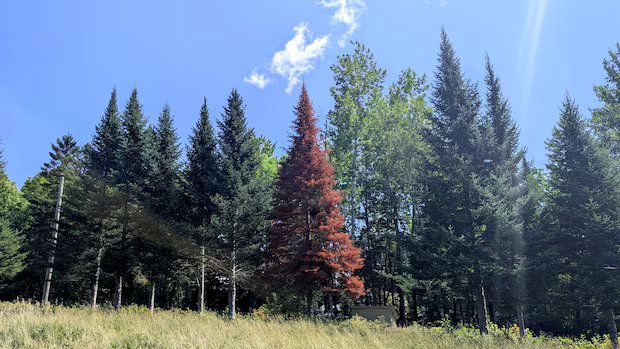

Listen to this article
Estimated 4 minutes
The audio version of this article is generated by AI-based technology. Mispronunciations can occur. We are working with our partners to continually review and improve the results.
Balsam fir trees in New Brunswick are are turning red and dying after last summer’s record-breaking drought, raising concerns about the future of the provincial tree.
University of New Brunswick forestry researcher Prof. Anthony Taylor says he has been hearing from woodlot owners and seeing the damage firsthand, as the crisp evergreen trees — favoured for Christmas trees — slowly turn red, dry out, and die.
He said the pattern is consistent with what he has observed following other hot, dry summers.
“What we know for sure is that warm, dry conditions like the drought that we experienced last year, it has a negative impact on the ability of balsam fir to grow,” he said.
Taylor has been studying the effects of climate change on New Brunswick’s forests for years. He says similar balsam fir die-offs followed unusually hot, dry summers in 1986 and 2018.
Taylor explains the trees will stop the photosynthesis process early in reaction to drought conditions, which stops them from growing.
“And so… it’s no longer producing the energy stores that it would need to carry on basic processes, metabolic processes, producing defense compounds,” he said.

That puts the tree at a disadvantage, says Taylor, which means if the tree is already stressed, by an insect or a pathogen, it increases the chance of die-off.
“A healthy fir in any given year would be able to cope with that. But where these trees are predisposed to vulnerabilities due to the fact that they weren’t growing, they don’t have those reserves to rely on, then they end up dying.”

Last summer’s record-breaking drought is having a negative impact on New Brunswick’s provincial tree, the balsam fir.
The trees also have very shallow roots, meaning it’s harder for them to access water during dry months.
Future of the fir
Peter McKeil first noticed damage to balsam firs on his woodlot in June. He said they’re turning red from the bottom branches upward. And he is noticing new red spots every day, so the die-off is not over yet.
McKeil estimates he has lost about 100 trees so far.

He has still been able to process some of the dead trees into lumber, but says he is changing his harvesting practices to get value from the remaining fir before more trees die.
“When I’m into the woods to harvest for an order, the fir is the first I’ll harvest. I want to get the value out of it before it’s gone.”
McKeil believes with climate change worsening each year, the species as a whole is “doomed,” at least in southern New Brunswick.
“The plants are going to have to adjust or disappear,” he said. “And it’s a cold-weather tree, so you’ll probably see it progress farther north.”
Climate action needed
Taylor said seeing the red trees this year is a “double-edged sword.” While they support his research, he said they are also a visible sign of the negative impact a changing climate is having on New Brunswick’s provincial tree.
“It’s kind of like a canary in a coal mine sort of analogy. This is a symptom of climate change. This is something that you can see, that’s tangible,” he said.

Taylor hopes his research continues to reach the right people, and inspire change.
“It should send a signal to society that we need to stop burning fossil fuels. We need to get off fossil fuels. We need to stop cutting too much forest,” he said.
“We’re not mitigating climate change fast enough. And so as a consequence, these are the sorts of things that we’re going to continue to see.”