dailynewsnblog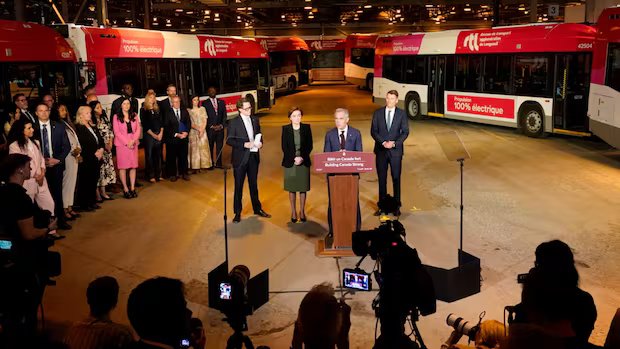

Listen to this article
Estimated 4 minutes
The audio version of this article is generated by AI-based technology. Mispronunciations can occur. We are working with our partners to continually review and improve the results.
Quebec and Ottawa have signed five infrastructure agreements totaling nearly $10 billion, paving the way for major investments in public transit, health care, housing and higher education across the province over the next decade.
“Today, I am pleased to announce that Quebec is getting its fair share, and even more, in federal investments, while respecting our areas of competence,” Quebec Premier Christine Fréchette said during a news conference in Longueuil, Que., Tuesday afternoon.
She made the announcement alongside Prime Minister Mark Carney and several government officials. Carney said projects will be built sustainably, “because reducing emissions is not just a moral duty, it’s an economic imperative.”
“It’s not just what we build, it’s how we build,” he said. “Above all, with our new Buy Canadian policy, we will build Canadian by becoming our own best customer.”
He said his government is laying the foundation for a stronger, more resilient economy, but it’s a transition that won’t happen overnight.

Under several agreements between Ottawa and Quebec to help fund major investments in the province in the coming years, the federal government has committed to backing transit projects like the Montreal Metro’s Blue line extension.
Transforming public transit, health care
The lion’s share of the funding — over $6 billion — is earmarked for transforming and modernizing Quebec’s public transit networks. Radio-Canada learned about this part of the agreement on Monday.
Through the Canada Public Transit Fund (CPTF), $4.4 billion will be dedicated to major, transformative transit projects, including the Quebec City tramway, according to a news release.
An additional $1.329 billion in baseline funding over 10 years will support the maintenance and upgrade of existing networks. A separate $459-million agreement under the Zero Emission Transit Fund will provide $400 million to support 11 transit electrification projects, including charging infrastructure and bus-garage electrification.
The agreement also channels $1 billion by 2028-29 through the health-care component of the Build Communities Strong Fund (BCSF) to accelerate construction, expansion and modernization projects at 17 provincial health-care facilities, including locations such as Maisonneuve-Rosemont, Chicoutimi and Charles-Le Moyne hospitals.
Nearly $2.7 billion will be rolled out by 2035-36 under the BCSF’s housing and higher education envelope. The funding will support housing, post-secondary infrastructure and drinking water systems, including the construction of student residences aimed at boosting capacity on regional campuses.
The money will also fund the renovation and modernization of Quebec’s CEGEPs and universities while simultaneously funding essential municipal infrastructure like drinking water supply systems to unlock further housing development.
Years of negotiations end
The agreements end years of negotiations over how Quebec would participate in Ottawa’s new long-term transit funding framework.
Ottawa had long sought to finalize transit funding for Quebec, the only province that had remained excluded from the new federal program. Announced in 2024, the fund provides $25 billion in investments across the country over 10 years.
The Quebec government under former premier François Legault had been pressing Ottawa for a larger contribution toward major transit projects, including Montreal’s Blue line extension and Quebec City’s tramway.
Now, Carney is working with Fréchette, appointed to the premier position after Legault stepped down.
“It was less than two months ago we met before the premier was formally sworn into the role and we had a very clear meeting of minds,” Carney said.
Fréchette said, since assuming her duties, she has wanted to demonstrate to Quebecers that “we’re governing, that we’re moving forward.”
Brian Nash, speaking for the public transit advocacy group Trajectoire Québec, said new projects like the Blue line expansion in Montreal and the tramway project in Quebec City are needed.
“Our transit infrastructure, Montreal in particular, is kind of falling apart,” he said.
The agreement is good news, he insisted, but it is clearly not enough funding to deal with all the public transit issues the province already has.
“We still have to find more solutions on the short term to fund the rest of the maintenance of our Metro system, for example,” he said.