dailynewsnblog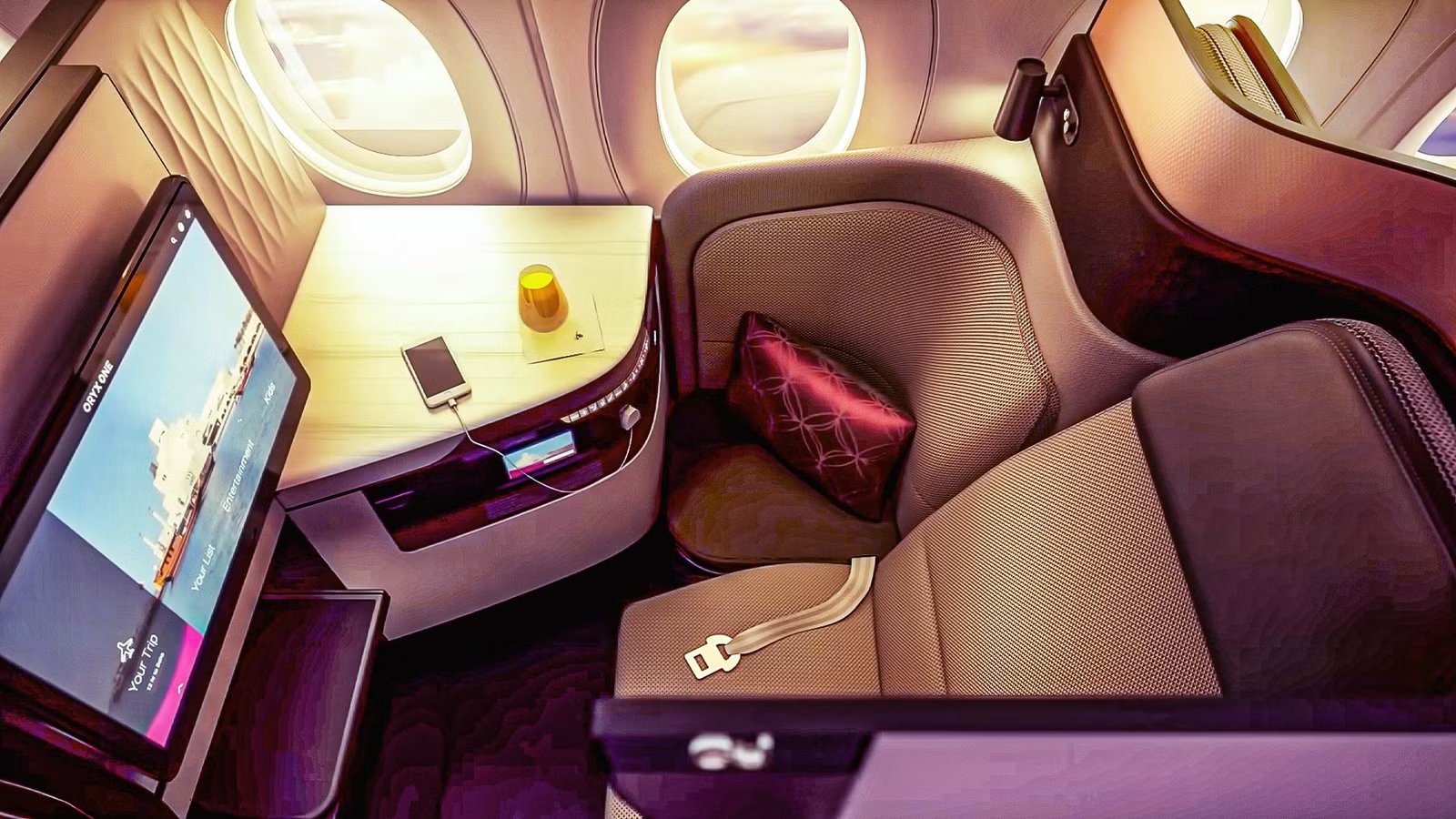
For years, the answer to the world’s best business class debate has often started — and usually ended — with the QSuite from  Qatar Airways. It has become the industry benchmark: a business class suite with a closing door, genuine privacy, flexible center-seat arrangements, and enough innovation to make many rival cabins feel a generation behind.
In 2026, however, the comparison is becoming more complicated.  Emirates is no longer relying only on its brand halo, giant entertainment screens, and famous Airbus A380 bar. Its $5 billion “Project Phoenix” retrofit program is finally giving its Boeing 777 fleet the kind of direct-aisle-access business class product many passengers long expected from the Dubai-based carrier. Emirates says its fully retrofitted 777s include a new business class configuration and refreshed interiors, while its A380 remains one of the most distinctive premium aircraft in commercial aviation.
However, as we will discover, with so many business class changes and upgrades going on, the most important variable in 2026 may not be the airline name printed on the ticket. It may be the exact aircraft that is operating the route.
Two Visions Of Business Class Luxury

The headline difference between Qatar Airways and Emirates is philosophical. Qatar Airways has built QSuite around the idea that the best business class seat should feel as private and customizable as possible. The sliding door and digitally controlled dividers are the most obvious symbols of that philosophy, but the real appeal goes deeper. QSuite is designed for passengers who want to turn the aircraft cabin into a personal space: a place to sleep, work, dine privately, or travel together without feeling exposed to the rest of the cabin.
Emirates has historically taken a different approach. Its premium reputation was not built on having the most private business class seat in the sky. In fact, its older Boeing 777 business class, with a 2-3-2 layout on many aircraft, was long considered one of the weakest points in the airline’s long-haul premium offering. But Emirates’ wider ecosystem has always been powerful: the A380 upper deck, onboard lounge, chauffeur-driven car to the airport, enormous entertainment library, strong global lounges, polished branding, and a sense that the airline turns long-haul travel into an event rather than simply a journey.
That distinction matters because passengers buy different things for different reasons. A solo business traveler on an overnight flight may care most about the door, the bed, and whether a colleague across the aisle can see them sleeping. A leisure traveler going via  Dubai International Airport (DXB), the Maldives, Australia, or Europe may place more value on the bar, the social atmosphere, the chauffeur at both ends, and the overall spectacle of the trip. Qatar sells privacy first. Emirates sells the total experience.
QSuite Still Leads On Privacy

The QSuite’s strongest advantage is still the seat itself. The latest QSuite Next Gen raises the privacy proposition further, with higher motorized doors, a 21.5-inch (55 cm) 4K OLED screen, 60W USB-C power delivery, and a lie-flat surface of around 79 inches (200 cm). The seat is approximately 23 inches (58 cm) wide in the upright position, giving it a strong comfort profile even before factoring in the door, increased storage, and the flexible layout options.
Emirates’ upgraded Boeing 777 business class is a major step forward because it finally tackles the carrier’s biggest hard-product weakness. The refreshed 777 introduces a 1-2-1 layout, replacing older 2-3-2 cabins that left some passengers without direct aisle access. The new seat is around 21 inches wide and converts into a 78.6-inch (199 cm) flat bed. That puts Emirates much closer to the modern business class standard than its older 777 cabins, which were increasingly out of step with passenger expectations.
|
Feature |
Qatar Airways QSuite Next Gen |
Emirates New 777 Business Class |
Advantage |
|---|---|---|---|
|
Layout |
1-2-1 |
1-2-1 |
Tie |
|
Sliding Doors |
Yes |
No full-height suite door |
Qatar |
|
Seat Width |
23 inches (58 cm) |
21 inches (53 cm) |
Qatar |
|
Flat-Bed Length |
79 inches (200 cm) |
78.6 inches (199 cm) |
Near tie |
|
Direct Aisle Access |
Yes |
Yes on retrofitted 777s |
Tie |
Even so, the Emirates upgrade does not fully erase Qatar’s advantage. The new Emirates 777 product has high dividers and much better access, but it does not offer the same fully enclosed suite concept as QSuite. For travelers choosing primarily on privacy, Qatar still wins when the itinerary is operated by a QSuite-equipped aircraft. Emirates has closed an important gap, but it has not quite matched the defining features that have made QSuite famous.
How Qatar Airways’ Qsuite Next Gen Stacks Up Against Every Rival Business Class Suite In 2026
Qatar Airways unveils Qsuite Next Gen, a business class suite designed to silence doubters and maintain its position at the top of luxury travel.
Family Suite Or Flying Bar?

Qatar’s signature innovation is not only that the QSuite has a door. It is that the center seats can be configured in ways that most business class cabins cannot match. Removing dividers allows couples to transform their adjacent QSuites into a “double suite”, while the famous Quad Suite allows four adjacent center seats to open into a shared space. This creates something close to a private room for families, friends, or colleagues traveling together, changing the cabin from a row of individual seats into a flexible social space.
Emirates’ equivalent signature feature is not a seat arrangement but the A380 onboard lounge. Located at the rear of the upper deck, it gives business class and first class passengers somewhere to stand, talk, drink, and briefly escape their seats. The A380 bar remains one of the most recognizable premium cabin features in the industry, and it gives Emirates a social advantage that Qatar cannot replicate on its QSuite aircraft.
|
Traveler Type |
Better Fit |
Why |
|---|---|---|
|
Solo Traveler Who Wants Maximum Sleep |
Qatar QSuite |
Door, privacy, and stronger cocoon effect |
|
Couple Traveling Together |
Qatar QSuite |
Center seats can create a more intimate setup |
|
Family Of Four |
Qatar QSuite |
Quad Suite creates a shared private zone |
|
Social Leisure Traveler |
Emirates A380 |
Onboard lounge adds a unique experience |
|
First-Time Premium Traveler |
Emirates A380 |
Bigger “wow factor” and more aircraft theater |
This is where the comparison becomes more subjective. Qatar is better if the ideal flight is quiet, private, and controlled. Emirates is better if the ideal flight feels like an occasion. A family of four may get more practical value from QSuite’s Quad configuration. A couple on a celebratory trip may remember the Emirates A380 bar more vividly than a slightly more private seat. One product turns business class inward; the other makes it more social.
The Battle On The Ground

The onboard comparison is important, but the ground experience is also a major part of what passengers are buying. At  Doha Hamad International Airport (DOH), Qatar Airways has one of the strongest business class lounge propositions in the world, led by its Al Mourjan lounges. These spaces are designed around quiet luxury: large seating areas, dining, showers, work zones, family spaces, and a more refined atmosphere that mirrors the privacy-first logic of QSuite.
Emirates, by contrast, has more of a scale advantage at Dubai International Airport. Its business class lounges in Terminal 3 are vast, practical spaces built to handle huge connecting flows, with extensive dining, showers, business facilities, and the convenience of being embedded inside Emirates’ own dedicated terminal ecosystem.
Globally, the distinction is slightly different. Emirates has the largest proprietary lounge network, with its own Emirates lounges in more than 30 airports worldwide. Qatar Airways operates its own premium lounges on a smaller scale at select destinations like  London Heathrow Airport (LHR) and Singapore Changi Airport (SIN). But its wider strength comes via
  oneworld, with business class passengers able to access nearly 700 airport lounges worldwide.
That means Emirates has the stronger branded lounge footprint, while Qatar has the broader alliance-backed lounge ecosystem. For travelers who value a consistent airline-controlled experience, Emirates has an edge; for travelers connecting across partner airlines, Qatar’s oneworld access can be more useful.
|
Ground Feature |
Qatar Airways |
Emirates |
Advantage |
|---|---|---|---|
|
Home Hub Lounge Experience |
Al Mourjan business class lounges at Doha Hamad International |
Multiple large Emirates business class lounges at Dubai Terminal 3 |
Qatar for refinement; Emirates for scale |
|
Home Airport Lounge Style |
Quiet, polished, premium, more retreat-like |
Expansive, practical, high-capacity, connection-focused |
Depends on traveler |
|
Proprietary Global Lounge Network |
Qatar Airways Premium Lounges at a few select destinations |
Emirates lounges in more than 30 airports worldwide |
Emirates |
|
Partner Lounge Access |
oneworld lounge access on eligible itineraries |
More limited outside Emirates’ own and partner arrangements |
Qatar |
Airport transfers are the other ground-level area where Emirates can change the value calculation. Emirates’ chauffeur-drive service is one of its clearest advantages for eligible business class passengers, particularly in expensive cities or on trips where convenience matters as much as the flight itself. Having a complimentary connection at both ends of a flight ensures that Emirates often has the more complete door-to-door proposition.
Dining Is Premium, But The Experience Feels Different

Both Qatar Airways and Emirates offer high-end business class dining, but they do not deliver it in quite the same way. Qatar’s QSuite dining experience is built around privacy, pacing, and personalization. The airline’s “dine-on-demand” model works especially well because the seat itself supports the concept: passengers can close the suite door, set their own meal timing, and turn the space into something closer to a private restaurant booth than a conventional aircraft seat. The service is designed to feel individualized, with a more deliberate rhythm that suits passengers who want to eat, work, sleep, or snack on their own schedule.
Emirates also offers a premium multi-course dining experience, but the tone is more like luxury hospitality at scale. The menus are often route-specific, with regional dishes reflecting the destination or origin, and the beverage program is one of the airline’s traditional strengths. Where Qatar’s meal service feels tied to the privacy of the suite, Emirates’ feels tied to the wider brand experience: generous portions, polished presentation, recognizable premium touches, and, on the A380, the ability to continue the social side of the flight in the onboard lounge. A passenger can have dinner at the seat, then go to the bar for a cocktail or glass of champagne, which gives the Emirates experience a more social and less cocooned feel.
|
Category |
Qatar Airways QSuite |
Emirates Business Class |
|---|---|---|
|
Overall Dining Feel |
Private, restaurant-style, highly individualized |
Polished, generous, hospitality-led |
|
Service Rhythm |
Strong dine-on-demand emphasis |
Premium service with a more structured feel |
|
Best Setting |
Behind a closed suite door |
At the seat, then potentially the A380 bar |
|
Menu Identity |
Fine-dining presentation and personalization |
Regional variety and large-scale premium catering |
|
Beverage Experience |
Premium wines and champagne served privately |
Strong wine/champagne program plus A380 lounge |
|
Best Passenger Fit |
Sleep-focused or privacy-focused travelers |
Social, leisure, and experience-focused travelers |
|
Main Advantage |
Control over timing and atmosphere |
Broader sense of occasion |
The difference is especially noticeable on overnight flights. Qatar is often the better fit for travelers who want maximum control: eat quickly, dine late, skip the main service, or stretch the meal out privately without feeling like the cabin is moving through a single scripted sequence. Emirates can still be very flexible, but its strength is the sense of occasion — the feeling of being part of a large, polished premium cabin operation rather than tucked away in a private suite. Put simply, Qatar’s dining is more intimate and suite-driven. Emirates’ dining is more expansive and hospitality-driven.
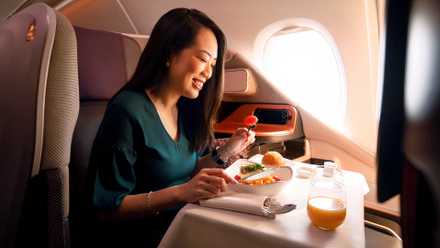
6 Airlines With The World’s Most Superior Business Class Dining In 2026
These airlines all offer restaurant-level dining at 30,000 feet.
Most Importantly, The Aircraft Choice Is Crucial

Business class on Qatar Airways and Emirates is priced similarly, so it comes down to personal consideration of all the factors noted above. But there is one other crucial factor that will determine your business class experience: the aircraft operating the route.
Emirates is currently undergoing a full retrofit of its Boeing 777-300ER fleet, and about a quarter of the aircraft now fly with the new configuration. So it’s great if your flight includes an aircraft with the new layout, but if not, you’re stuck with an antiquated 2-3-2 layout that has a middle seat and window seats without direct aisle access, not to mention angled lie-flat beds. And, of course, it goes without saying, if your flight isn’t on an A380, then don’t expect the upper deck lounge experience.
Similarly, if your preference is for the Qatar Airways QSuite experience, you need to take careful note of the aircraft being used for your flight. The airline says that it is available on all Airbus A350-1000s and select Boeing 777s and A350-900s. It is not featured on the Airbus A380, Boeing 787, or Airbus A330. So pay careful attention to that seat map when booking your flight to determine if your aircraft will, in fact, have Qatar Airways’ best experience.
That is also why the smartest 2026 advice is to book an aircraft, not just the airline. Then it comes down to what matters most to you based on your journey. For dining and sleeping with privacy or traveling with family, choose Qatar Airways. For the full door-to-door experience, Emirates is now closer than ever.