dailynewsnblog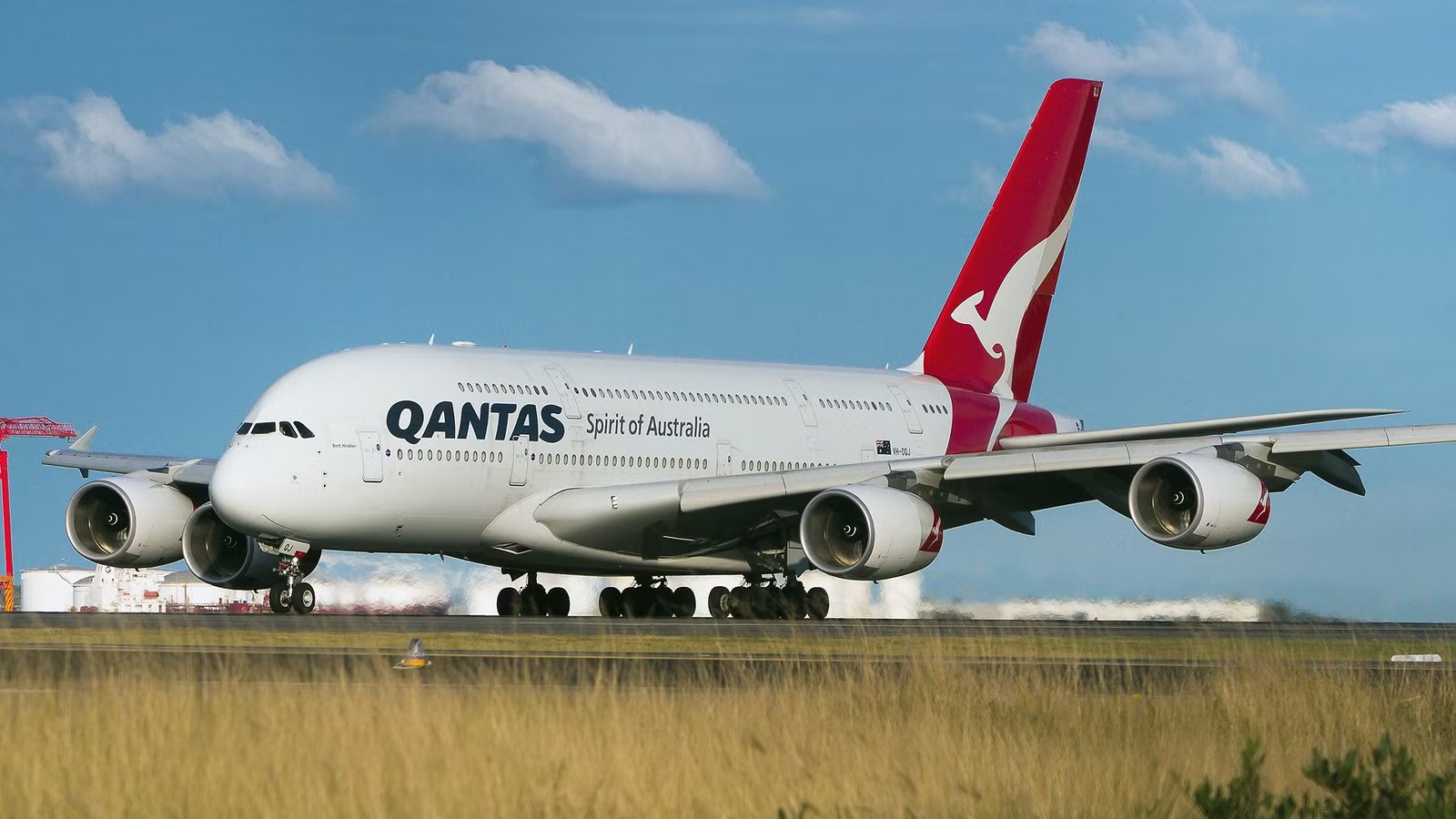
Qantas is one of ten scheduled operators of the Airbus A380. Ch-aviation shows that the  oneworld member has ten superjumbos, which average 17.1 years, older than most other carriers’ A380s. The first frame to arrive was VH-OQA in September 2008. It is the world’s second-oldest active airline-operated double-decker.
When flights are considered, Qantas is the world’s sixth-largest superjumbo user. OAG data indicates that it currently has 5% of the type services, equivalent to one in every 20 movements. The airline will stop using the A380 from Melbourne soon.
Qantas’ Two-Hour European A380 Flights

Every so often, Australia’s flag carrier flies the 485-seat double-decker quadjet to and from Dresden Airport (DRS), which is in the east of Germany near the border with Czechia. As Analytic Flying points out, this is entirely for heavy maintenance. In contrast to Qantas, British Airways and Lufthansa, for example, undertake heavy maintenance on their A380s in the Philippines.
Given the average age of Qantas’ A380s, Analytic Flying shows that they’re currently in the middle of their C-checks. Two more airframes have just completed the process in DRS or are currently undergoing it. Often, but not always, the aircraft are swapped at  London Heathrow Airport (LHR), which avoids long and expensive empty flights.
VH-OQJ Has Just Been Empty Flown To Heathrow, But…

Analytic Flying indicates that VH-OQJ has just finished its C-check in DRS. This is why Flightradar24 shows that ‘Quebec Juliet’ was positioned empty from LHR to DRS on October 15. QF6038 left Germany at 10:35 AM and arrived at the UK’s busiest airport at 11:16 AM local time, with the leg taking one hour and 42 minutes.
QJ is the world’s 16th-oldest active double-decker. The frame had been in Germany for three months. On July 16, the 16.1-year-old aircraft flew from  Sydney Kingsford Smith Airport (SYD) to Singapore Changi Airport (SIN) as QF6015. The following day, QF6019 was used for the long 12-hour-plus sector from SIN to DRS.
The plan was for QJ to re-enter commercial service on October 15 by operating QF2 from LHR back to SYD via SIN, but that did not happen. Flightradar24 shows that QF2 was canceled yesterday, with QJ remaining overnight at LHR. Analytic Flying points out that:
“It is the inherent risk of doing this. It is not uncommon for small issues to materialize following a heavy check, and they are not as easy to deal with at an outstation [like LHR] when running against the curfew clock.”
The latest information is that Quebec Juliet is due to depart from LHR on October 16 as QF7002, with a scheduled departure time of 9:30 PM. That flight number was most recently used on August 14, 2026, when VH-OQI used it en route back to Australia. On October 16, two Qantas A380s will thus leave LHR at nearly the same time, with QF2 (operated by VH-OQL) due to depart at 8:50 PM.
VH-OQD Has Just Flown Empty From Heathrow

Recall that VH-OQJ left DRS for LHR on October 15. On the same day, the 17.9-year-old VH-OQD departed from the UK for the German airport as QF6037. The aircraft left at 1:45 PM and arrived in continental Europe at 4:59 PM local time for its heavy maintenance check. The process may be completed in January 2027.
Inevitably, the duration of the heavy maintenance depends on anything being discovered and any remedial work being completed. For example, Analytic Flying shows that the C-check of VH-OQI took a long four months due to fixing wing spar cracks. Whether ‘Quebec Delta’ will be flown empty to LHR depends on whether another aircraft will be flown in the opposite direction.
QD was delivered to Qantas in August 2009 and was the 26th superjumbo off the production line. It is now the world’s fifth-oldest active double-decker. The airline has accelerated the retirement of its ten remaining A380s, with the gradual process beginning in 2028. They’ll be replaced by the A350-1000, with substantially better economics and a better hard product.